Why Does My Shoulder Hurt at Night? How to Sleep With Shoulder Pain
It's 3:25 a.m. You roll onto your right side, the way you've slept for forty years. A deep, hot ache flares at the top of your arm, and you're awake before you know why. You roll back. The ache follows you, slow and dull, down toward the elbow.
If your shoulder is fine by day and cruel by night, you're not imagining it. Shoulder pain at night has clear, common causes, and most of them have something to do with how you lie. This page covers why it happens, how to sleep with shoulder pain, and what to do the moment it wakes you. At the end are four points I press before bed. They are the top of the shoulder (GB21) and the back of the forearm (TE5). Then the back of the hand (TE3) and the wrist crease (HT7).
Shoulder pain at night: the short answer
| Question | Answer |
|---|---|
| Why does my shoulder hurt at night? | Lying still lets a sore joint stiffen, and lying on it squeezes the tender tissue. With nothing to distract you, the ache feels louder. |
| What are the usual causes? | Rotator cuff strain, an irritated bursa, frozen shoulder, arthritis, and the way you lie. Sore side down, arm overhead or arm under the pillow. |
| How should I sleep? | On your back with a pillow under the sore elbow, or on the good side hugging a pillow. Not on your stomach. |
| What to do when it wakes me? | Roll off it, prop the arm on a pillow, keep the shoulder covered and warm, and breathe out slowly. No pressing at night. |
| When is it urgent? | Left shoulder or arm pain with chest pressure, breathlessness, sweating or nausea. Call emergency services straight away. |
Press along with me: a video for shoulder pain at night
If you would rather watch than read, here I press the points on myself, sitting down. Pause it any time.
Woken by Pain at Night? 7 Pressure Points for Sleep (15 Min) · Watch on YouTube
Why does my shoulder hurt at night?
By day, you move. You reach, lift, swing your arms as you walk. That movement keeps a sore shoulder loose, and your busy mind gives the ache less attention.
At night, all of that stops. You lie in one position for hours. The tender tissue around the joint stiffens and swells a little, like a hinge left out in the rain. Then you turn over, the shoulder takes your weight, and the ache is the first thing you notice.
There's also less going on around you. No conversation, no television, no chores. In a dark, quiet room, a pain you ignored at lunchtime can feel twice as big.
Why does my shoulder hurt when I lie on my side?
When you lie on your side, the whole weight of your upper body presses down through the point of your shoulder. The tendons and the small cushion of fluid inside the joint are pinched between bone and mattress.
Healthy tissue doesn't mind. Irritated tissue does. That's why so many people find the shoulder is quiet all day and only complains in bed.
Lying on the good side isn't always the answer either. The sore arm can flop forward across your chest, with the elbow tucked in tight. That twists the joint inward and crowds the tender spot from another angle. More on how to stop that below.
Six common causes of shoulder pain at night
1. The rotator cuff tendons
Four small muscles wrap around the ball of your shoulder like fingers holding an orange. Their tendons are called the rotator cuff. With years of reaching, lifting and gardening, those tendons can become worn and sore.
A sore rotator cuff often aches on the outside of the upper arm. It tends to bite when you reach up, reach behind you to tuck in a shirt, or lie on that side.
Most rotator cuff pain comes from slow wear rather than one injury. A sudden tear after a fall is different. If you can't lift the arm after a fall, see a doctor soon.
2. An irritated bursa
A bursa is a small, flat sac of fluid that lets the tendons glide over the bone. When it becomes irritated, doctors call it bursitis. The sac is tucked right under the point of your shoulder.
Lie on that side, and you press on it directly. The pain is often sharp at first and then settles into a throb.
3. Frozen shoulder
With a frozen shoulder, the lining of the joint thickens and tightens. The shoulder grows stiffer over months. Reaching for a high shelf, fastening a bra or putting on a coat becomes slow and awkward.
It's most common between about forty and sixty, and more common in people with diabetes. Night pain is often worst in the early, "freezing" stage. It usually eases over time, but it can take a long while, so it's worth having a doctor confirm it.
4. Arthritis in the shoulder
Wear-and-tear arthritis can affect the shoulder, though less often than the knee or hip. It brings a deep ache, stiffness in the morning, and sometimes a grinding feeling when you move the arm.
Like most stiff joints, it complains after long stillness. Hours in bed are exactly that.
5. The way you lie
Sometimes the shoulder is only mildly sore, and the sleeping position does the rest. Three positions are hard on any shoulder:
- Arm up and behind your head while lying on your back. This crowds the top of the joint all night.
- Arm tucked under your pillow while lying on your side. This stretches the joint under load.
- Face down, both hands tucked up by your head. The shoulders, neck and lower back are all twisted at once.
6. Pain that starts somewhere else
A stiff neck can send an ache into the top of the shoulder and down the arm. So can a tight upper back. If moving your neck brings on the shoulder pain, or you feel tingling into the hand, the neck may be involved.
Rarely, a shoulder ache comes from deeper inside the body, including the heart. That's why the warning signs further down this page matter.
How to sleep with shoulder pain
You'll move in the night anyway. Nobody stays still till morning. But falling asleep in a kind position buys your shoulder a few calm hours, and those hours count.
On your back. Keep your arms down, not above your head. Lay a pillow across your stomach at a slant, so your sore elbow rests on it. The arm sits slightly forward and supported, instead of sinking back toward the mattress. A small pillow under the elbow alone also helps.
On your good side. Hug a firm pillow against your chest. Rest the sore arm on top of it, so the elbow sits away from your ribs and the hand doesn't hang down. A second pillow behind your back stops you rolling onto the sore side in your sleep.
If you can only sleep on the sore side. Some people have slept on the same side all their life. If that's you, roll back a little, so your weight sits on the flat of your shoulder blade instead of the point of your shoulder. A thin pillow tucked under your ribs can lift some weight off the joint.
If both shoulders hurt. Sleep propped up on your back, with a wedge pillow or a stack of pillows behind you. Some people sleep better in a recliner for a few nights while a flare settles.
On your stomach. I'd gently suggest moving away from this one. It's hard on the shoulders and the neck at the same time.
What to do when shoulder pain wakes you
This is the moment that decides the rest of your night. Here's what I do.
- Roll off the shoulder slowly. Turn onto your back or your good side. Move the whole body together, like a log, rather than twisting.
- Give the arm a pillow. Rest the sore elbow on a pillow across your stomach, or hug one if you're on your side. The aim is an arm that is held, not hanging.
- Keep the shoulder covered. A cold shoulder sticking out of the duvet stiffens faster. Pull the covers up, or wear a soft long-sleeved top to bed.
- Breathe out longer than you breathe in. Out through the mouth, slow and unhurried, as if you were cooling a cup of tea. A tense body holds the shoulder tighter.
- Don't look at the clock. Counting the hours left keeps you up longer than the shoulder does.
If you need the bathroom, sit on the edge of the bed for about 30 seconds first. Feet flat, let the sore arm rest in your lap. Then stand up slowly, pushing up with the good hand.
One thing I don't do in the middle of the night: press points. Searching for a tender spot and working it is wake-up work. At night, the job is to get comfortable and stay calm. I keep all my pressing for the daytime and for bedtime.
Daytime habits that help a sore shoulder at night
What you do between breakfast and bedtime shapes how the shoulder feels at 2 a.m.
- Keep it moving, gently. A shoulder that rests in a sling all day is stiffer at night. Small, comfortable movements, several times a day, keep the joint from setting.
- Try a seated arm swing. Sit on a sturdy chair. Lean forward a little and let the sore arm hang down beside your knee, loose and heavy. Make small, slow circles with it, like stirring a pot. Ten each way. Stop if it hurts more.
- Bring things down to your level. Move everyday items from high shelves to waist height for a while. Fewer reaches overhead means fewer flare-ups.
- Carry on the good side. Shopping bags and handbags on the sore shoulder add up over a day.
- Watch how you sit. Hunching forward over a phone or a tablet rolls the shoulders in. Bring the screen up toward your eyes instead.
- Warmth in the evening. Many people find a warm wheat bag or a warm shower on the shoulder before bed soothing. Keep it warm, not hot, and never sleep on a heat pad.
If your doctor or physiotherapist has given you exercises, keep doing those. They come first.
Before bed: four points I press for shoulder pain
I have studied Vietnamese acupressure for fifteen years. This is the short routine I do for a sore shoulder, sitting on the edge of my bed or in a chair, about ten minutes. Start with the point on the shoulder itself, then work down the arm, and finish with the settling point at the wrist.
If you'd also like a foot point for a shoulder that won't let the arm lift, I've written about one on the little toe here.
On the shoulder itself: the top of the shoulder — Jianjing (GB21)
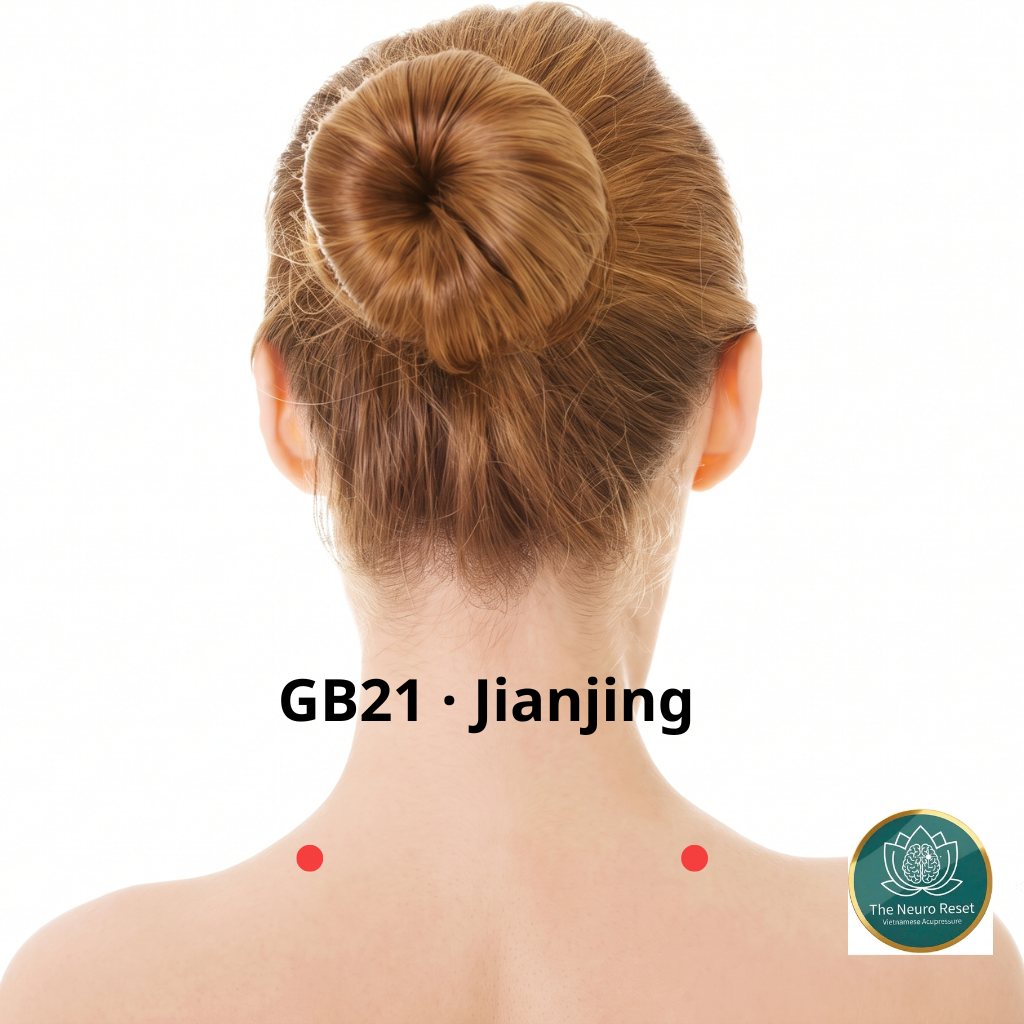
Sit in a chair with arms, and rest both forearms on the armrests so your shoulders drop. Find the bony knob at the base of your neck, the one that sticks out when you bow your head. Then find the bony tip of your shoulder.
The spot sits halfway between them, on the top of the muscle ridge. Reach across with your opposite hand and hook your fingertips over it. Probe slowly until one spot stings. Rub it in small circles, pressing down onto the muscle, for one to three minutes on each side.
Work gently on the sore side. Skip this point if you are pregnant, or if you've had recent shoulder or neck surgery.
For an ache down the arm: the back of the forearm — Waiguan (TE5)

Rest your forearm on your lap, palm down, and let it go heavy. Lay three fingers across the back of your wrist, starting at the crease.
Right above them, between the two forearm bones, is a soft valley. Search it with your thumb tip until one spot stings sharply. Rub it in small circles for one to three minutes, then change arms.
For a stiff neck and shoulder: the back of the hand — Zhongzhu (TE3)
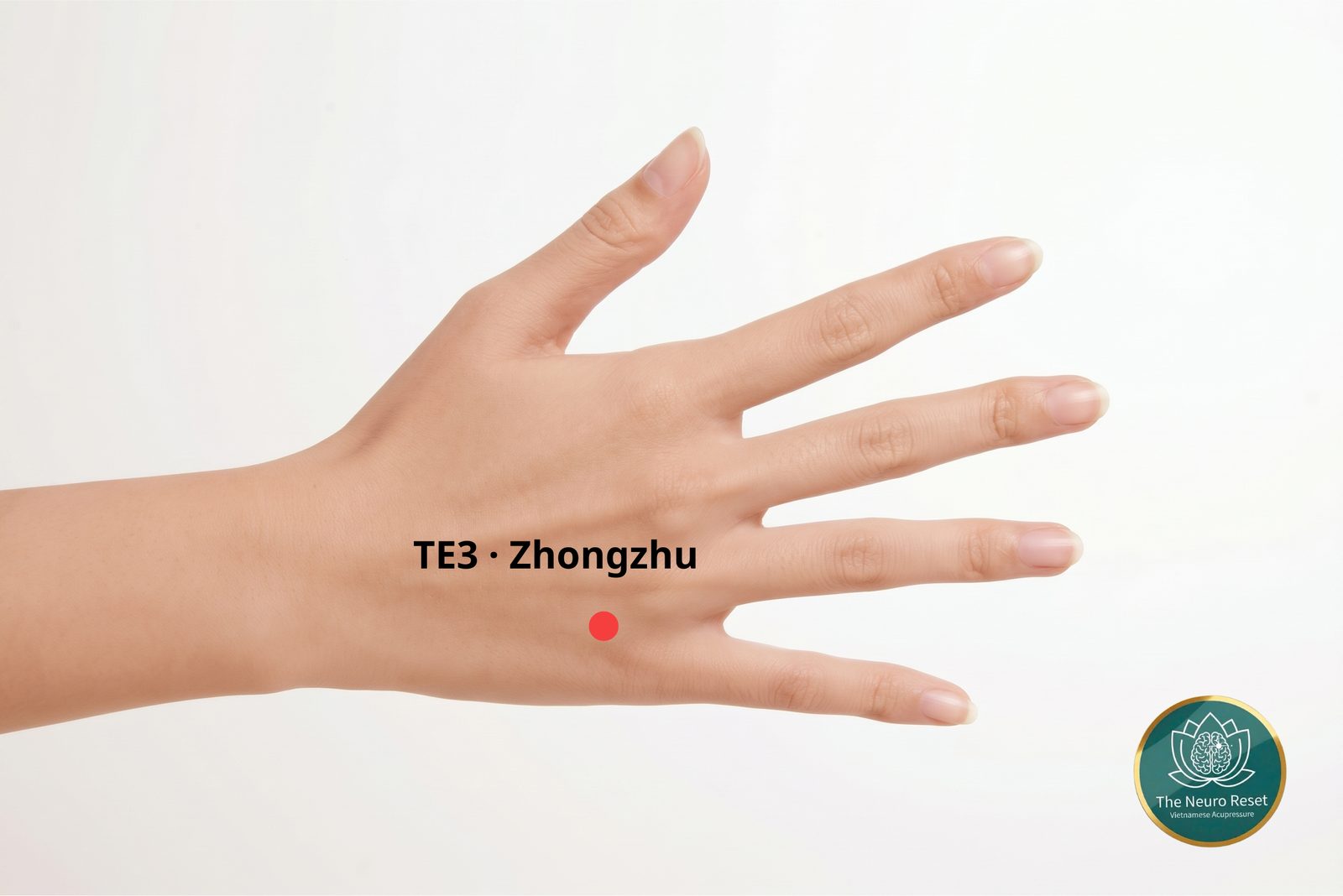
Rest your hand on the table, palm down, fingers relaxed. Put your opposite thumb tip in the valley between the knuckles of your ring finger and little finger.
Slide back toward the wrist about one thumb-width. Your thumb drops into a narrow groove between two bones. Search the groove for the tender spot and work it for one to three minutes. Then the other hand.
For everyone: the wrist crease — Shenmen (HT7)
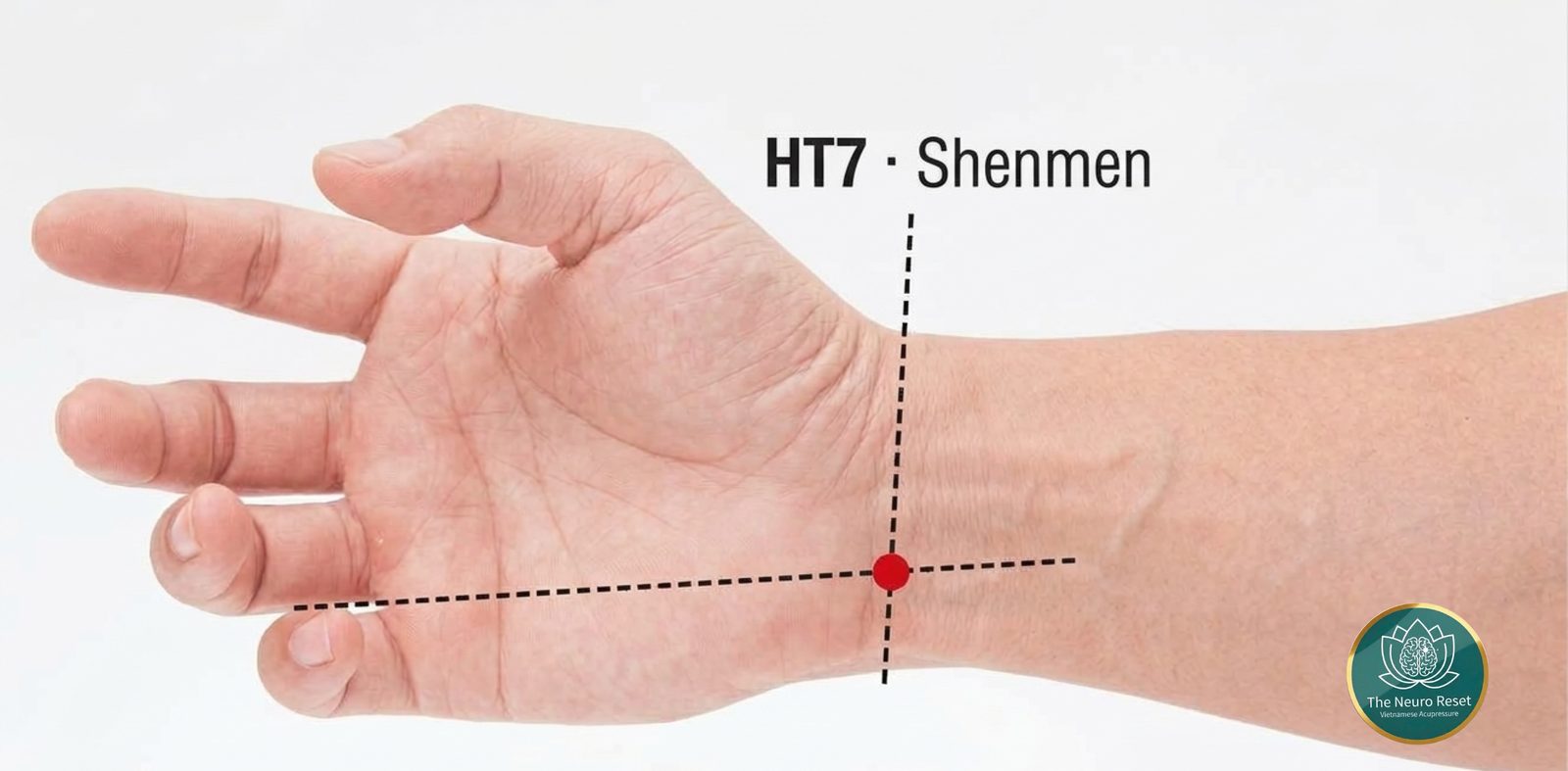
Turn your palm up. Follow the crease at your wrist toward the little-finger side, until your thumb meets a small round bone. Back off a few millimetres toward the thumb side, into a small hollow.
Press there with the tip of your other thumb for one to three minutes, then swap wrists. This is the point I finish on, to help the body settle before lying down.
When you finish: arrange your pillows first, then lie down into them. It's easier than building the nest once you're in bed.
How I press the points for shoulder pain at night
- Find the area. You don't need to land on a pinhead. Get into the right neighbourhood.
- Search for the tender spot. Move your fingertip slowly around the area. One spot will feel sharper than the rest. That's your spot.
- Make small circles on that spot. Use the tip of your thumb, not the soft pad, with your nail short. Circle slowly without sliding away.
Start with about one minute per spot. Build up to two or three minutes over the following nights. It should feel tender while you press and ease once you lift off.
Stop and leave a spot alone if it still hurts after you lift your finger off. The same goes if the pain spreads, or the skin looks swollen, hot or red.
Sore hands, or a shoulder that won't let you reach? A pressure tool with a rounded tip can do the work for you. A comb-shaped one is handy for the top of the shoulder, because you can hook it over without lifting your arm high.
When to see a doctor about shoulder pain at night
Most night-time shoulder pain comes from the joint and the tissue around it. But some signs need a doctor, and a few need one straight away.
Call emergency services now (911, 999 or 000) if:
- you have pain in the left shoulder, arm, jaw or chest with pressure, tightness, breathlessness, sweating, nausea or light-headedness
- the pain came on suddenly and feels crushing, or is unlike anything you've had before
See your doctor soon if:
- you hurt the shoulder in a fall or accident, or it looks out of shape
- you can't lift your arm, or it has suddenly gone weak
- you have a fever, or the shoulder is hot, red or swollen
- you feel numbness, tingling or weakness running down the arm into the hand
- the pain wakes you every night for more than a few weeks, or keeps getting worse
- the pain is the same in every position and nothing eases it
- you've also lost weight without trying, or have night sweats
If any of these fit, start there. The routine on this page can wait.
For a medical view, read the NHS page on shoulder pain, including pain that is worse at night.
The honest timeline for shoulder pain at night
Some things help on the first night. A pillow under the elbow, a pillow to hug, and a covered shoulder often make a difference straight away.
The rest is slower. Shoulders take their time. Tendons and joint linings settle over weeks, and a frozen shoulder can take many months. For the pressing, think about ten minutes each evening for two to four weeks. Some people notice a softer, quieter shoulder. Some notice very little, and I'd rather you heard that from me now.
What This Won't Do
This won't mend a torn tendon, unfreeze a frozen shoulder overnight, or replace anything your doctor or physiotherapist has given you. Keep taking exactly what was prescribed, and keep doing the exercises you were shown. This is something you do in addition. A routine you can do with your own two hands, so the shoulder has a calmer evening before the night begins.
Short videos on shoulder pain at night
Two short clips from my channel on the same subject. Each one is under a minute.
Questions people ask about shoulder pain at night
Why does my shoulder hurt at night but not during the day? By day, movement keeps the joint loose and your mind is busy. At night you lie still for hours, the sore tissue stiffens, and lying on it adds pressure. With nothing else to notice, the ache feels stronger.
Why does my shoulder hurt when I lie on my side? Your body weight presses down through the point of the shoulder. If the tendons or the bursa under it are irritated, that pressure sets them off. Lying on the good side with a pillow to hug usually helps.
What is the best sleeping position for shoulder pain? For most people, on the back with a pillow under the sore elbow, or on the good side hugging a pillow. Try to avoid the stomach, the arm above your head, and the arm tucked under the pillow.
Is shoulder pain at night a sign of a rotator cuff problem? Often, yes. A sore rotator cuff commonly aches at night and when you reach up or behind you. Frozen shoulder, bursitis and arthritis can feel similar, so a doctor or physiotherapist is the one to tell them apart.
Should I worry about left shoulder pain at night? Usually it's the joint. But left shoulder or arm pain with chest pressure, breathlessness, sweating or nausea can come from the heart. Call emergency services straight away if that's what you feel.
Are there pressure points for shoulder pain? In Vietnamese tradition, points on the top of the shoulder, the back of the forearm and the back of the hand are commonly used. I press them in the daytime and before bed, never in the middle of the night.
Should I use heat or ice on shoulder pain at night? Many people find gentle warmth soothing before bed, especially for a stiff shoulder. After a fresh strain, some prefer a cold pack for a few minutes during the day. Never fall asleep on a heating pad, and ask your doctor if you're unsure.
I have spent fifteen years studying traditional Vietnamese medicine, and I write about things you can do for yourself at home, sitting down.
This is general wellness education, not medical advice. It is not a substitute for care from your doctor. If you have a health condition, are pregnant, or take medication, check with your doctor first.
(Points shown: GB21 Jianjing, TE5 Waiguan, TE3 Zhongzhu, HT7 Shenmen.)