The tightness that keeps coming back. The nights that keep breaking.
Vietnamese traditional medicine has worked with these through pressure points for generations — the hands and feet, the head and face, the neck and shoulders, the back. I teach them point by point, in plain language: where the point is, what pressing it does, and when not to use it. Alongside the care your doctor has given you. Not instead of it.
No needles. No equipment. Done sitting in a chair or on the edge of the bed.

Press here. The body answers somewhere else.
Vietnamese traditional medicine has mapped places on the body where firm, accurate pressure produces a change you can feel. The pressure sends a signal along the nerves, and the body answers in three layers.
At the point itself
Under your thumb you will usually feel a dull, spreading sensation and then a softening. That is what people describe. How much of it lasts, and for how long, differs from person to person.
Along the nerve segment
The signal travels into the segment of the spinal cord that nerve enters. This is the part of the working model that explains why the tradition pairs a point on the hand with a complaint felt in the head. It is a model, not a proven mechanism — see the evidence.
Through the whole body
The alert branch of the nervous system steps down. Breathing slows. The body gets a chance to settle itself.
I teach a tradition. I read the trials.
Acupressure is old practice and live research at the same time. Here is what peer-reviewed trials actually show — including where they fall short.
In one hospital programme of 519 acupressure treatments, self-rated anxiety fell by about four points and self-rated pain by about two, on nought-to-ten scales. One programme in one place — not proof it will do the same for you.
Monson E. et al. “Beyond Pills: Acupressure Impact on Self-Rated Pain and Anxiety Scores.” J Altern Complement Med, 2019;25(5):517–521A randomised sham-controlled trial found better self-reported sleep and lower anxiety in the group given real acupoint pressure rather than pressure on false points. The people studied were in hospital with burns, aged 18 to 55 — not people at home in their sixties and seventies.
Salajegheh Z. et al. BMC Complementary Medicine and Therapies, 2024A systematic review of shiatsu and acupressure found the strongest evidence for pain, and useful evidence on sleep for people living in care homes — while judging much of the research small and hard to blind. That is an honest picture, not a promise.
Robinson N, Lorenc A, Liao X. BMC Complementary and Alternative Medicine, 2011;11:88These are findings from studies about a practice. They are not a statement about what will happen to you. Studies in this field are often small and their methods differ. Individual results vary widely, and some people notice nothing. Acupressure is not a treatment for any condition and does not replace medical care.
The evidence is promising and still mixed. Acupressure sits alongside medical care; it does not replace it. I would rather tell you that here than let you find it out later.
You can find all five in under a minute.
Every point in the full method comes with the exact spot, how hard to press, and how long to hold. These five are where most people begin.
The web between thumb and finger
Squeeze the soft webbing where the thumb meets the index finger. A workhorse for tightness behind the eyes and up the back of the neck.
LI-4 HeguThe wrist crease, little-finger side
On the crease where the hand meets the wrist, in line with the little finger. Rest your thumb there and breathe out slowly. In Vietnamese practice this is one of the points people return to when they want to settle before sleep.
HT-7 ShenmenThree finger-widths below the wrist
On the inside of the forearm, between the two tendons. The point people reach for in a car or on a boat.
PC-6 NeiguanThe middle of the inner wrist crease
Turn your palm up and find the crease where the hand meets the wrist. The spot sits in the middle, between the two cords.
PC-7 DalingThe centre of your palm
Curl your fingers in loosely. The spot sits beside the place where your middle fingertip lands.
PC-8 LaogongThe inside edge of your foot
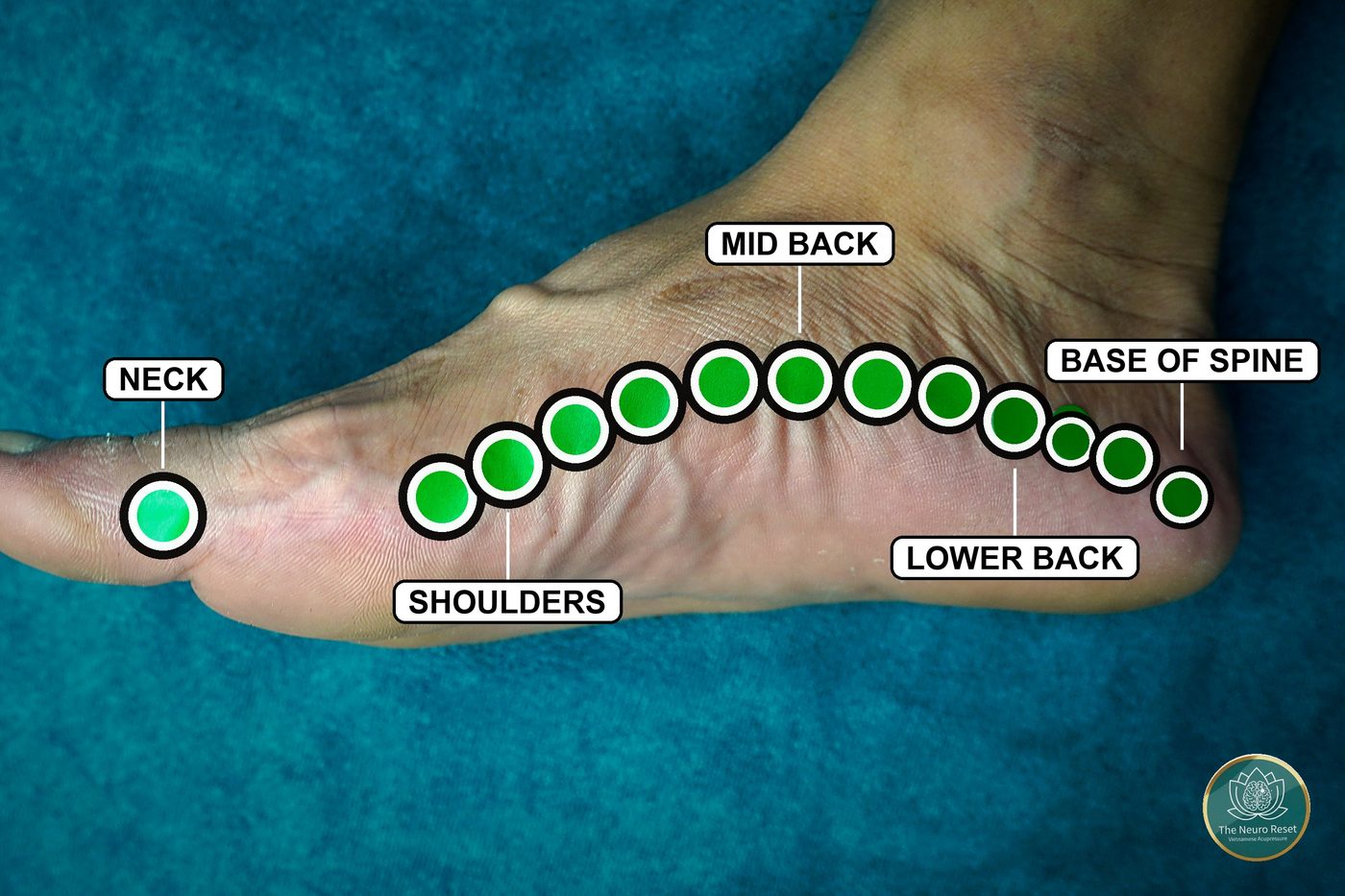
Seven spots in a line, from the base of your big toe back to your heel. The whole map is free, below.
See all 15 hand & wrist points →
Pain in the heel, knee, hip, neck or shoulder? See the 22 foot zones →
The Foot Map. Free, and yours to keep.
The Foot Map — fifty pages, large print. Seven spots along the inside edge of your foot, and the order to press them in.
In this tradition that edge is read as the line of your spine: the big toe for the neck, the arch for the lower back, the heel for the base of it.
It prints on an ordinary home printer, in black and white. I will send it straight away.
Where does it hurt?
Pick the page that sounds like you. Each one shows where to press, sitting in a chair.
Foot Pressure Point for Lower Back Pain: Where to Press
Sciatica Pressure Points on the Feet: Inside of the Heel
Stiff Neck Pressure Point on the Foot: Top of the Big Toe
Upper Back Tension Pressure Point: The Band Across Your Foot
Why Do I Wake Up in the Middle of the Night? 6 Reasons
Acupressure Points for Leg Cramps at Night: Calf and Foot
Tools for pressing at home
Your thumb is enough to start. When your hand tires or a spot is hard to reach, a kit you hold with your whole hand can do the pressing for you.

The Lower Back & Feet Kit
Two tools you hold with your whole hand: one glides along the inner edge of the foot, one fits the heel and arch. Used sitting in your chair, with free videos to follow.
See how it works →
The Whole-Body Home Kit
Four tools for an ache that moves around: back, feet, knees and the back of the neck. Used sitting in your chair, with free videos to follow.
See how it works →
The Bedside & Chair Kit
The whole-body tools, plus a slim pen to keep on your nightstand for the nights the ache wakes you.
See how it works →I am asking permission first.
Plenty of websites fill this space with first names and initials attached to sentences nobody can check. We would rather not do that, because you have no way of knowing whether those people exist.
We are going back to the people who wrote to us and asking, one at a time, whether we may publish their full name and what they were dealing with. Some will say no. That is their right, and it takes time.
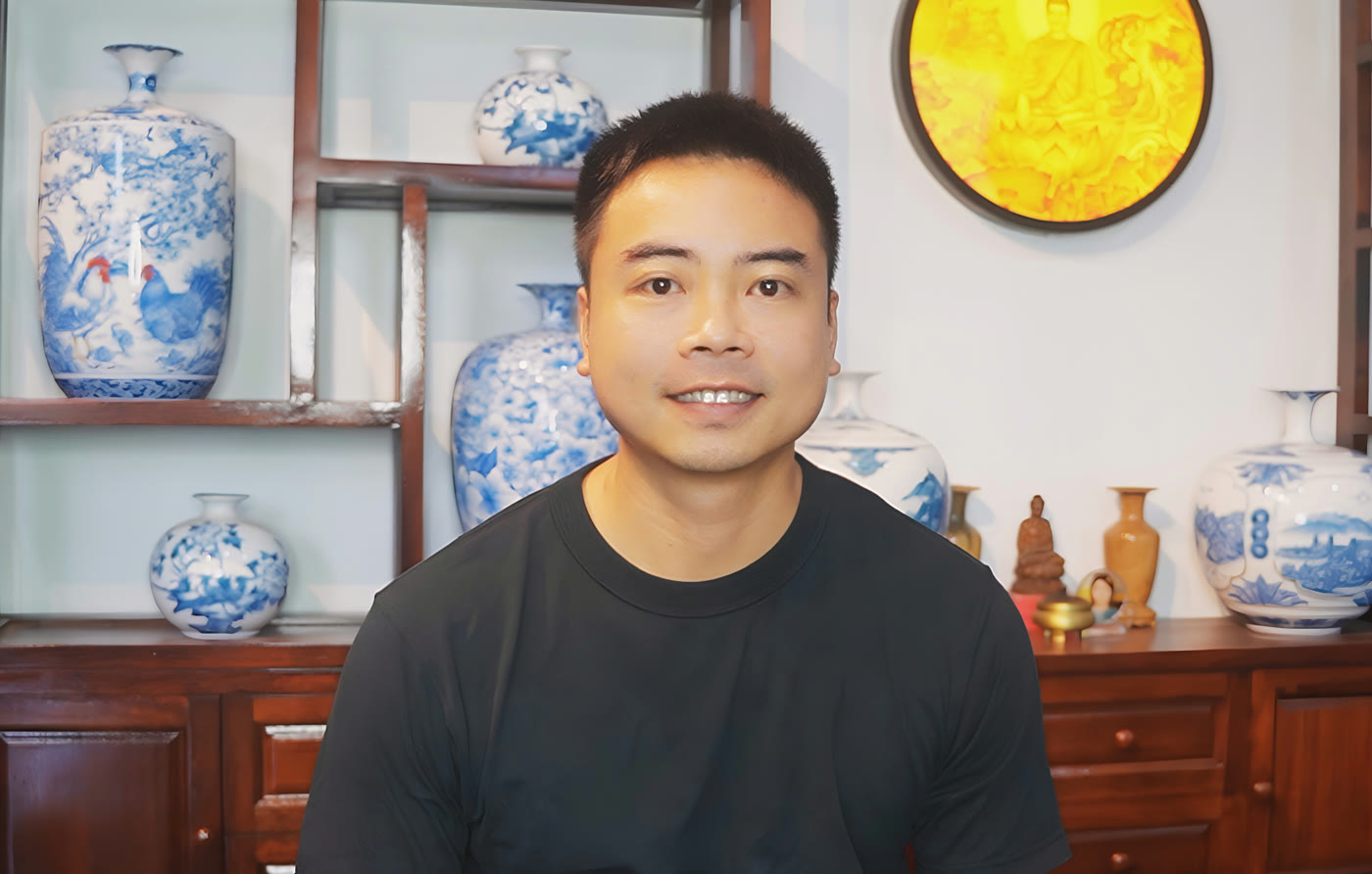
Nguyen Duy Phong
Researcher and teacher of Vietnamese traditional acupressure
Fifteen years of study, and fifteen years of practising it — on myself, and with people who come to the centre I run in Ninh Binh, Viet Nam. Nothing on this website is medical advice, and nothing here replaces care from your own doctor.
I study and practise Vietnamese traditional acupressure — pressure and hand work across the whole body: the hands and feet, the head and face, the neck and shoulders, and the back.
- Learned from teachers with long practical experience, then tested in daily practice
- Every technique cross-checked against current clinical literature
- Cautions taught before any point — what it does, and when not to use it
- Plain language, large type, printable — written to be used, not admired
Good to know before you start
Is this the same as acupuncture?
No needles are involved. Acupressure uses fingertip pressure on the same points acupuncture targets, so you can practise it safely on yourself with no equipment.
Does it actually work?
Research is promising for pain, anxiety, nausea and sleep, though results are still mixed and studies vary in quality. We teach it as a complement to good medical care, never a replacement — and we show you the evidence so you can decide for yourself.
Do I need any experience or tools?
None. If you have hands and fifteen minutes a day, you can begin with the free Foot Map today.
Is it safe for everyone?
Acupressure is generally very safe. There are specific situations — pregnancy, certain conditions, injured areas — where some points should be avoided, and we cover every contraindication clearly before you use a point.
What do I get for free?
The Foot Map — fifty pages, large print, showing seven spots along the inside edge of your foot and the order to press them in. Free, no payment details.
Start with five points and fifteen minutes.
Take the book and the card, try the three points tonight, and see what your body tells you.