Temple Headache Relief: 3 Pressure Points to Press Along
It starts as a dull pressure at the back of the neck. By the afternoon it has crept up and settled on both sides of your head, right at the temples, squeezing like a band that someone keeps tightening. You rub your temples. It eases for a second, then comes back.
That headache is real, and you don't have to sit and wait it out. This page is the written version of my 9-minute press-along video. You sit in a chair and press three spots with me: the muscle from the neck out to the shoulders (the Jianjing (GB21) area), a small dip on the wrist called Lieque (LU7), and the middle joint of the ring finger.
Temple headache: the short answer
| Question | Answer |
|---|---|
| Which pressure points help a temple headache? | The muscle from the base of the neck out to the shoulder (GB21 area), Lieque (LU7) on the thumb side of the wrist, and the middle joint of the ring finger. |
| How long does it take? | About 9 minutes, sitting in a chair. One minute on each side, three spots. |
| Which wrist first? | The spot works across the body: the left wrist for the right side of the head, the right wrist for the left side. Start with the wrist opposite the side that hurts more. |
| What can pressing do? | It can loosen the neck and shoulders and help you feel calmer while the ache settles. It won't make headaches stop for good. |
| When should I get help right away? | A sudden, severe headache, the worst you've had, a headache after a fall or a blow to the head, or one with a high fever and stiff neck, weakness, numbness, trouble speaking or changes in vision. |
Press along with me: the video for temple headache
This page is the written version of the video below. Watch it and press along with me, or read the steps further down. Pause any time.
Temple Headache Relief: 3 Pressure Points to Press Along · Watch on YouTube
Why does a headache sit at both temples?
A headache that wraps around both temples like a band is often the kind that builds from a tight neck and shoulders. You hunch over a phone or a book, you sit long in one position, you clench your jaw without noticing. By evening the muscles from the shoulders up to the base of the skull are pulling, and the ache shows up at the sides of your head.
Most people rub the soft hollow beside the eye first, the spot called Taiyang (EX-HN5). Light circles there can bring a moment of comfort, and that's fine to do. But when the ache is fed by a tight neck and shoulders, it tends to come back. That's why this routine works on the shoulders, the wrist and the ring finger instead of only the sore spot.
The book I work from, a Vietnamese reflex therapy manual, notes that this temple pattern often comes with a cold or a fever, too. So if your temples ache while you're coming down with something, this routine is a gentle thing to do while you rest. A high fever with a stiff neck is a different matter, and needs a doctor.
Before you start: when to get help right away
Most temple headaches are not dangerous. But please get medical help straight away, before any routine, if the headache:
- comes on suddenly and is the worst headache of your life
- started after a fall or a blow to the head
- comes with a high fever and a stiff neck
- comes with weakness or numbness on one side, a drooping face, or trouble speaking
- comes with changes in your vision, confusion, or fainting
- is a new kind of headache that started after age 50, or keeps getting worse day after day
Keep taking your medication and keep seeing your doctor. This routine is something you do alongside it.
The routine, point by point
I have studied Vietnamese acupressure for fifteen years. These three spots come straight from one short chapter of the reflex manual I use, the chapter for headaches at both temples. Sit on a chair with your feet flat. I keep the time in the video; you press along.
Point 1: From the neck out to the shoulders — Jianjing (GB21) area
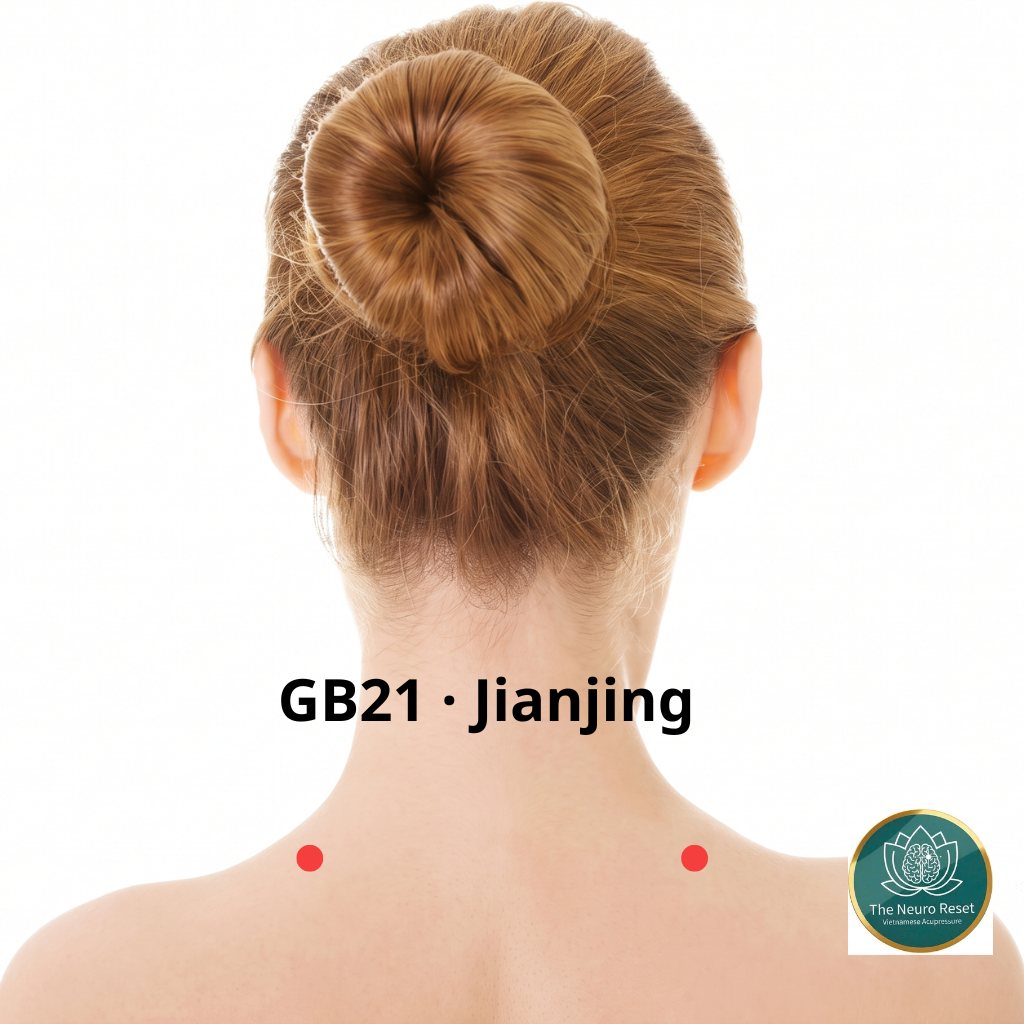
Start with the muscle that runs from the base of your neck out to the tip of your shoulder (video 0:41). Reach your right hand across to your left shoulder. Grip the thick muscle right where your neck meets your shoulder, between your fingers and the heel of your hand.
Squeeze firmly, let go, and move a little further out. Work your way to the tip of the shoulder, then start again at the neck. Let the other arm hang heavy and breathe out slowly. After a minute, switch: left hand to your right shoulder, starting at the neck.
The book says to squeeze hard here. I'd say firm, on the spot that stings. If your shoulders are very sore, lighter squeezes are fine.
Point 2: The crossed-hands wrist spot — Lieque (LU7)
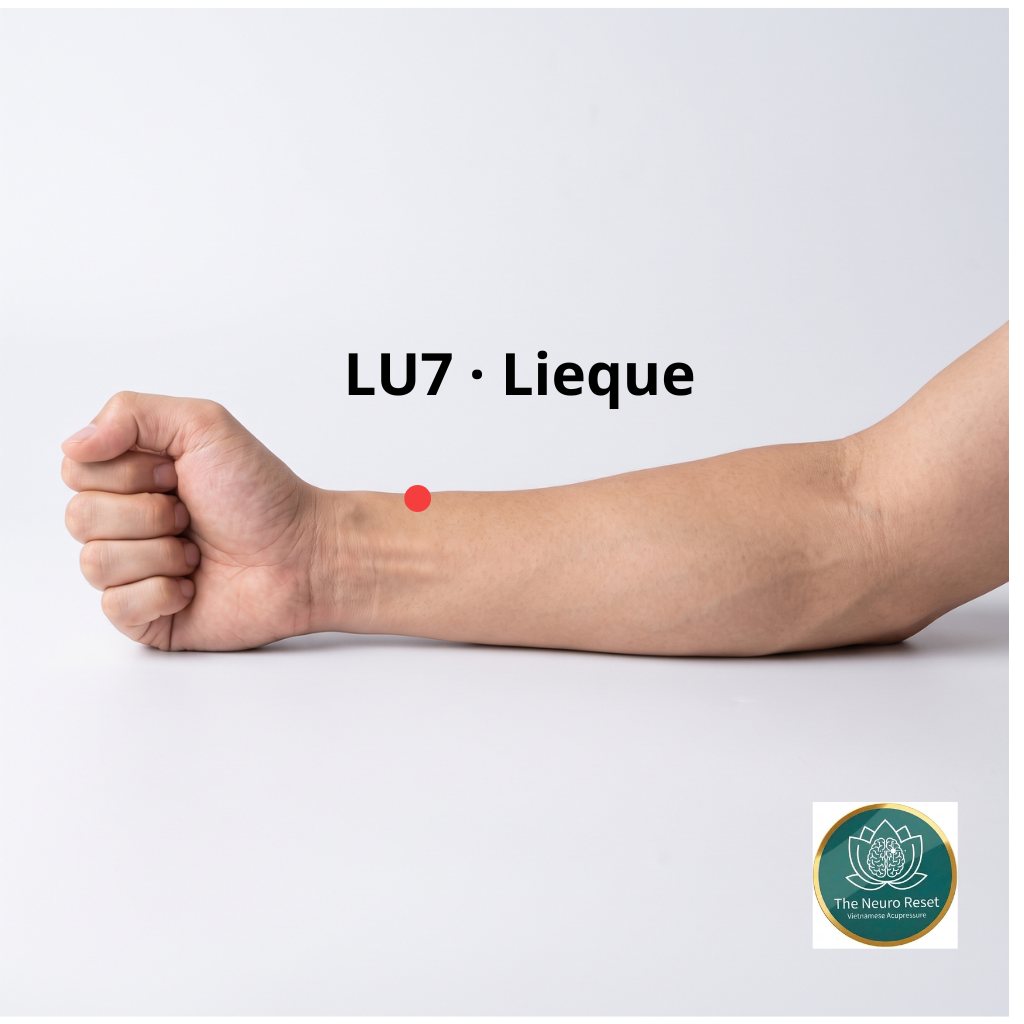
This one is easy to find and easy to remember (video 3:09). Open both hands and hook the webs between your thumbs and index fingers into each other, right hand on top. Your right index finger now lies along the thumb side of your left wrist. Where the tip of that finger lands, in a small dip on the bone, is the spot.
Now lift your left forearm up in front of you, and wrap your right hand over it from above. Press the spot with your fingertips. Press, and let go, slow and steady. Let your jaw go loose.
After a minute, hook your hands again, left hand on top this time, and find the same dip on your right wrist.
This spot works across the body. Pressing the left wrist helps the right side of the head, and the right wrist helps the left side. If one temple hurts more, start with the wrist on the other side.
Point 3: The middle joint of the ring finger
The last spot is on your ring finger (video 5:45). Spread your fingers. Find the middle joint of your ring finger, the knuckle halfway along it. Hold it between the thumb and index finger of your other hand.
Press, and rub small circles all the way around that joint. Search around it for the tender spot, and stay there. Breathe out slowly and let your shoulders drop. After a minute, switch to the other hand.
When you finish, sit still for a moment. Rest your fingertips lightly on your temples and notice how they feel now. Many people notice the band around the head loosens a little.
How I press the points for temple headache
- Find the area. You don't need a pinhead. Use the landmarks: where the neck meets the shoulder, the dip under your fingertip on the wrist bone, the middle joint of the ring finger.
- Search for the tender spot. Move slowly around the area. One spot will feel a little more tender than the rest. That's your spot.
- Press and release, or make small circles there. Hunt for the spot that stings. That's the one. Stay on it.
Leave a spot alone if the skin is broken, swollen, red or hot. If you're pregnant, check with your doctor before pressing.
Fingers too tired or too big for the small spots? The wrist dip and the finger joint are small. A stiff thumb is wide, and it tires before the minute is up. The Neuro Reset Acupressure Pen has a small, smooth tip that lands right on the spot, and you hold it loosely, like a pencil. Your hands get tired. The pen doesn't. If you'd rather keep it simple, your fingertips work for the whole routine.
The honest timeline for temple headache
Some things you can feel the first time: looser shoulders, a softer jaw, slower breathing, and often a lighter feeling around the temples.
The rest is slower. Many people feel a small change the first time; steady change usually takes two to three weeks of doing this every day. Two habits help it along: every hour, roll your shoulders back a few times, and when a headache starts, come back to the spot that felt most tender today.
One small plan: the next time your temples start to ache, sit down and do the wrist spot, once, for one minute on each side. Would you try that?
What This Won't Do
This won't make headaches stop for good, and I won't promise you that it will. It won't tell you why your head hurts, and it can't replace a check-up, especially if your headaches are new, getting worse, or different from usual.
What it can do is give you nine calm minutes with your own hands: looser shoulders, a calmer breath, and something to do besides wait for the ache to pass.
Questions people ask about temple headache
What pressure points help a headache at the temples? The ones I use are the muscle from the neck out to the shoulder (around Jianjing, GB21), Lieque (LU7) on the thumb side of the wrist, and the middle joint of the ring finger. Press each one for about a minute on each side.
How do I find Lieque (LU7) for a headache? Hook the webs between your thumbs and index fingers together. The tip of your top index finger lands in a small dip on the thumb side of the other wrist. That dip is the spot. Press it with your fingertips.
Why press the wrist on the opposite side? In the reflex therapy I learned, this wrist spot works across the body: the left wrist for the right side of the head, the right wrist for the left. Do both wrists, and start with the side opposite the worse temple.
Is a headache on both sides of the head serious? Most are not. A band-like ache on both sides often comes with tight neck and shoulder muscles, or with a cold. Get help right away if it's sudden and severe, follows a blow to the head, or comes with a high fever and stiff neck, weakness, numbness, trouble speaking or vision changes.
How long should I press each point? About one minute on each side. The whole routine takes about 9 minutes. Hunt for the spot that stings. That's the one. Stay on it.
Can acupressure help a tension headache? Research on acupuncture shows some benefit for tension-type headache; acupressure uses the same points but has much less research. I'd call it a gentle, low-risk thing to try alongside your doctor's advice, not a replacement for it.
I have spent fifteen years studying traditional Vietnamese medicine, and I write about things you can do for yourself at home, sitting down.
This is general wellness education, not medical advice. It is not a substitute for care from your doctor. If you have a health condition, are pregnant, take blood thinners, have a pacemaker, or take medication, check with your doctor first. Do not press on broken skin, a rash or a swollen area.
(Points shown: the GB21 Jianjing area from the neck to the shoulder, LU7 Lieque on the wrist, and the middle joint of the ring finger from Vietnamese Dong Ung reflex therapy.)