Hip Pain at Night Lying on Your Side? Why It Happens and What Helps
It's 1:50 a.m. You're lying on your right side, the way you always have. A deep, hot ache sits on the outside of your hip, right on the bony point that meets the mattress. You roll onto your back. Ten minutes later, the other hip starts.
If your nights go like this, you are far from alone. Hip pain at night when lying on your side is one of the most common reasons people over fifty wake up. It has usual causes. And there are changes you can make tonight, plus a short routine for the weeks ahead. At the end are the four points I press before bed. They are the side of the buttock (GB30) and the outer knee (GB34). Then the back of the knee (BL40) and the inner leg above the ankle (SP6).
Hip pain at night: the short answer
| Question | Answer |
|---|---|
| Why does my hip hurt at night? | Lying on your side presses the outer hip into the mattress for hours. Sore tendons, a bursa or a stiff joint then complain. |
| What are the usual causes? | Outer-hip pain (often called hip bursitis), hip arthritis, the wrong mattress, and a nerve from the lower back. |
| Should I lie on the painful side? | Usually not. Lie on the other side, or on your back, with pillows in the right places. |
| What to do when it wakes me? | Change position slowly, put a pillow between your knees, keep warm and breathe out long. No pressing at night. |
| What to do before bed? | About ten minutes of pressing, sitting on the edge of your bed, plus a gentle daytime routine. |
Press along with me: a video for hip pain at night
If you would rather watch than read, here I press the points on myself, sitting down. Pause it any time.
Woken by Pain at Night? 7 Pressure Points for Sleep (15 Min) · Watch on YouTube
Why does my hip hurt at night when I lie on my side?
Picture the outside of your hip. Under the skin is a bony knob at the top of your thigh bone. Strong tendons wrap over it, and a small cushion of fluid sits between them. That cushion is called a bursa.
When you lie on your side, your whole body weight rests on that one knob. Hour after hour, the tendons and the bursa are squeezed between bone and mattress. In a healthy hip, that's fine. In a hip that is already sore, it's enough to wake you.
The top hip has its own problem. When your top knee drops forward and down onto the bed, it pulls the tendons on the outside of that hip tight. So even the side you're not lying on can ache by morning.
Why does my hip hurt at night but not during the day?
During the day, you move. Walking and shifting in a chair keep stiff tissue warm and loose. Your mind is also busy, so a low ache fades into the background.
At night you lie still for hours. Stiff places set like glue. There is no noise or task to distract you, so the same ache feels twice as loud. And your weight sits on one spot for far longer than it ever does in daylight.
Four common causes of hip pain at night
1. Outer-hip pain (hip bursitis and sore tendons)
This is the most common one. The ache sits on the outside of the hip, right on the bony point. It's often worse when you lie on that side, climb stairs or stand up from a low chair. It may spread down the side of the thigh toward the knee.
For years this was called trochanteric bursitis. Today many doctors call it greater trochanteric pain syndrome. The tendons on the side of the hip have become sore and tired, and the bursa may be irritated too.
What helps: take pressure off that bony point at night, and keep the hip from dropping across your body (more below). In the daytime, avoid crossing your legs and standing with your weight sunk into one hip.
2. Hip arthritis
Arthritis lives inside the joint itself, not on the outside. The ache is usually felt deep in the groin or the front of the hip. Sometimes it travels down the front of the thigh toward the knee.
It's often stiff first thing in the morning and eases as you get going. Putting on socks and getting in and out of the car may become harder. At night, the joint can throb after a long or busy day.
What helps: gentle movement during the day, a warm shower before bed, and a pillow under or between the knees. If you have pain medicine from your doctor, keep taking exactly what was prescribed.
3. A mattress that is too firm or too soft
A mattress that is too firm pushes back hard on the hip bone. One that is too soft lets your hips sink lower than your shoulders. Then your spine curves and the hip twists all night.
If your hip feels fine away from home but sore in your own bed, look at the mattress.
What helps: you may not need a new mattress. A thin, soft topper laid over a firm mattress often gives the hip bone somewhere to sink. If your mattress sags, turn it, or try a firmer one.
4. Pain coming from the lower back
The big nerve that runs down the back of the leg starts in the lower back. When it is irritated, pain can be felt in the buttock and the hip. People call this sciatica.
Nerve pain tends to feel different. It burns, shoots or tingles, and it often runs below the knee. It may be worse lying on one side, or when you cough or sneeze.
What helps: a pillow between your knees keeps your lower back level. If the pain runs below the knee with numbness, tingling or weakness, see your doctor before you try anything else.
Should I sleep on the side of my painful hip?
Usually not. Lying on the sore side puts your full weight on the very spot that hurts.
But lying on the good side can also hurt, if the top knee drops down and forward. The answer is not one perfect position. It's the right pillows in the right places.
How to sleep with hip pain
Here is what I suggest to people who wake with a sore hip. Try one change at a time, so you know what works for you.
- Lie on the good side, with a pillow between your knees. Use a firm pillow, thick enough to keep your top knee level with your top hip. A long body pillow that reaches the ankles is even better.
- Hug a second pillow. It stops your top arm and shoulder from rolling forward, which drags the top hip with them.
- On your back, put a pillow under your knees. This takes strain off the front of the hip and the lower back.
- If you must lie on the sore side, soften what's under it. A thin topper, or a soft folded blanket under the hip, gives the bone somewhere to sink.
- Keep the hip warm. A cold room makes stiff places stiffer. Socks and a warm layer over the hips help.
- Get in and out of bed the gentle way. Sit on the edge, then lower yourself onto your side with your knees together. Reverse it to get up.
Hip bursitis at night: what makes it worse
A few everyday habits keep a sore outer hip from settling.
- Crossing your legs, in a chair or in bed.
- Standing with your weight sunk into one hip, like holding a toddler on your side.
- Sitting in low, soft chairs that leave your knees higher than your hips.
- Long walks on hills or stairs before the hip is ready.
None of these is forbidden. But if your hip wakes you every night, cut back on them for a few weeks and see what changes.
What to do when hip pain wakes you at night
This is the moment that decides the rest of the night. Here's what I do.
- Don't look at the clock. Counting the hours left keeps you awake longer than the hip does.
- Breathe out longer than you breathe in. Out through the mouth, slow and unhurried, like cooling a cup of tea.
- Roll over slowly, knees together. Think of turning like a log, not twisting at the waist. Settle on the good side or on your back.
- Put the pillow back where it belongs. It has usually slipped. Between the knees for side lying, under the knees for back lying.
- Move your feet. Gently point and pull back your toes ten times. It eases a stiff leg without waking you up fully.
- Still sore after about 20 minutes? Sit on the edge of the bed for 30 seconds, feet flat on the floor. Breathe out slowly. Then lie back down on the other side.
If you need the bathroom, sit on the edge of the bed first. Count to thirty, then stand up slowly with one hand on the bed.
One thing I don't do at night: press points. Searching for a tender spot and working on it is wake-up work. At night, the job is to stay calm and warm. I keep all my pressing for the daytime and for bedtime.
A gentle daytime routine for the hip
The tendons on the side of the hip get stronger when they are used, little and often. All of this can be done sitting on a firm chair.
- Outward knee press. Sit tall, knees hip-width apart. Place your hands on the outside of your knees. Press your knees outward into your hands for five slow seconds, then relax. Five times.
- Slow sit-to-stand. Stand up from a firm chair without using your hands if you can. Sit down slowly, taking three seconds. Five times, then rest.
- A short walk every day, on flat ground, at a pace that leaves the hip no worse the next morning.
If anything here makes the pain sharper that night, do less. If your doctor or physiotherapist has given you exercises, follow theirs first.
Pressure points for hip pain: four I press before bed
I have studied Vietnamese acupressure for fifteen years. This is the short routine I do myself, sitting on the edge of my bed, about ten minutes. Start with the point that matches your night, then finish with the settling point.
One rule for a sore outer hip: don't press on the sore bony knob itself. Work the points around it, not the bone that already hurts.
If your hip and buttock ache: the side of the buttock — Huantiao (GB30)
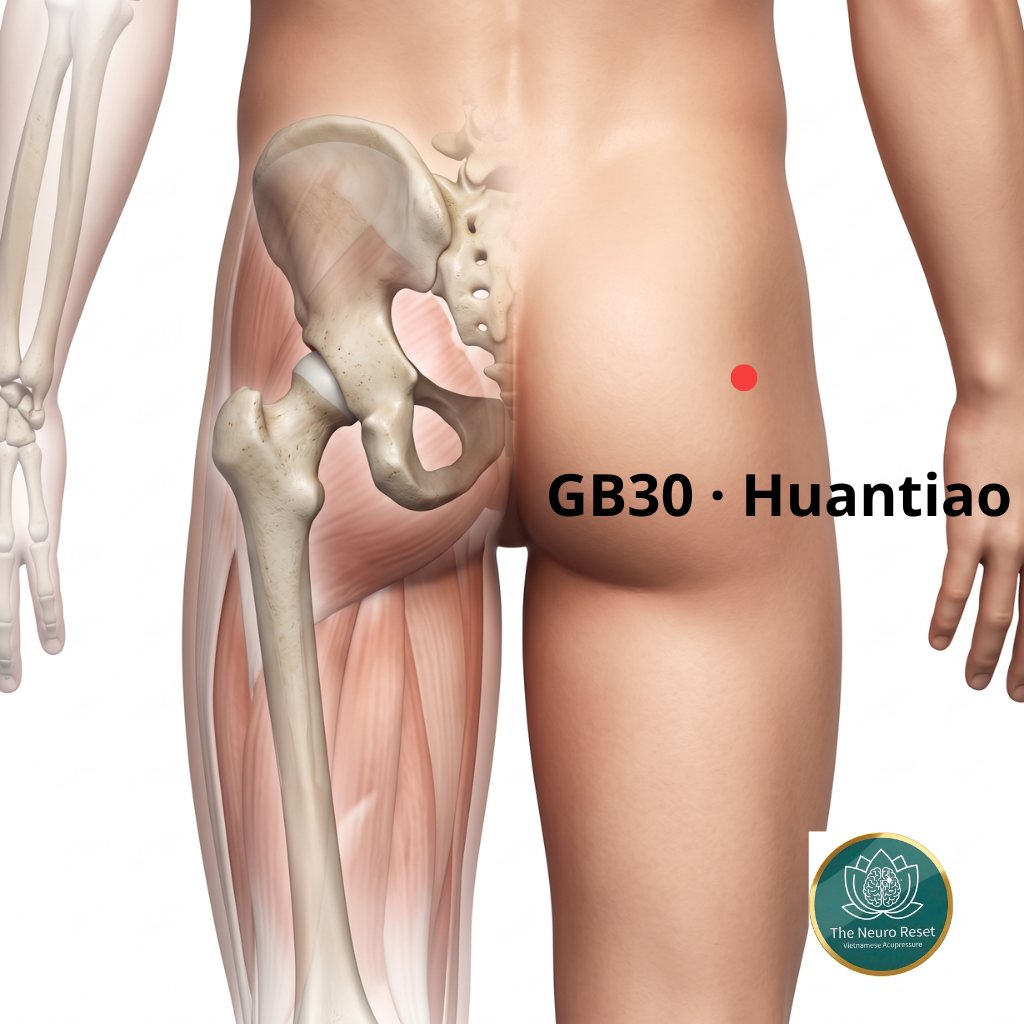
This point sits deep in the side of the buttock. Picture a line from the bony knob on the side of your hip to the base of your spine. The area is a third of the way along that line, starting from the hip.
Your thumb can't reach deep enough here, and twisting to try strains the wrist. So I use a tool. Sit on the edge of a firm bed and shift your weight onto the other buttock. Reach behind with the Y-shaped tool and rest its rounded end on the area. Lean it in gently until one spot stings, then make small circles.
If you don't have a tool, sit on a firm chair with a tennis ball under that spot. Let your weight settle onto it slowly. One to three minutes each side, very gently the first time.
Skip this point if your hip replacement is still in its first months. Skip it, too, if you have leg pain below the knee, numbness or weakness.
If the ache runs down the side of your leg: the outer knee — Yanglingquan (GB34)
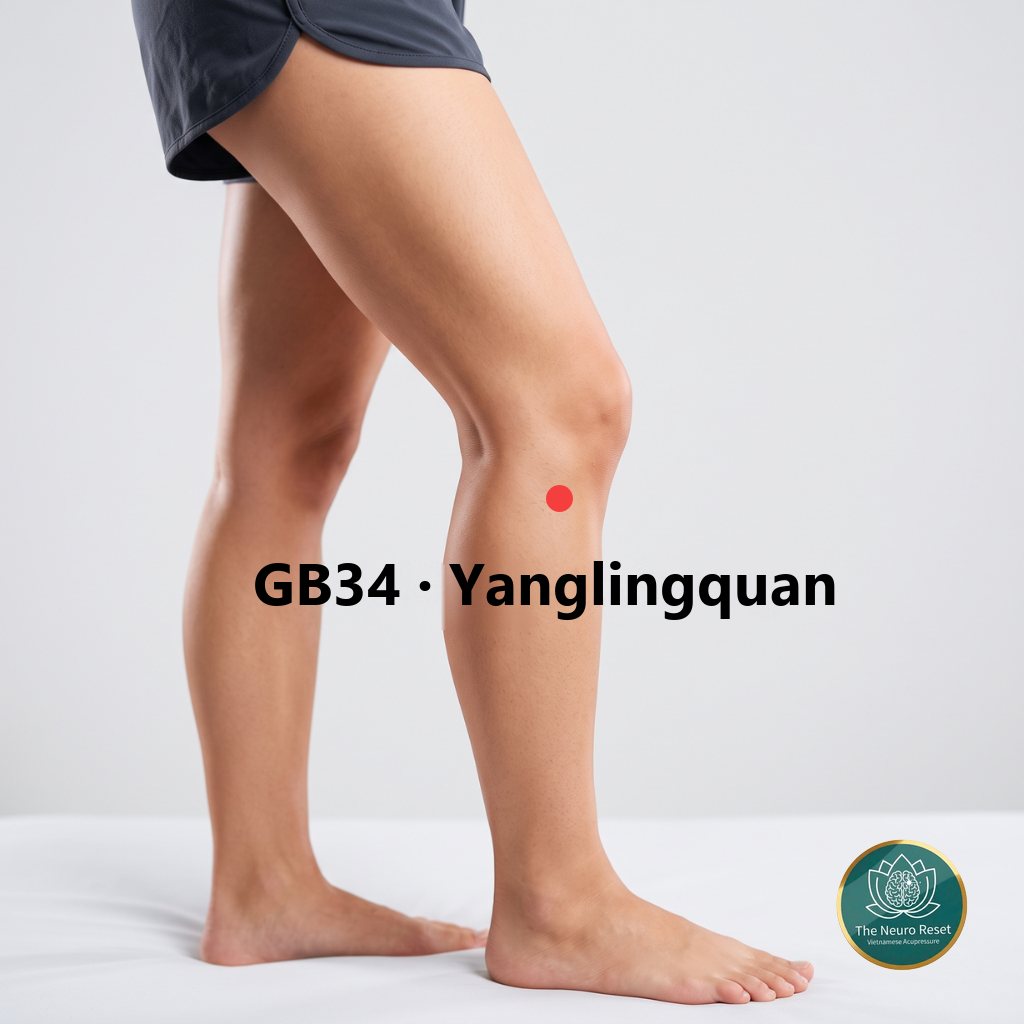
Sit with your foot flat and knee bent. Run your fingers down the outside of your knee until you meet a small, round knob of bone. Slide down and forward from it into the soft dip.
Search that dip for the spot that stings. Rub it in small circles for one to three minutes, then do the other leg. If you feel a jolt toward the foot, lift off and move a little toward the shin.
If the ache runs down the back of your leg: the back of the knee — Weizhong (BL40)
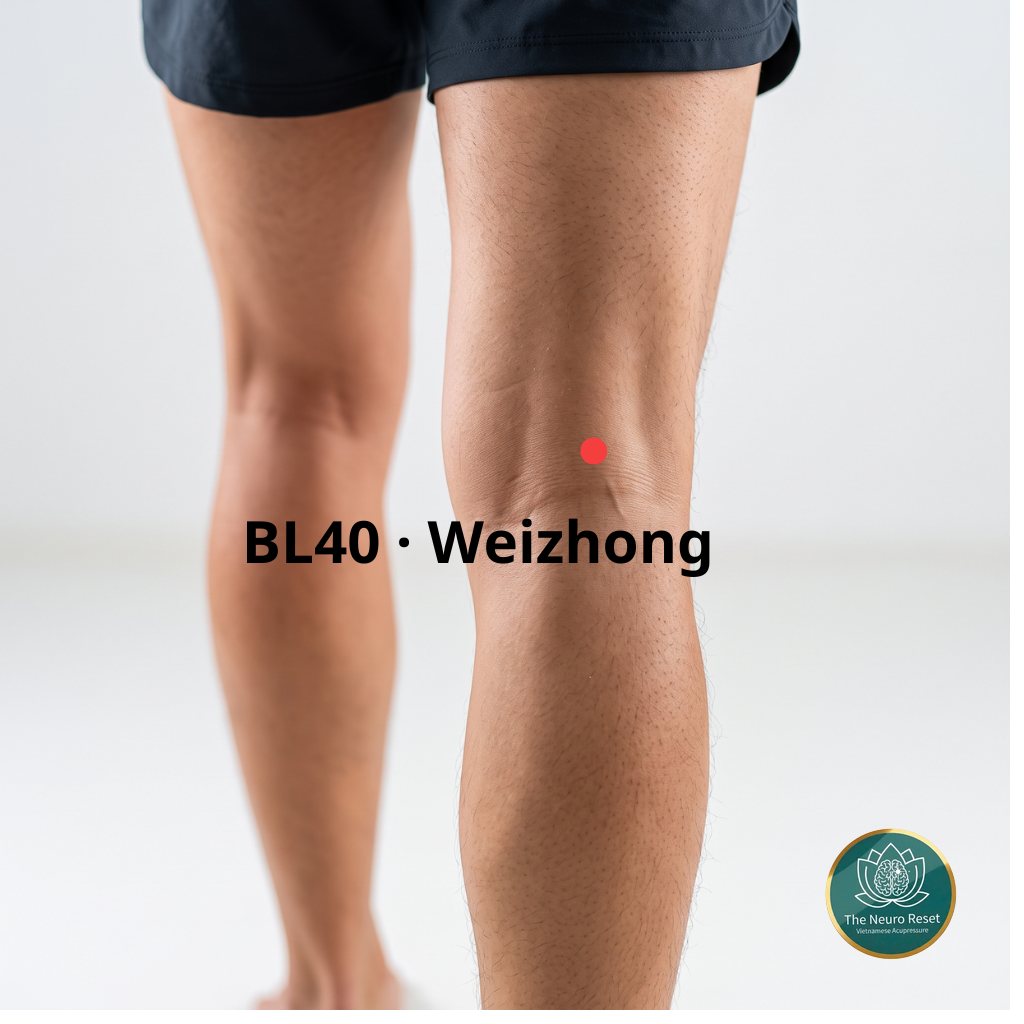
Sit on the front edge of a chair, knee bent to about a right angle. Wrap both hands around the knee so your fingertips meet in the hollow behind it. Feel the firm cord on each side. The area is on the skin crease, halfway between them.
Light pressure only here. If you feel a pulse under your finger, move off it. Skip it if you have varicose veins or a past clot in that leg. One to three minutes on each leg.
For everyone, to settle: above the inner ankle — Sanyinjiao (SP6)
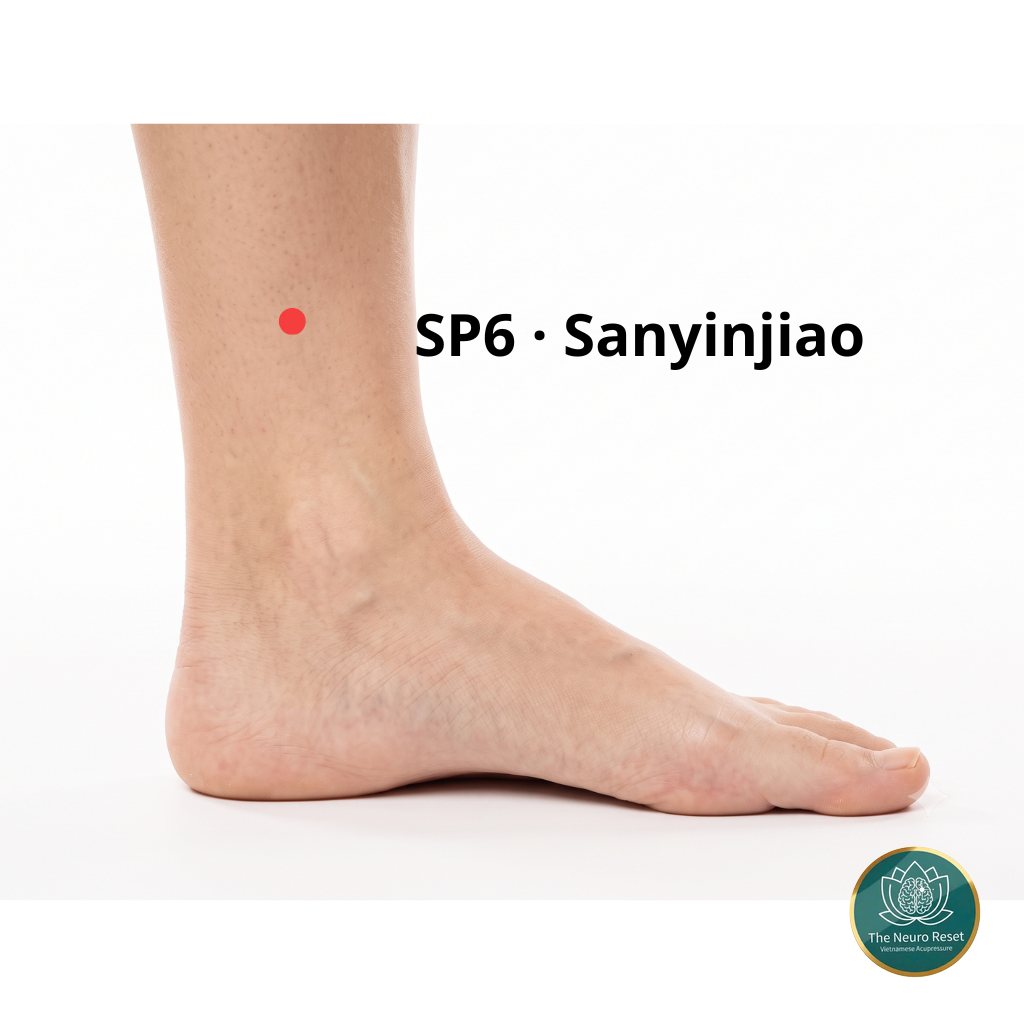
Rest one foot across your other knee. Find the bump of your inner ankle bone and lay four fingers flat above it. At the level of the top finger, roll off the back edge of the shin bone into the soft groove. The spot is often quite tender. Then the other leg.
Skip this point if you are pregnant, or if the skin there has a bulging vein, swelling or a wound.
When you finish: pillow between your knees, lie down on the good side, phone out of reach.
How I press the points for hip pain at night
- Find the area. You don't need to land on a pinhead. Get into the right neighbourhood.
- Search for the tender spot. Move your fingertip or tool slowly around the area. One spot will feel sharper than the rest. That's your spot.
- Make small circles on that spot. Use the tip of your thumb, nail short, or the rounded end of a tool. Circle slowly without sliding away.
Start with about one minute per spot, and build up to two or three over the following nights. It should feel tender while you press and ease once you lift off.
Stop and leave a spot alone if it still hurts after you lift off. The same goes if the pain spreads, or the skin looks swollen, hot or red.
Sore hands or stiff fingers? A Y-shaped tool with rounded ends does the pressing for you. It reaches the buttock point without twisting your back, and it finds the tender spot more easily than a tired thumb.
When to see a doctor about hip pain at night
Most hip pain at night comes from sore tendons or a stiff joint. But sometimes it's a message worth listening to. Please see your doctor if:
- the pain started after a fall or a knock, even a small one
- you can't put weight on the leg, or you suddenly limp badly
- you have a fever, or the hip is hot, red or swollen
- the pain is deep in the groin and spreads to the knee
- you have numbness, tingling or weakness in the leg or foot
- you have trouble controlling your bladder or bowels — this needs urgent help
- the pain is new, getting worse each week, or comes with night sweats or weight loss
- you have a hip replacement and new pain in that hip
- nothing has changed after about two weeks of the steps on this page
If any of these fit, start there. The routine on this page can wait.
For a medical view, read the Arthritis Foundation on the causes of hip pain at night.
The honest timeline for hip pain at night
Some things help on the first night. A pillow between the knees, a softer layer under the hip, and staying off the sore side often make a difference straight away.
The rest is slower. Sore tendons settle over weeks, not days. For the daytime routine and the pressing, think about ten minutes a day for three to six weeks. Some people notice a lot. Some notice very little, and I'd rather you heard that from me now.
What This Won't Do
This won't rebuild a worn hip joint, and it won't make a tendon new again. Nobody honest can promise that. It won't replace anything your doctor has given you, either. Keep taking exactly what was prescribed. This is something you do in addition. A routine you can do with your own hands, instead of lying awake waiting for the hip to wake you again.
Short videos on hip pain at night
Two short clips from my channel on the same subject. Each one is under a minute.
Questions people ask about hip pain at night
Why does my hip hurt at night when I lie on my side? Lying on your side puts your weight on the bony knob at the outside of the hip. Sore tendons and the small cushion over that bone get squeezed for hours. Arthritis, a poor mattress and an irritated nerve can add to it.
What is the best sleeping position for hip pain? For most people, it's lying on the good side with a firm pillow between the knees. Lying on your back with a pillow under the knees also works well. Try one change at a time and keep what helps.
Should I sleep on the side of my painful hip? Usually not, because it presses straight on the sore spot. If you can't sleep any other way, put a thin topper or a soft folded blanket under the hip.
Can a mattress cause hip pain? It can make it worse. A very firm mattress presses hard on the hip bone, and a very soft one lets the hips sink and twist. A thin topper over a firm mattress often helps.
How do I know if it's bursitis or arthritis? Outer-hip pain usually sits on the bony point at the side and hurts when you lie on it. Arthritis is usually felt deeper, in the groin or front of the hip, with morning stiffness. Only your doctor can tell you for sure.
Are there pressure points for hip pain? In Vietnamese acupressure, three are commonly used for an aching hip and leg. They are the side of the buttock, the outer knee and the back of the knee. I press them before bed, never in the middle of the night. Don't press on the sore bony knob itself.
When should I worry about hip pain at night? See your doctor after a fall, if you can't bear weight, or if you have fever or a hot, swollen hip. The same goes for numbness or weakness in the leg, or pain that keeps getting worse.
I have spent fifteen years studying traditional Vietnamese medicine, and I write about things you can do for yourself at home, sitting down.
This is general wellness education, not medical advice. It is not a substitute for care from your doctor. If you have a health condition, are pregnant, or take medication, check with your doctor first.
(Points shown: GB30 Huantiao, GB34 Yanglingquan, BL40 Weizhong, SP6 Sanyinjiao.)