Acupressure Points for Neck Pain and a Stiff Neck: 7 to Press Along With Me
Acupressure points for neck pain you can press at home, sitting in a chair: behind the ear, Yifeng (TE17); beside the bump at the base of the neck, near Dazhui (GV14); behind the knee, Weizhong (BL40); and the middle joint of the big toe. About one minute each. Hunt for the spot that stings. That's the one. Stay on it.
It's 7:30 in the morning. You go to back the car out of the driveway, and your head won't turn. So you turn your whole body instead, slowly, with one hand on the seat. Your neck feels like a rusty wheel that someone forgot to oil.
This page is the written version of my 16-minute press-along video. If you'd rather read than watch, everything is here, in the same order. You sit in a chair and work through seven spots, from behind the ears down to the big toe. Three of them sit on named points. They are behind the ear (TE17), beside the bump at the base of the neck (GV14), and behind the knee (BL40). The last one is the middle joint of the big toe.
Neck pain: the short answer
| Question | Answer |
|---|---|
| What is this routine? | Seven spots for a stiff neck, about one minute each, sitting in a chair. It follows the Vietnamese Dong Ung method. |
| What do I need? | A chair, a hair dryer for the first spot, and about 16 minutes. |
| Which spots? | Warm air behind the ears (TE17), eyebrows to temples, back of the hand, palm, beside the spine at the back of the neck (GV14), behind the knees (BL40), and the big toe joint. |
| How hard do I press? | Hunt for the spot that stings. That's the one. Stay on it. Never force your neck to turn. |
| When should I see a doctor first? | After a fall or accident, or with fever, a sudden severe headache, or numbness or weakness in your arms. |
Press along with me: the video for neck pain
This page is the written version of the video below. Watch it and press along with me, or read the steps further down. Pause any time.
How to Relieve a Stiff Neck: 7 Pressure Points (Press Along) · Watch on YouTube
Why does my neck get so stiff?
Think of the muscles at the back of your neck as ropes holding up a heavy ball. Your head is that ball. When you hold it still in one position for a long time, the ropes stay pulled tight. After a while, they forget how to let go.
That is why a stiff neck so often shows up in the morning. You may have slept with your head twisted, or on a pillow that is too high or too flat. For hours, one side of your neck was stretched and the other side was squeezed. Then you wake up and try to move it all at once.
Daytime habits add to it. Looking down at a phone, a book or a tablet. Sitting at a screen that is too low. A cold draught from an open car window. Shoulders that creep up toward your ears when you're worried. Over the years, the small joints in the neck change too. Many people feel that as stiffness first thing, which eases a little once they get moving.
Before you start
Sit on a firm chair with your feet flat on the floor. Keep a hair dryer within reach, plugged in and set to warm.
Keep taking your medication and keep seeing your doctor. This is something you do alongside it, not instead of it. Did your neck pain start after a fall or an accident? Does it come with fever, a severe headache, or numbness or weakness in your arms? Then please see your doctor before you try anything here.
And one rule for the whole routine: never force your neck to turn.
The routine, point by point
Each spot takes about one minute. Where a spot has two sides, you give each side its own minute. Breathe out slowly while you work, and let your shoulders drop.
Warmth first: behind the ear — Yifeng (TE17)

Find the soft hollow right behind your earlobe. That hollow, and the side of the neck below it, is where the warm air goes. (video 0:36)
Set the hair dryer to warm, not hot. Test the air on the back of your wrist first. Hold it about a hand's width away from your skin.
Aim the air at the hollow behind the earlobe and down the side of your neck. Keep it moving in small, slow circles. Never let it rest on one spot. If it feels hot, move it further away.
One minute on one side. In the video I start on the right. Then switch hands and warm the other side for another minute.
If your skin has poor feeling, or you bruise or burn easily, keep the dryer further back and check your skin often.
To soften the face and sides of the head: eyebrows to temples
This one works both sides at the same time, using slow strokes rather than pressing. (video 3:04)
Place two fingertips at the inner end of each eyebrow. Stroke slowly along the brows to the outer end, and on into the hairline at your temples. Then curve up over the top of each ear, and down behind the ear.
Lift off, come back to the inner eyebrows, and stroke again. Keep every stroke slow and smooth, always in the same direction. Breathe out with each stroke and let your jaw go soft. Keep going for one minute.
Working from a distance: back of the hand, finger webs to wrist
Hold one hand in front of you, palm down, and spread the fingers wide. Look at the grooves between the knuckles, running from the finger webs back toward the wrist. (video 4:25)
With the fingertips of your other hand, stroke along those grooves, from the webs back toward the wrist. Lift off, go back to the webs, and stroke again. Spreading the fingers opens each web a little more.
One minute on the first hand. In the video I start with the left. Then switch hands for another minute.
The other side of the hand: palm, wrist to finger webs
Raise one hand with the palm facing out, away from you. Find the crease where your hand meets your wrist, and put your other thumb in the middle of it. (video 6:51)
Stroke from the wrist out across the palm, to the webs between the fingers. Lift off, come back to the wrist, and stroke again. Use enough pressure to feel it, on the spot that stings.
One minute on the first hand, then switch for another minute. Let your shoulders drop away from your ears.
Close to the stiffness: beside the spine at the back of the neck
Reach one hand up behind your neck. Bend your head forward a little and feel for the bump at the base of your neck. That is the bone that sticks out most. (video 9:14)
Place your fingertips on the muscle beside the spine, a little above that bump. Stroke down toward the bump with short, gentle strokes.
Stay beside the bone, never on it. Keep your head still while you work, and breathe out slowly. One minute on one side, then switch hands for the other side of the spine.
If your arm or shoulder won't let you reach back here, skip it for now. I'll come back to that below.
For the back of the body: behind the knee — Weizhong (BL40)
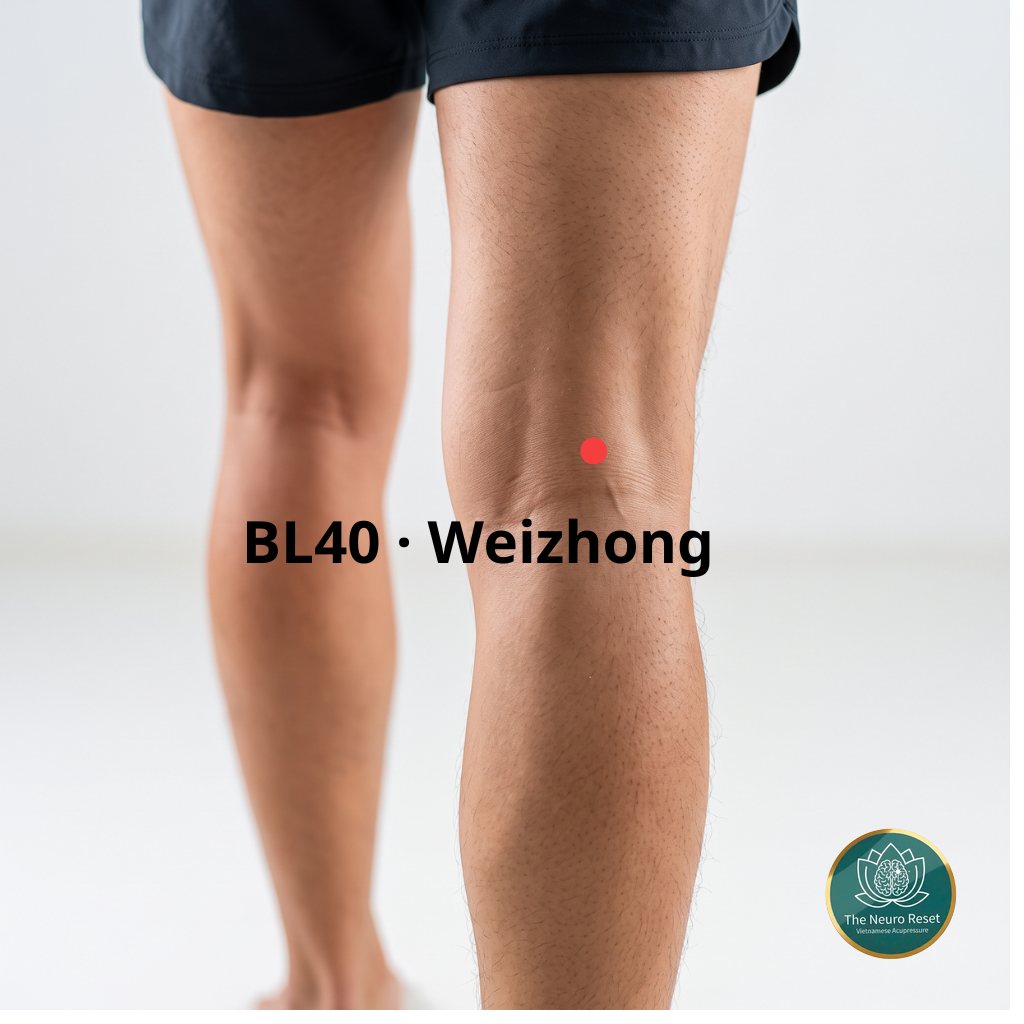
Find the crease at the back of your knee. In the middle of it there is a soft hollow. If standing is steady for you, you can feel for it with one foot up on a chair. Otherwise, find it sitting down. (video 11:36)
Sit down, reach behind both knees, and rest your fingertips in the middle of each crease. Press very lightly and make small, slow circles. This spot needs soft fingertips, not a hard press. One minute, both knees at once.
Skip this spot if the back of your knee is swollen, or your calf is painful, red or hot. Those signs need a doctor.
The one I save for last: the big toe joint
Cross one foot over your other knee, and hold the foot with one hand. If crossing your leg is hard, rest the foot on a low stool instead. (video 12:57)
With your other hand, find the first joint of your big toe. It is the knuckle in the middle of the toe, where it bends. Pinch it gently between your thumb and finger, and make small circles on that joint. Search around the joint for the tender spot.
One minute on one foot, then cross the other foot over and do the same. Skip this spot if the skin on the toe is broken, cracked or infected.
I wrote a whole page on why I trust this little joint for a neck that won't turn. You can read it here: the pressure point on your big toe for a stiff neck.
After the routine: test your neck gently
When all seven are done, turn your head slowly to one side, then the other. Don't push to the end of the range. Many people notice it turns a little further and a little more easily. Some notice very little the first time, and that is normal too.
Three habits help the routine last through the day:
- Keep your neck warm when it is cold or windy. A scarf counts.
- Lift your screen or your book up to eye level, so your head isn't hanging forward.
- Roll your shoulders back a few times every hour.
How I press the points for neck pain
- Find the area. Use the landmarks: the hollow behind the earlobe, the bump at the base of the neck, the crease behind the knee. You don't need a pinhead. The right neighbourhood is enough.
- Search for the tender spot. Move slowly. One spot will feel a little sharper than the rest.
- Make small, slow circles or strokes on it. Firm enough to feel, on the spot that stings. It should ease once you lift off.
Start with one minute per spot, as in the video. Leave a spot alone if it still hurts after you lift off, or the skin looks swollen, hot or red.
When your arms can't reach. Spot five is the hard one for many people. A stiff neck often comes with stiff shoulders, and lifting your hand behind your head can be the thing that hurts. Thumbs get tired. And there may be no one at home to press your neck for you. That is what the Neuro Reset Wooden Stick is for. It is light wood with two rounded ends, and it fits your palm. It reaches the back of your neck so your arm doesn't have to bend as far. Your hands get tired. The stick doesn't.
When to see a doctor about neck pain
Most stiff necks ease on their own within days. But some come with signs that need a doctor, not a pressure point. Please get checked if:
- your neck pain comes with numbness, tingling or weakness in your arms or hands
- you have a stiff neck with a fever, especially with a headache or if light hurts your eyes. Get help the same day.
- the pain started after a fall, a car accident or a jolt to the head or neck
- you get a sudden, severe headache, the worst you've ever had. Call emergency services.
- the stiffness is getting worse, or hasn't eased after a couple of weeks
- the pain wakes you at night and won't settle, or comes with weight loss you can't explain
If any of these fit, start there. The routine can wait.
The honest timeline for neck pain
Some things you may feel in the first session. The warm air loosens the side of the neck. Your head turns a little further at the end.
The rest is slower. A neck that has been stiff for weeks or months usually needs time. Think about doing the routine once a day for two to three weeks before you decide how well it suits you. Many people notice their mornings get easier. Some notice very little, and I'd rather you heard that from me now.
What This Won't Do
This won't change the wear in the joints of your neck, and it won't undo an injury. It isn't a replacement for your doctor or your physiotherapist. If they have given you exercises or medicine, keep doing exactly what they told you. This is something you do in addition. Sixteen quiet minutes, with your own hands, so that turning your head stops being a decision and becomes a movement again.
Questions people ask about neck pain
Which acupressure points help neck and shoulder pain? In this routine: behind the ear (TE17), beside the bump at the base of the neck (GV14), the back of the hand between the finger webs and the wrist, behind the knee (BL40) and the middle joint of the big toe. Work both sides, about one minute each, and never force your neck to turn.
How do I get rid of a stiff neck fast? For an ordinary stiff neck, gentle warmth and slow movement often help most. Warm the side of the neck, stroke the muscles gently, then turn your head slowly without forcing it. Expect it to ease over a few days rather than all at once.
What pressure points help a stiff neck? In this routine I use three named points. They are Yifeng (TE17) behind the earlobe, the area beside Dazhui (GV14) at the base of the neck, and Weizhong (BL40) behind the knee. I add strokes on the face and hands, and the middle joint of the big toe.
Is heat or ice better for a stiff neck? For stiffness, most people find gentle warmth more comfortable. It helps tight muscles let go. Ice is more often used in the first day or two after a strain or knock. If your neck is swollen or the pain came from an injury, ask your doctor which to use.
Why is my neck stiff every morning? Your neck stays in one position for hours while you sleep, often twisted or on the wrong height of pillow. The muscles stay tight and are slow to let go. Over the years the small joints of the neck change too, which many people feel most first thing.
Can I use a hair dryer on a stiff neck? Yes, if you keep it on warm, not hot. Test the air on your wrist, hold it a hand's width away, and keep it moving. Skip it if your skin has poor feeling, because you may not notice it getting too hot.
Why press the big toe for a neck? In the Vietnamese Dong Ung method, the big toe joint is used as a match for the neck. Many people feel a difference there that surprises them. I explain it in full on the big toe page.
Can I do this routine every day? Yes. Once a day is a good rhythm. If a spot is still sore the next day, give it a day off or press more lightly.
I have spent fifteen years studying traditional Vietnamese medicine, and I write about things you can do for yourself at home, sitting down.
This is general wellness education, not medical advice. It is not a substitute for care from your doctor. If you have a health condition, are pregnant, take blood thinners, or take medication, check with your doctor first.
(Points shown: warmth over TE17 Yifeng · eyebrows-to-temples stroke · finger webs to wrist · palm, wrist to finger webs · beside GV14 Dazhui · BL40 Weizhong · first joint of the big toe.)