Leg Cramps at Night: Why They Happen and How to Stop Them
It's 3:12 a.m. Your calf has turned to stone. The muscle is a hard knot under the skin, your toes are curled down, and the pain has pulled you straight out of sleep. You grab at your leg in the dark and wait for it to let go.
Night leg cramps are one of the most common reasons people over fifty wake up. They usually last a few minutes. The soreness can stay all the next day. This page explains why they happen, how to get through one safely, and how to make them less frequent. At the end are the five points I press before bed. They are the middle of the back of the calf (BL57), the back of the knee (BL40) and the outer knee (GB34). Then the sole of the foot (KI1) and the inner leg above the ankle (SP6).
Leg cramps at night: the short answer
| Question | Answer |
|---|---|
| What is it? | A sudden, painful tightening of a leg muscle during sleep. It is most often the calf, sometimes the foot or the thigh. Doctors call it nocturnal leg cramps. |
| Is it common? | Very. It becomes more common with every decade after fifty. |
| Why does it happen? | Often there's no single cause. Muscles that shorten with age, long hours of sitting, toes pointed down in bed, fluids, some medicines and some health conditions all play a part. |
| What to do when it hits? | Pull your toes toward you. Then sit on the edge of the bed with the foot flat on the floor. Stand up slowly, holding on to something. |
| How to prevent it? | A gentle calf stretch before bed, enough fluid during the day, warm legs, loose covers over your feet, and a few minutes of pressing. |
Press along with me: a video for leg cramps at night
If you would rather watch than read, here I press the points on myself, sitting down. Pause it any time.
Numb Feet at Night? Pressure Points to Press Along · Watch on YouTube
What are leg cramps at night?
A night leg cramp is a muscle that tightens on its own and won't let go. You didn't ask it to. You can't relax it by willing it.
The calf is the usual place, and you can often see the muscle bunched into a ball. Your foot may point down hard, or your toes may curl. Some people call it a charley horse.
What causes leg cramps at night?
For most people there is no one clear reason. Doctors still debate exactly what sets a cramp off. The best guess is that the nerve controlling the muscle starts firing on its own, and the muscle locks.
Several things make that more likely.
1. Age, and muscles that have grown shorter
Over the years, muscles and tendons lose some of their stretch. We also lose some muscle, and what is left tires more easily. A calf that has grown short and tired is quicker to lock.
This is part of why cramps are so much more common after sixty. It is not a sign that you've done something wrong.
What helps: a gentle stretch of the calf and the back of the thigh every evening. I'll show you how below.
2. Long hours of sitting, or a long day on your feet
A day in a chair keeps the calf short and still for hours. A day on hard floors or in the garden tires it out. Either one can set up a cramp later that night.
What helps: get up and walk a little every hour or so.
3. The way your feet lie in bed
When you lie on your back, your feet naturally point down. Heavy blankets tucked in tight push them down further. That position keeps the calf shortened all night, which is exactly the position in which a cramp likes to start.
What helps: loosen the covers at the foot of the bed. A pillow under your knees, or between them if you sleep on your side, keeps the legs in a softer, more natural position.
4. Fluids
Not drinking enough during the day can make cramps more likely. So can sweating on a hot day, or a lot of alcohol in the evening.
Many people in their sixties drink less because they want fewer trips to the bathroom at night. That is understandable. But it is better to drink well earlier in the day than to go short altogether.
What helps: drink steadily through the morning and afternoon, then ease off in the last two hours before bed.
5. Some medicines
Several common medicines are linked with cramps in some people. These include some water pills (diuretics), some cholesterol medicines such as statins, and some blood pressure and breathing medicines.
What helps: if your cramps started or got worse after a new medicine, mention it to your doctor or pharmacist. Please don't stop or change a medicine on your own.
6. Health conditions
Cramps can travel with diabetes, nerve problems in the feet, kidney or liver disease, thyroid problems, poor circulation in the legs, and pregnancy. Most people with night cramps don't have any of these. But if your cramps are frequent, it's worth asking your doctor to check.
Why do leg cramps get worse with age?
Muscles get shorter and tire faster. Many of us sit more, and the list of daily medicines grows. Sleep also turns lighter in the second half of the night, so a cramp is more likely to wake you fully.
How to stop a leg cramp at night immediately
When a cramp hits, the aim is to lengthen the muscle that has locked, gently and without falling. Here is what I do.
- Sit up in bed. Don't stay flat and fight it.
- Straighten the leg and pull your toes toward you. Use your hand, or keep a scarf or towel by the bed and loop it around the ball of your foot. Pull slowly. Breathe out long and slow while you hold it.
- Still locked? Swing your legs over the edge of the bed and sit. Put the cramping foot flat on the floor. A cool floor often feels good here. Press your heel gently down while you stay seated. This stretches the calf with your own weight, without asking it to hold you up.
- Stand only when the worst has eased. Turn on a lamp first. Keep one hand on the bed or a sturdy chair. Rise slowly, then take a few small, slow steps.
- Afterwards, warm it. A warm hand resting on the calf, a blanket, or a pair of socks. If you want to touch the muscle, stroke it lightly with a flat palm. Don't dig into it.
For a cramp in the front of the thigh, the stretch goes the other way. Sitting on the edge of the bed, slide that foot back under the bed so the knee bends. For a cramp in the sole or toes, pull the toes up toward the shin with your hand.
One thing I don't do in the middle of the night: press points. Pressing hard into a muscle that is in spasm can leave it bruised and more sore the next day. Searching for a tender spot is also wake-up work. I keep all my pressing for the daytime and for bedtime.
The most important part: getting up safely
I want to stay on this, because it matters more than anything else on the page.
A cramp makes you want to jump out of bed. Please don't. You are half-asleep, in the dark, and in pain. The leg that is cramping can't be trusted to hold your weight. And when you stand up fast from lying down, your blood pressure can dip for a few seconds. Add sharp pain to that, and some people go light-headed or faint.
In comments under videos about night cramps, people describe exactly this: a cramp at three in the morning, a rush to the bathroom, and a faint on the hard floor. Hard floors and hard edges are the reason the bathroom is the worst place for it to happen.
So, every time:
- Sit on the edge of the bed for at least 30 seconds before you stand. Feet flat on the floor.
- Light first, then stand. A small night light between the bed and the bathroom helps.
- Hold on to something steady as you rise: the bed, a sturdy chair, a rail.
- Wear slippers with a grip, or go barefoot. Socks alone slide on smooth floors.
- If you feel dizzy, sit back down straight away. If there's nothing to sit on, lower yourself to the floor before you fall.
- Keep a phone within reach of the bed, and think about leaving the bathroom door unlocked at night.
If you live alone, tell a family member or friend that this happens to you. It is not a fuss. It is a sensible plan.
How to prevent leg cramps at night
Most of the change comes from small things done every day.
A gentle stretch before bed
This is the step with the best evidence. One trial followed adults over fifty-five. Those who stretched their calves and the backs of their thighs each night before bed had fewer cramps after six weeks. Their cramps were also less painful.
All of this can be done sitting on the edge of your bed:
- Calf stretch with a towel. Sit with one leg stretched ahead, heel resting on the floor or the bed. Loop a towel around the ball of your foot. Pull gently until you feel a stretch in the calf. Hold for about 30 seconds, then the other leg.
- Back-of-the-thigh stretch. Sit near the edge of the bed with one leg straight out and the foot relaxed. Sit tall, hands on the bent knee, and lean forward from the hips, keeping your back straight. Hold for about 30 seconds. Skip this one if it sets off sciatica.
- Ankle pumps. Point and flex both feet slowly, ten times.
Keep it gentle. You want a pull, about halfway to your limit. A stretch should never feel like the muscle is about to tear.
The rest of the day
- Drink steadily from morning to mid-afternoon, then ease off before bed.
- Move every hour. A walk around the house counts.
- Keep your legs and feet warm. Socks in bed help many people.
- Loosen the covers so your feet aren't pushed into a pointed position.
What deficiency causes leg cramps at night?
You'll often read that night cramps mean you're low in magnesium, potassium or calcium. Sometimes low minerals do play a part, especially with water pills or after a bout of vomiting or diarrhoea. But in most people, the cramps aren't caused by a shortage of anything.
If you're wondering about magnesium or any other supplement, please ask your doctor first. Supplements can interact with other medicines, and some aren't safe with kidney problems. A simple blood test can tell your doctor whether your levels are actually low.
Leg cramps or restless legs?
The two are often mixed up. A cramp is a hard, painful lock in one muscle. You can usually see or feel the knot.
Restless legs feel different. There's an uncomfortable, crawling or itching feeling deep in the legs, and a strong urge to move them. Moving brings relief, and it often starts in the evening while you're sitting or lying still. Restless legs is a different condition, and it's worth raising with your doctor.
Before bed: five points I press on myself
I have studied Vietnamese acupressure for fifteen years. This is what I add after the stretches, sitting on the edge of my bed, about ten minutes in all. Do both legs, even if only one cramps.
If your calf cramps: the middle of the back of the calf — Chengshan (BL57)
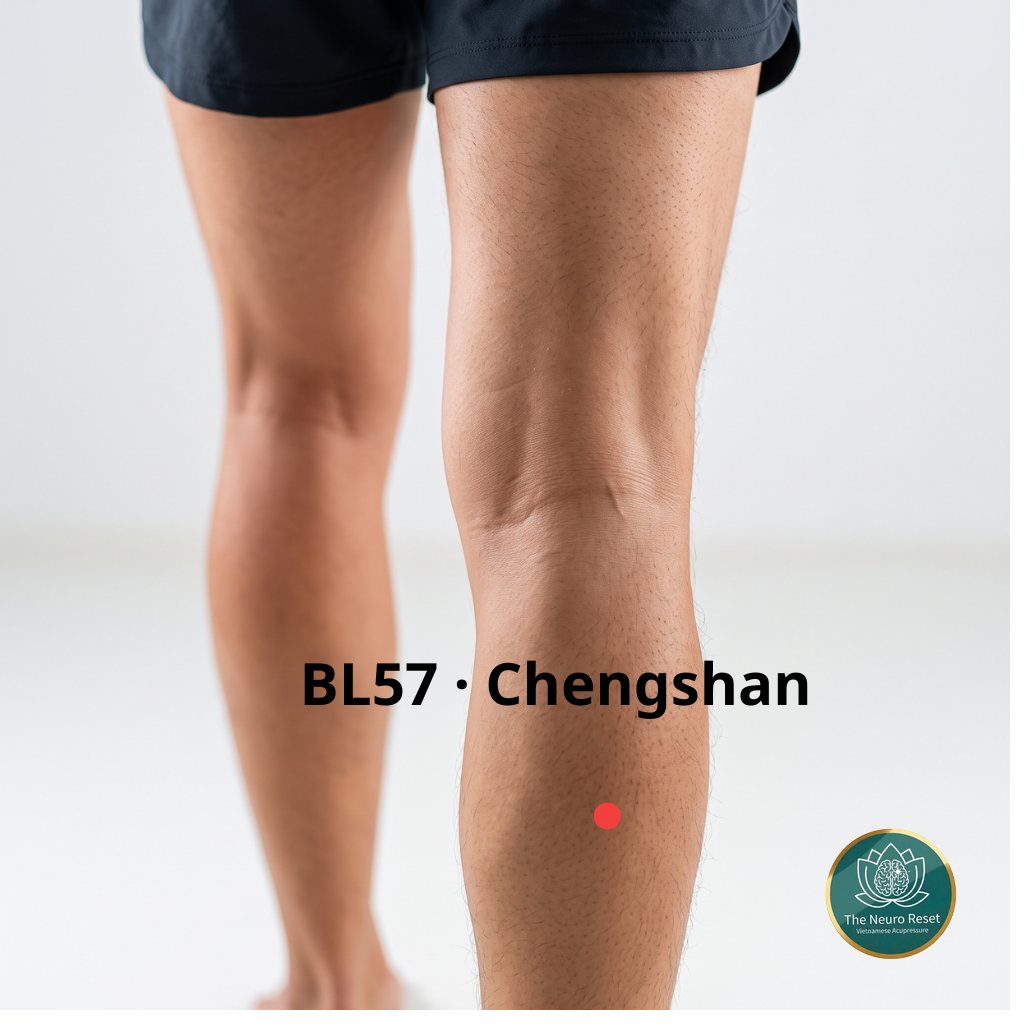
Sit and cross one leg over the other knee, or rest the foot on a low stool. Run your thumb up the back of your calf from the heel, along the tendon. Where the tendon ends and the two bulges of the calf muscle begin, there's a dip at the tip of an upside-down V.
Probe that dip until one spot stings. Rub it in small circles for one to three minutes on each leg. If your calf is still bruised and sore from last night's cramp, go very lightly, or leave it for a night.
If your calves feel tight all the time: the back of the knee — Weizhong (BL40)
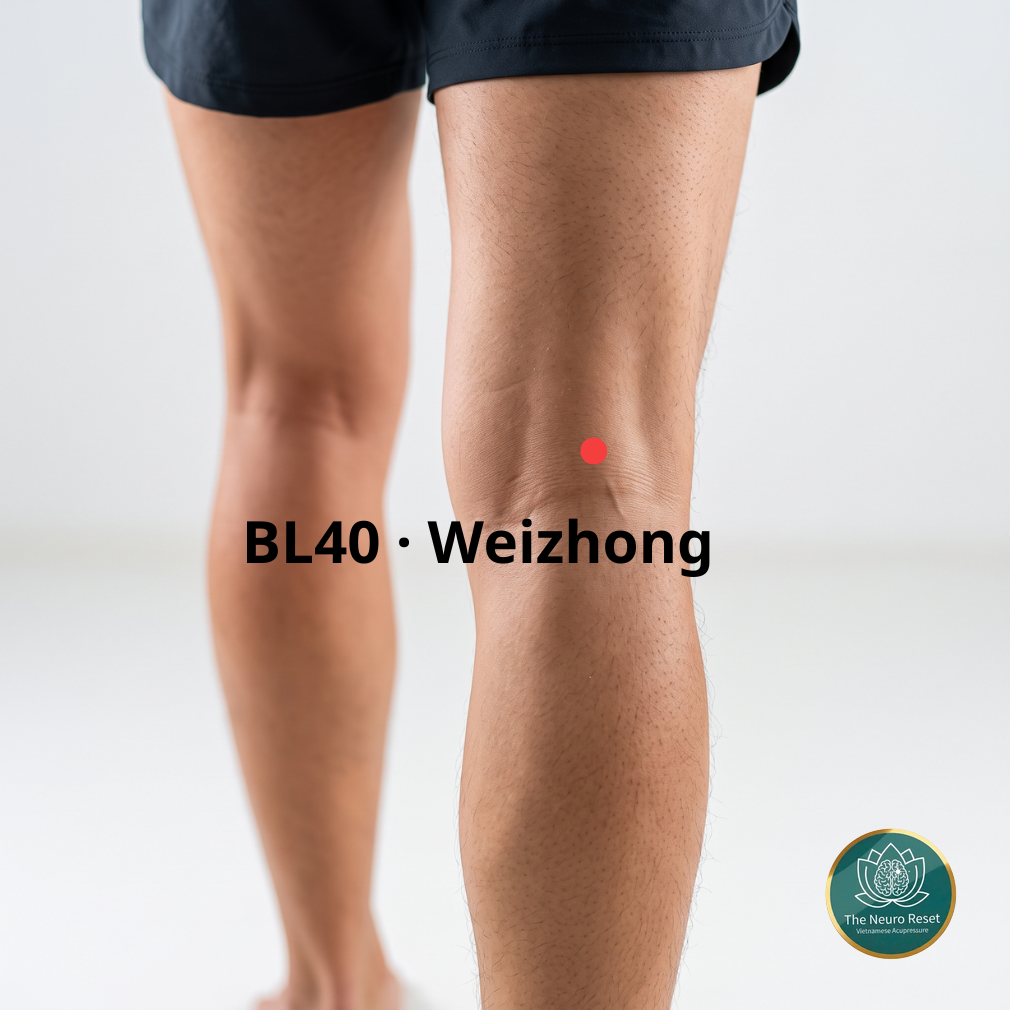
Bend your knee to about a right angle. Wrap both hands around it so your fingertips meet in the hollow behind it. Feel the firm cord on each side. The area is on the skin crease, halfway between them.
Light pressure only here. If you feel a pulse under your finger, move off it. One to three minutes on each leg.
If the cramp runs down the outside of your leg: the outer knee — Yanglingquan (GB34)
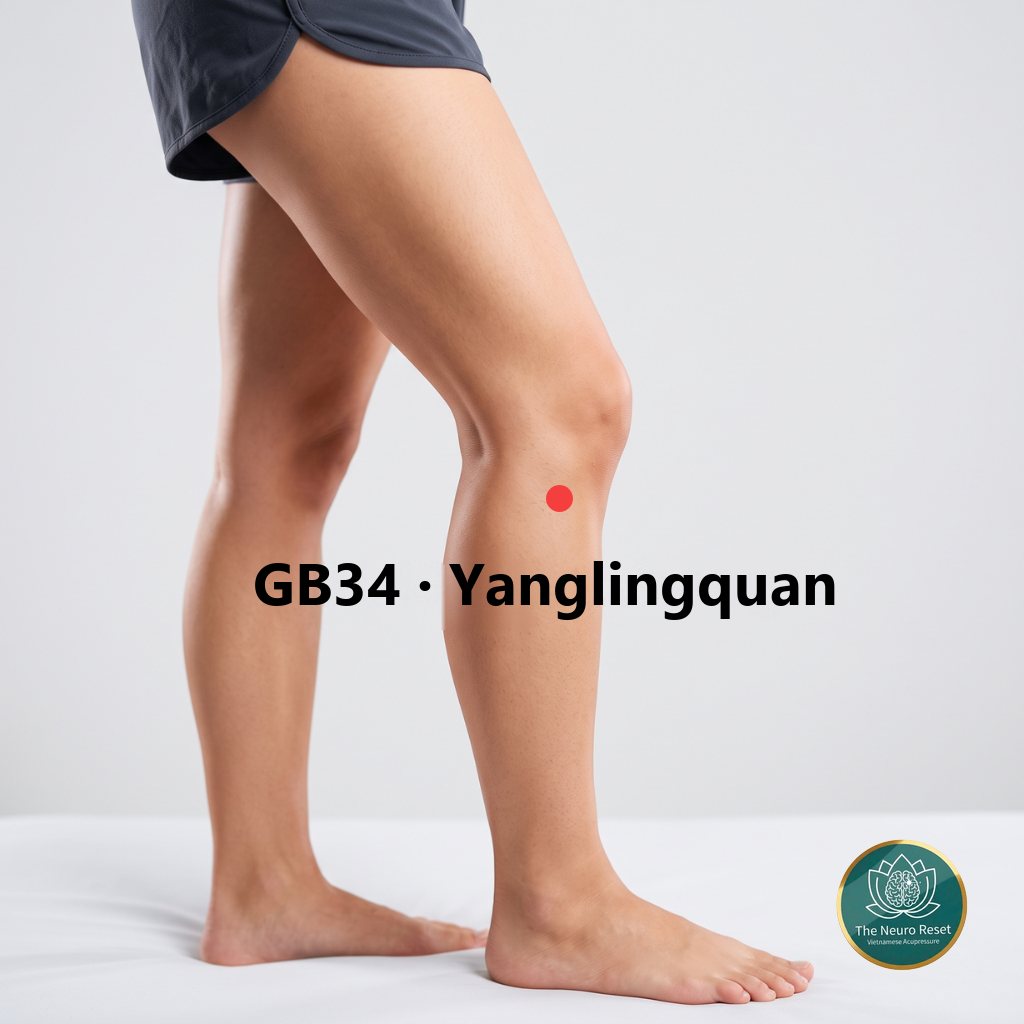
Run your fingers down the outside of your knee until you meet a small, round knob of bone. Slide down and forward from it into the soft dip. Search that dip for the spot that stings. One to three minutes on each leg.
If you feel an electric jolt toward your foot, lift off. Move slightly forward, toward the shin, and press more gently.
If your foot or toes cramp: the sole of the foot — Yongquan (KI1)
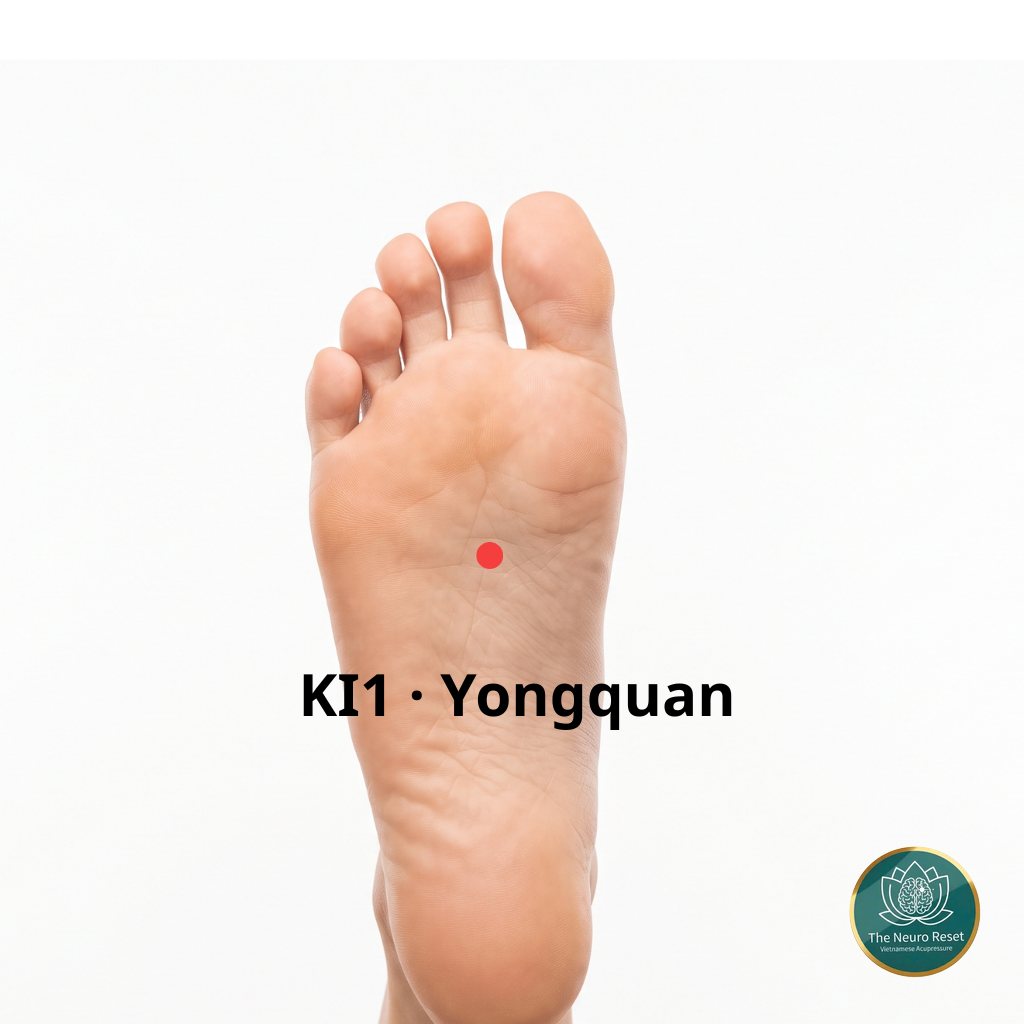
Rest one foot across the other knee so the sole faces you. Curl your toes. A hollow appears below the ball of the foot, in line with the second and third toes. Relax the toes and probe that hollow until one spot stings. One to three minutes on each foot.
The skin on the sole is thick, so a smooth, round-ended stick helps here.
For everyone, to settle down: above the inner ankle — Sanyinjiao (SP6)
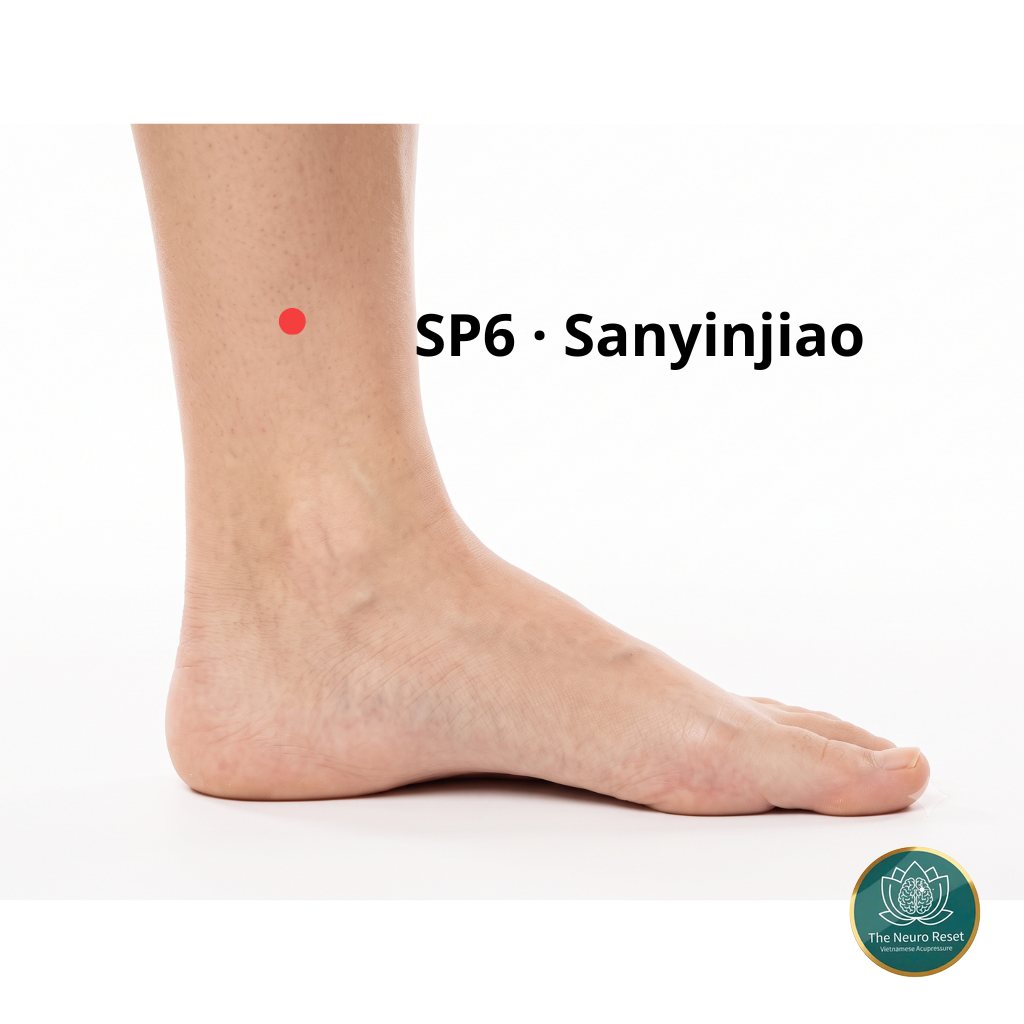
Bring one foot up across your other knee. Find the bump of your inner ankle bone and lay four fingers flat above it. At the level of the top finger, roll your fingertip off the back edge of the shin bone into the soft groove. It's often quite tender. Then the other leg.
Skip this point if you are pregnant, or if the skin there has varicose veins, swelling, a rash or a wound.
When you finish: socks on, covers loose over your feet, lie down.
How I press the points for leg cramps at night
- Find the area. You don't need to land on a pinhead. Get into the right neighbourhood.
- Search for the tender spot. Move your fingertip slowly around the area. One spot will feel sharper than the rest. That's your spot.
- Make small circles on that spot. Use the tip of your thumb, not the soft pad, with your nail short. Circle slowly without sliding away.
Start with about one minute per spot, and build up to two or three over the following nights. It should feel tender while you press and ease once you lift off.
Stop and leave a spot alone if it still hurts after you lift your finger off. The same goes if the pain spreads, or the skin looks swollen, hot or red.
Sore hands, or can't reach your calves? A smooth, round-ended stick can do the pressing for you. It also reaches the back of the calf without bending far forward.
When to see a doctor about leg cramps at night
Most night cramps are harmless, if miserable. But please see your doctor if:
- cramps wake you most nights, or are getting worse
- one calf is swollen, warm, red or painful between cramps — get help the same day, as this can be a clot
- your leg feels weak, numb or tingly, or the muscle seems to be shrinking
- your legs ache or cramp when you walk and ease when you rest
- cramps began after a new medicine
- you have diabetes, kidney, liver or thyroid problems, and the cramps are new
- you have fallen, or nearly fallen, getting up with a cramp
If any of these fit, start there. The routine on this page can wait.
For a medical view, read the NHS page on leg cramps, including cramps at night.
The honest timeline for leg cramps at night
Some things help on the first night: loose covers, warm feet, a towel by the bed, and getting up slowly.
The stretching takes longer. In the trial I mentioned, people stretched every night for six weeks. Many people notice fewer cramps somewhere around the third or fourth week. For the pressing, think about ten minutes each evening for two to six weeks. Some people notice very little, and I'd rather you heard that from me now.
What This Won't Do
This won't promise you a night without a single cramp, and nobody honest can. It won't replace anything your doctor has given you, either. Keep taking exactly what was prescribed. This is something you do in addition. A few minutes with your own hands each evening, and a safer way out of bed when a cramp still comes.
Short videos on leg cramps at night
Two short clips from my channel on the same subject. Each one is under a minute.
Questions people ask about leg cramps at night
What causes leg cramps at night? Usually there's no single cause. Shorter muscles with age, long hours of sitting and feet pointed down in bed all play a part. So can too little fluid, some medicines and some health conditions.
How do you stop a leg cramp at night immediately? Sit up, straighten the leg and pull your toes toward you. If that isn't enough, sit on the edge of the bed with the foot flat on the floor and press the heel down. Stand slowly, holding on to something.
Why do I get calf cramps at night as I get older? Muscles lose some stretch and strength over the years, and a short, tired calf locks more easily. Many people also sit more, take more medicines and sleep more lightly. So a cramp is both more likely and more likely to wake you.
Is there a pressure point for leg cramps? The point I use most is in the middle of the back of the calf, Chengshan (BL57). I press it before bed, along with the points above. I never press it during a cramp at night.
What deficiency causes leg cramps at night? Low magnesium, potassium or calcium can play a part for some people. In most people, no shortage is found. Please ask your doctor before taking magnesium or any supplement.
Should I take quinine for leg cramps? Not on your own. Health regulators in the US and UK have warned against routine use of quinine for cramps, because of rare but serious side effects. If it was prescribed for you, talk to your doctor before changing anything.
Does pickle juice help leg cramps? Some people swear by it. The research is small and mostly in young athletes. It is also very salty, so check with your doctor first if you watch your salt.
I have spent fifteen years studying traditional Vietnamese medicine, and I write about things you can do for yourself at home, sitting down.
This is general wellness education, not medical advice. It is not a substitute for care from your doctor. If you have a health condition, are pregnant, or take medication, check with your doctor first.
(Points shown: BL57 Chengshan, BL40 Weizhong, GB34 Yanglingquan, KI1 Yongquan, SP6 Sanyinjiao.)