Restless Legs at Night: What Causes Them and How to Calm Them
It's 10:40 p.m. The lamp is off and the pillow is cool. Then it starts, deep inside both calves. A crawling, pulling feeling, as if something under the skin wants to get up and walk. You shift your feet. It eases for a breath, then comes back stronger.
If that's your evening, this page is for you. Restless legs at night have a name, some common causes and several things you can do about them. Some help tonight, and some help over a few weeks. At the end are the five points I press before bed. Three are on the leg: the middle of the calf (BL57), the outer knee (GB34) and below the knee (ST36). The last two are above the inner ankle (SP6) and on the sole of the foot (KI1).
Restless legs at night: the short answer
| Question | Answer |
|---|---|
| What is it called? | Restless legs syndrome, often shortened to RLS. Doctors also call it Willis-Ekbom disease. |
| What does it feel like? | Crawling, pulling, tingling or aching deep in the legs, with a strong urge to move them. |
| Why is it worse at night? | It wakes up when you sit or lie still. Your body clock also makes it stronger in the evening. |
| What causes it? | Often no single cause. Low iron, pregnancy, kidney disease, some medicines, caffeine and alcohol are the usual suspects. |
| What helps in the moment? | Get up and walk a few steps, rub your calves, try a warm or cool cloth. No point pressing at night. |
| What helps before bed? | A calm evening routine, and about ten minutes of pressing five points on the legs and feet. |
Press along with me: a video for restless legs at night
If you would rather watch than read, here I press the points on myself, sitting down. Pause it any time.
Numb Feet at Night? Pressure Points to Press Along · Watch on YouTube
What are restless legs?
Restless legs syndrome is a strong urge to move your legs. It usually comes with an odd feeling deep inside them. People describe it as crawling, pulling, fizzing, itching from the inside, or a dull ache.
Doctors look for four signs together. The urge to move. It starts or grows when you rest. Moving makes it better, at least for a while. And it is worse in the evening and at night.
It can be mild and come once in a while. Or it can arrive every evening and steal hours of sleep. Some people feel it in their arms too.
Restless legs vs leg cramps: how to tell them apart
Many people mix these two up. They feel quite different once you know what to look for.
| Restless legs | Leg cramp | |
|---|---|---|
| The feeling | Crawling, pulling, an itch you can't reach | A sudden, hard knot of muscle |
| Pain | Uncomfortable, sometimes aching | Sharp, often fierce |
| The muscle | Soft, not locked | Hard and tight to the touch |
| What helps | Moving the legs | Stretching the muscle out |
| How long | Comes and goes for hours in the evening | Usually a few minutes, then soreness |
If your calf locks into a hard ball that stops you in your tracks, that's a cramp. If your legs won't let you keep still, that's restless legs. Some people get both.
Why are restless legs worse at night?
Two things meet at bedtime. First, you stop moving. Restless legs wake up when the body goes still, on the sofa, in a long car ride, or in bed.
Second, your body clock. Researchers think the brain's dopamine activity dips in the evening. Dopamine helps control movement. Iron levels inside the brain may dip at night as well. Together, they make the evening the hardest hour.
That's why the feeling often settles toward dawn. Many people with restless legs finally sleep well in the early morning, right when the alarm is due.
What causes restless legs?
For many people, there is no single clear cause. It often runs in families. But several things are known to start it or make it worse, and some of them can be checked.
1. Low iron
This is the most important one to rule out. The brain needs iron to make dopamine. When iron stores run low, restless legs often get worse.
Here is the part people get wrong. Your blood can look "normal" on a basic test while your iron stores are low. Ask your doctor about a ferritin test, which measures stored iron.
Please don't start iron tablets on your own. Too much iron can build up in the body and do real harm. Some people also carry a condition that makes them store too much. Test first, then take only what your doctor advises.
2. Pregnancy
Restless legs are common in the later months of pregnancy. For most women, they fade within a few weeks of the birth. Mention it to your midwife or doctor, because iron needs rise in pregnancy too.
3. Kidney disease
Restless legs are very common in people with kidney disease, especially those on dialysis. If your kidneys are being monitored, tell your kidney team about your legs. They hear it often.
4. Some medicines
Several everyday medicines can stir up restless legs:
- Sedating antihistamines, the kind found in many allergy tablets and "night-time" or "PM" sleep aids.
- Some antidepressants.
- Some anti-sickness medicines.
- Some medicines for mood or psychosis.
If your legs got worse after starting a new medicine, tell your doctor or pharmacist. Please don't stop anything on your own. Ask whether the medicine, the dose or the timing can change.
5. Caffeine, alcohol and smoking
Coffee, tea, cola and chocolate in the afternoon can keep your legs busy at night. Alcohol in the evening often makes them worse in the small hours. Smoking does too.
6. Other health conditions
Nerve problems in the feet, diabetes and an underactive thyroid can all play a part. So can poor sleep itself. A tired brain makes the legs more restless, and restless legs make you more tired.
What deficiency causes restless legs?
Low iron is the one with the strongest link. Low folate or vitamin B12 can play a part in some people. Magnesium is often mentioned online, but the research on it is mixed.
The answer is the same for all of them. Ask your doctor for a blood test before you take anything. Guessing with supplements can hide the real cause.
What to do when your legs won't keep still
This is the moment that decides the rest of your evening. Here's what I do.
- Get up and walk a few steps. Sit on the edge of the bed for 30 seconds first, feet flat. Then stand slowly, one hand on the bed. A slow walk to the kitchen and back is often enough to quiet the legs.
- Rub your calves with your whole palm. Long, slow strokes from the ankle up toward the knee. Firm but kind. This is rubbing, not point pressing.
- Try warm or cool. A warm cloth or a heat pad on the calves helps many people. Others prefer a cool, damp cloth. Try each on different nights and keep the one that works for you.
- Move your ankles while sitting. On the edge of the bed, lift your heels and lower them, ten times. Then lift your toes and lower them, ten times. Then circle each ankle slowly.
- Give your mind something dull. A puzzle, a familiar book, folding a few towels. Restless legs seem to grow when you sit and wait for them.
When the feeling settles, go back to bed. Keep the lights low the whole time.
One thing I don't do at night: press points. Searching for a sore spot and working it is wake-up work. At night, the job is to calm the legs and get back to sleep. I keep all my pressing for the daytime and for bedtime.
What should you not do with restless legs?
- Don't sit still for hours in the evening. Get up and move every half hour or so.
- Don't take a sleep aid without checking the label. Many night-time tablets contain an antihistamine that can make restless legs worse.
- Don't start iron on your own. Test first.
- Don't stop a prescribed medicine on your own. Ask your doctor.
- Don't do hard exercise late at night. A gentle walk is fine. A hard workout can rev the legs up.
Evening habits that help restless legs
None of these works overnight. Kept for a few weeks, together they often make a real difference.
- Move during the day. A daily walk, a swim or gentle cycling. Steady, moderate movement helps more than a burst of hard effort.
- Keep caffeine to the morning, and ease off alcohol, especially in the last few hours before bed.
- Eat your last big meal a few hours before bed.
- Take a warm bath or shower in the evening, then let your body cool down.
- Keep regular bedtimes and wake-up times, weekends included.
- Plan long sitting. At the theatre or on a plane, take an aisle seat so you can stand up.
- A bedtime routine your legs can recognise. Mine is about ten minutes of pressing, sitting on the edge of my bed. It's below.
Can acupressure help restless legs?
I'll be honest with you: the research is thin. A small pilot study in 2022 tested acupressure in people on kidney dialysis who had restless legs. The leg symptoms eased during the weeks of pressing. A 2025 review of studies in dialysis patients came to a similar view. Massage and acupressure eased leg symptoms, but sleep quality did not change.
These are small studies in one group of people. They don't prove much for everyone else.
What I can tell you is what I see. Many people find a few calm minutes of pressing the legs before bed settling. It gives the legs attention before you ask them to lie still. Think of it as one part of your evening, alongside the habits above.
Before bed: five points I press on myself
I have studied Vietnamese acupressure for fifteen years. This is the short routine I do myself, sitting on the edge of my bed, about ten minutes. Start with the point nearest to where your legs feel worst, then finish with the two settling points.
If the crawling sits in your calves: the middle of the calf — Chengshan (BL57)
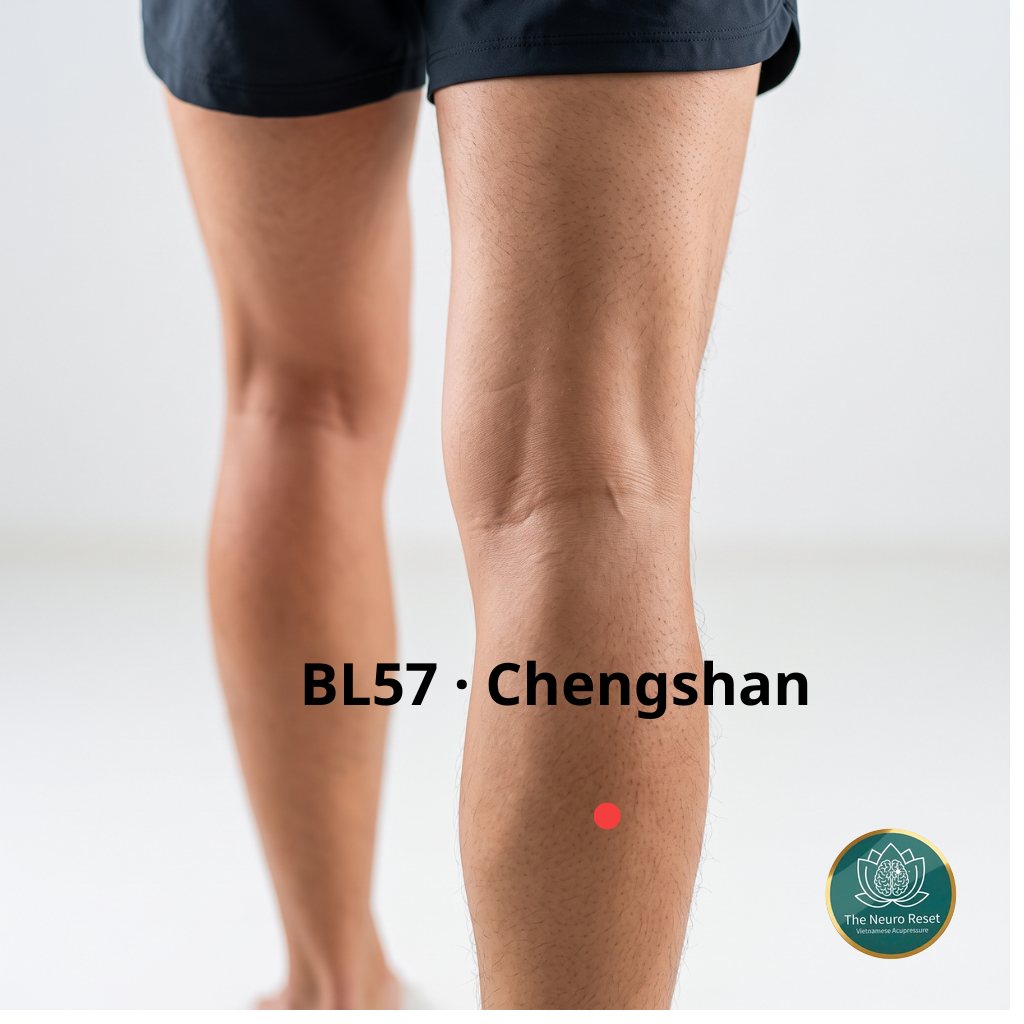
Sit and cross one leg over the other knee, or rest the foot on a low stool. Run your thumb up the back of the calf from the heel, along the tendon. Where the tendon ends and the two bulges of muscle begin, there's a dip at the tip of a V. Search it for the spot that stings. One to three minutes on each leg.
Skip it if one calf is suddenly swollen, warm and painful, or if there's a bulging vein there.
If the pulling runs down the outside of your leg: the outer knee — Yanglingquan (GB34)
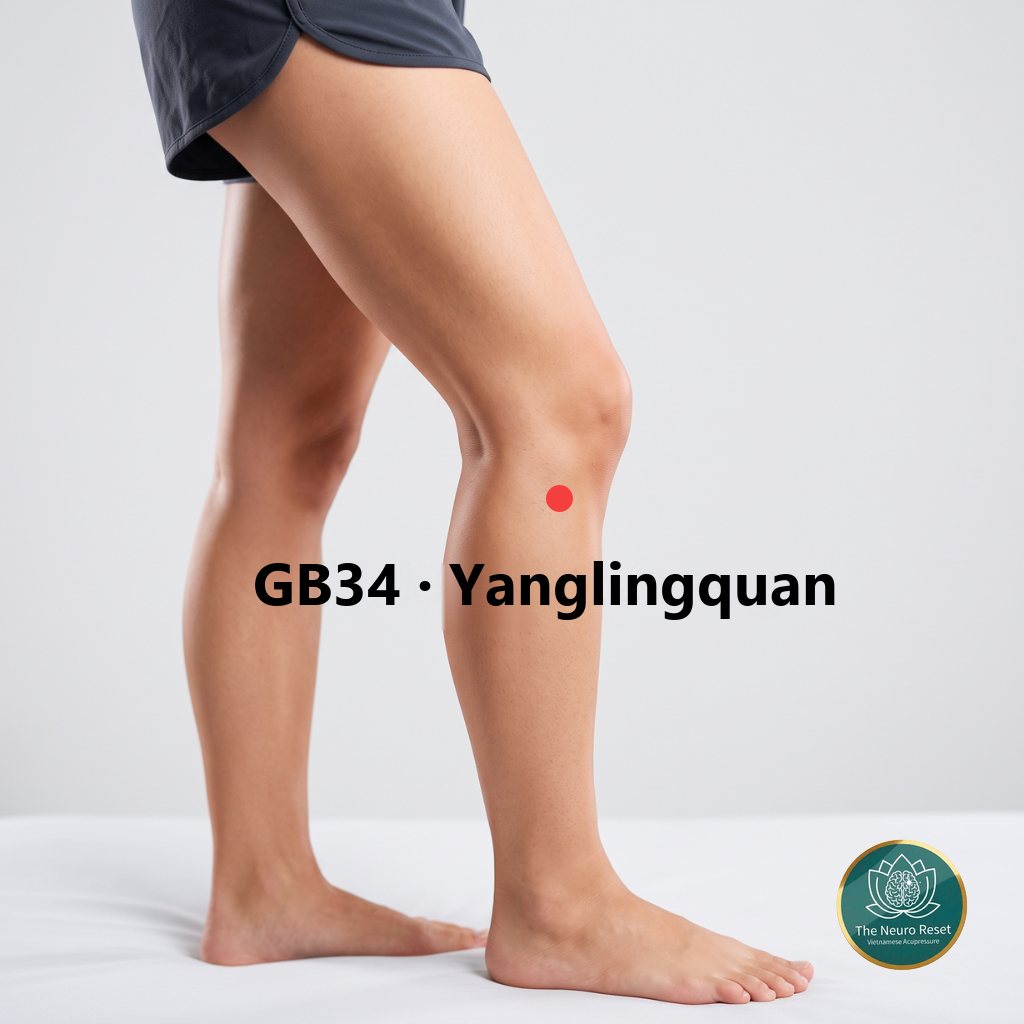
Run your fingers down the outside of your knee until you meet a small, round knob of bone. Slide down and forward from it into the soft dip. Search that dip for the tender spot. One to three minutes on each leg.
If you feel an electric jolt toward your foot, lift off. Move a little forward, toward the shin, and press more gently.
If your legs feel heavy and tired: below the knee — Zusanli (ST36)
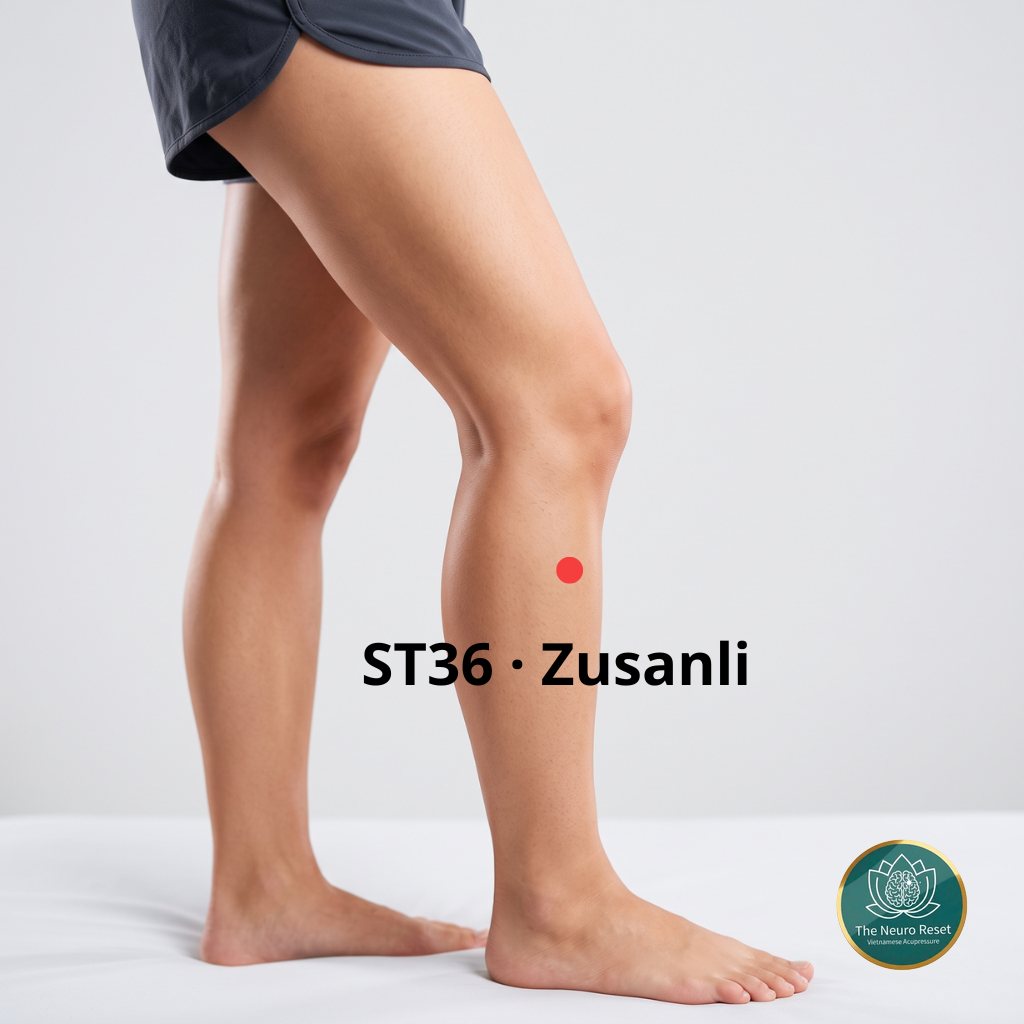
Sit with your knee bent to a right angle. Find the dip at the outer lower edge of your kneecap. Lay four fingers below it, going down the leg. Where the lowest finger lies, move one finger-width out from the sharp edge of the shin. Search that patch for the spot that stings. One to three minutes on each leg.
For everyone: above the inner ankle — Sanyinjiao (SP6)
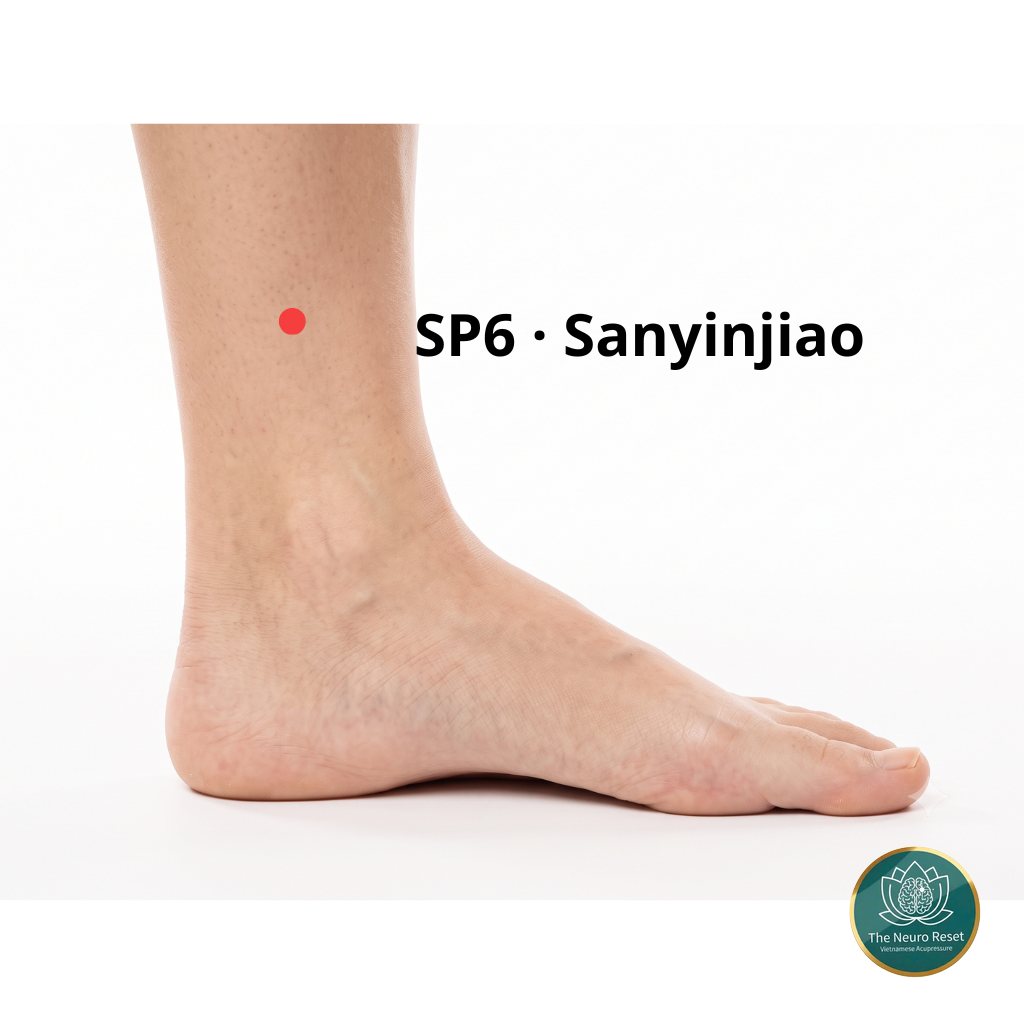
Bring one foot up across your other knee. Find the bump of the inner ankle bone and lay four fingers above it. At the level of your top finger, roll back off the edge of the shin bone into the soft groove. It's often quite tender. One to three minutes, then the other leg.
Skip this point if you are pregnant. Pregnancy is a common reason for restless legs, so please take this one seriously. Skip it too if the skin has a bulging vein, a rash or a wound, or you've had a clot in that leg.
For everyone: the sole of the foot — Yongquan (KI1)
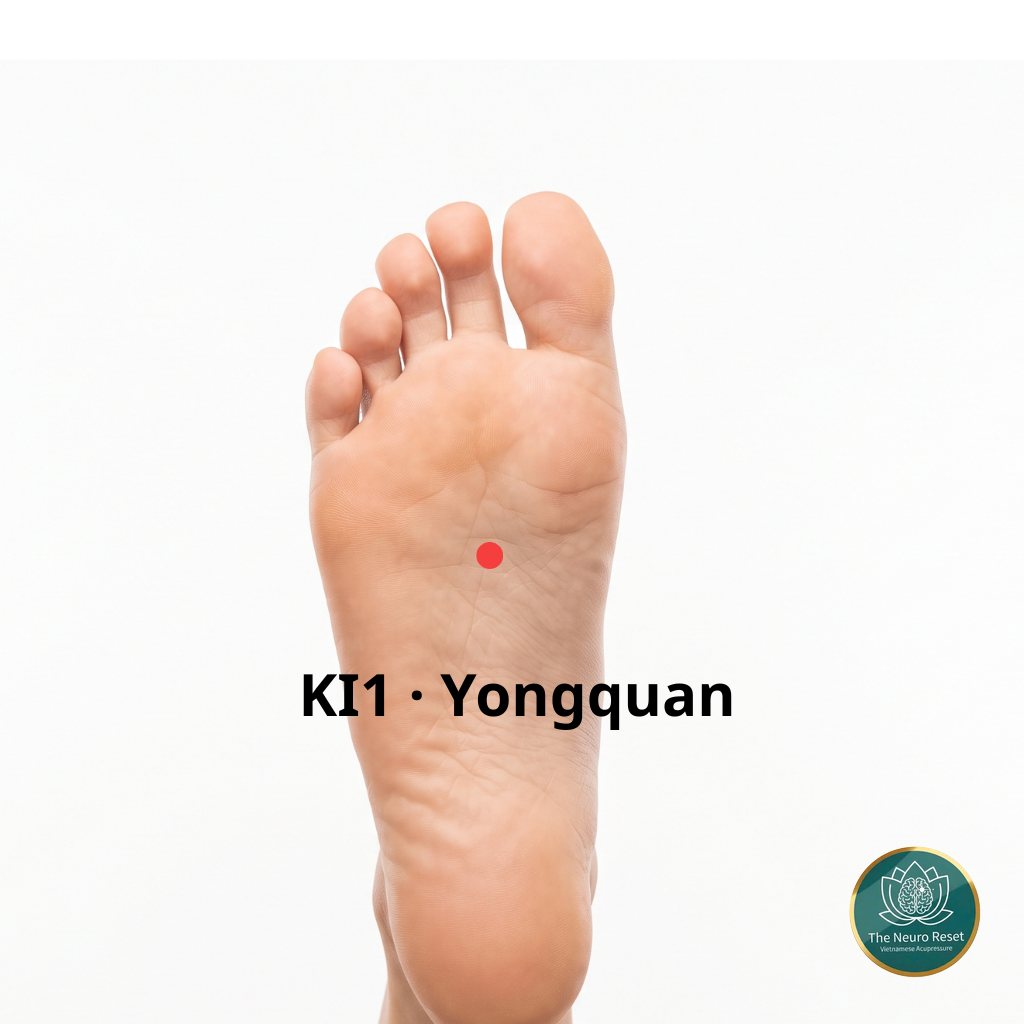
Rest one foot across the other knee, sole toward you. Curl your toes. A hollow appears below the ball of the foot, in line with the second and third toes. Relax the toes and search that hollow for the spot that stings. One to three minutes, then the other foot.
Skip it if the sole has cracks, sores or infection, or if you have poor feeling in your feet.
When you finish: socks on if your feet are cold, lie down, lights off.
How I press the points for restless legs at night
- Find the area. You don't need to land on a pinhead. Get into the right neighbourhood.
- Search for the tender spot. Move your fingertip slowly around the area. One spot will feel sharper than the rest. That's your spot.
- Make small circles on that spot. Use the tip of your thumb, not the soft pad, with your nail short. Circle slowly without sliding away.
Start with about one minute per spot. Build up to two or three over the following nights. It should feel tender while you press and ease once you lift off.
Stop and leave a spot alone if it still hurts after you lift off. The same goes if the pain spreads, or the skin looks swollen, hot or red.
Sore hands, or a long reach to your feet? A smooth, round-ended stick can do the pressing for you. It reaches the calf and the sole without bending far, and it finds the tender spot more easily than a tired thumb.
When to see a doctor about restless legs at night
Restless legs are common, but they are worth a proper look. Please see your doctor if:
- your legs keep you from sleeping most nights, or wear down your days
- your legs started bothering you after a new medicine
- you have kidney disease, diabetes, or are pregnant
- you feel numbness, burning or weakness in your feet or legs
- one leg is suddenly swollen, warm, red or painful — get help the same day
- you take a medicine for restless legs, and the feeling now starts earlier in the day, gets stronger, or spreads to your arms
- you feel low or hopeless most days
Ask about a ferritin blood test while you're there. If any of these fit, start with your doctor. The routine on this page can wait.
For a medical view, read the NHS guide to restless legs syndrome.
The honest timeline for restless legs at night
Some things help on the first night: a short walk, rubbing the calves, a warm cloth, an aisle seat.
The rest is slower. Cutting back evening caffeine and alcohol often shows its effect within a week or two. If low iron is part of the story, your doctor will tell you how long it takes to rebuild. It is often a matter of months.
For the pressing, think about ten minutes each evening for two to four weeks. Some people notice very little. I'd rather you heard that from me now.
What This Won't Do
This won't make restless legs disappear, and nobody honest can promise that. It won't raise your iron or replace a blood test. It won't replace anything your doctor has given you, either. Keep taking exactly what was prescribed. This is something you do in addition. A few calm minutes with your own two hands, so your legs have had their attention before you ask them to lie still.
Short videos on restless legs at night
Two short clips from my channel on the same subject. Each one is under a minute.
Questions people ask about restless legs at night
How do you stop restless legs at night? In the moment, get up and walk a few steps, rub your calves and try a warm or cool cloth. Over time, cut back evening caffeine and alcohol, move during the day and ask your doctor to check your iron. A calm bedtime routine helps many people too.
What is the main cause of restless legs? Often there is no single cause, and it can run in families. Low iron, pregnancy, kidney disease and some medicines are the best-known triggers. Caffeine, alcohol, smoking and poor sleep can make it worse.
What deficiency causes restless legs? Low iron has the strongest link, even when a basic blood test looks normal. Low folate or B12 can play a part in some people. Ask for a blood test before taking any supplement.
Why are my restless legs worse at night? They grow when you keep still, and bedtime is when you keep stillest. Your body clock also plays a part. Dopamine activity and brain iron seem to dip in the evening.
Does magnesium help restless legs? The research is mixed. Some people say it helps, and others notice nothing. Magnesium isn't safe for everyone, especially with kidney problems, so ask your doctor first.
Are restless legs the same as leg cramps? No. A cramp is a sudden, hard, painful knot in the muscle that eases when you stretch it. Restless legs are an urge to move, with a crawling or pulling feeling, and moving makes them better.
Can acupressure help restless legs? Research is limited to small studies, mostly in people on kidney dialysis, where leg symptoms eased. Many people find a few minutes of pressing before bed settling. Use it as one part of your evening, not instead of seeing your doctor.
Should I press points when my legs wake me at night? I don't. I press in the daytime and before bed. At night, get up and walk a few steps, rub the calves and keep the lights low.
I have spent fifteen years studying traditional Vietnamese medicine, and I write about things you can do for yourself at home, sitting down.
This is general wellness education, not medical advice. It is not a substitute for care from your doctor. If you have a health condition, are pregnant, or take medication, check with your doctor first.
(Points shown: BL57 Chengshan, GB34 Yanglingquan, ST36 Zusanli, SP6 Sanyinjiao, KI1 Yongquan.)