Numb Feet at Night? 6 Pressure Points to Press Along
It's late. You're in bed, the lamp is off, and your feet start to buzz. Pins and needles in the toes. Or the soles feel like cotton wool, as if they belong to someone else. In the morning, the first steps on the stairs feel unsure.
This page is the written version of my 14-minute press-along video. If you'd rather read than watch, everything is here, in the same order. Six spots, from above the knee down to the sole: above the knee (ST32), below the outer knee (GB34), the outside of the shin (GB36), a slow stroke around the inner ankle from the Vietnamese Dong Ung method, the outside of the heel (BL61) and the hollow on the sole (KI1). All done sitting down.
Numb feet at night: the short answer
| Question | Answer |
|---|---|
| Why do my feet go numb at night? | The nerves to your feet are the longest in your body. Pressure, lying still, and irritated nerves show up there first. At night you also notice it more. |
| Is it serious? | Often it comes and goes and is harmless. New, spreading or one-sided numbness, sudden loss of feeling, or a sore on the foot needs a doctor. |
| What does the routine involve? | Six spots: Futu (ST32), Yanglingquan (GB34), Waiqiu (GB36), an inner-ankle stroke, Pucan (BL61) and Yongquan (KI1). About one minute each, sitting. |
| How hard do I press? | Gently. With numb feet you may not feel how hard you press, so watch the skin. Hunt for the spot that stings. That's the one. Stay on it. |
| When will I feel a difference? | Some people notice the floor feels a little clearer right after. Steady change, if it comes, takes weeks. |
Press along with me: the video for numb feet at night
This page is the written version of the video below. Watch it and press along with me, or read the steps further down. Pause any time.
Numb Feet at Night? Pressure Points to Press Along · Watch on YouTube
Why do my feet go numb at night?
Think of the nerves in your legs as long telephone wires. They run from your lower back all the way to your toes. They are the longest wires in the body. When something presses on a wire, or the wire itself is tired, the line crackles. That crackle is the tingling. When the line goes quiet, that's the cotton-wool feeling.
Night makes it worse. You lie still for hours, and a crossed leg or a tight sheet over the toes can press on a nerve the whole time. Your calves stop moving, so blood moves slowly through the feet. And the house is quiet, so the buzzing gets all your attention.
Some causes need a doctor's eye. Diabetes is the best known. Low vitamin B12, a slow thyroid, a lot of alcohol, and some medicines can also irritate the nerves. So can a nerve pinched in the lower back. Doctors call long-lasting nerve trouble in the feet peripheral neuropathy. A few quick tests at your doctor's office can check the feeling in your feet.
If your feet also feel cold under the covers, I've written a separate page on cold feet at night. This page is about the numbness and the pins and needles.
Before you start
Sit on your bed or on a chair.
With numb feet, you may not feel how hard you're pressing. So press gently, and watch your skin. If it turns white or red, ease off. Skip any broken skin, sores, rashes, swelling, varicose veins, or places with recent surgery.
If you are pregnant, take blood thinners, or have a pacemaker, talk to your doctor before you start. Keep taking your medication and keep seeing your doctor. This is something you do alongside it.
The routine, point by point
The two spots near the knee are done on both legs at once, with no bending. From the shin down, I go one side at a time, except for the ankle stroke. Each spot gets about one minute.
An easy start for numb legs: above the knee — Futu (ST32)
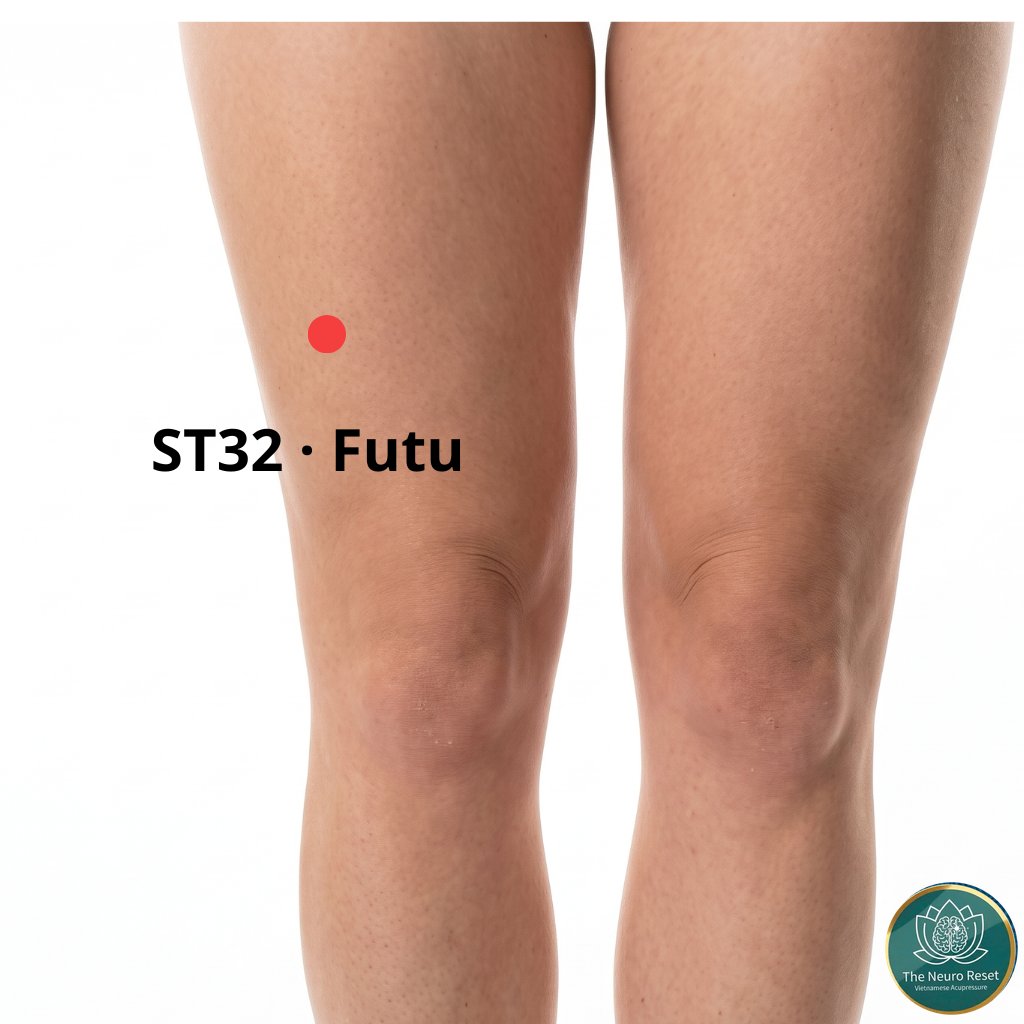
Sit comfortably with your legs relaxed and your feet flat on the floor. Find the top outer corner of your right kneecap (video 0:53).
Lay four fingers flat across your thigh, side by side, right above that corner. Where your top finger ends, lay the four fingers again, one more hand width up. The spot is at the top of that second hand width. It sits on the line from your kneecap up to the bony point at the front of your hip.
Now find the same spot on your left leg. Use your thumbs or fingertips on both thighs at once. Search for the tender spot on each side, then make small, slow circles.
This is a big muscle, so let your fingertips sink in slowly. Breathe out a little longer than you breathe in.
For the outer side of the leg: below the outer knee — Yanglingquan (GB34)
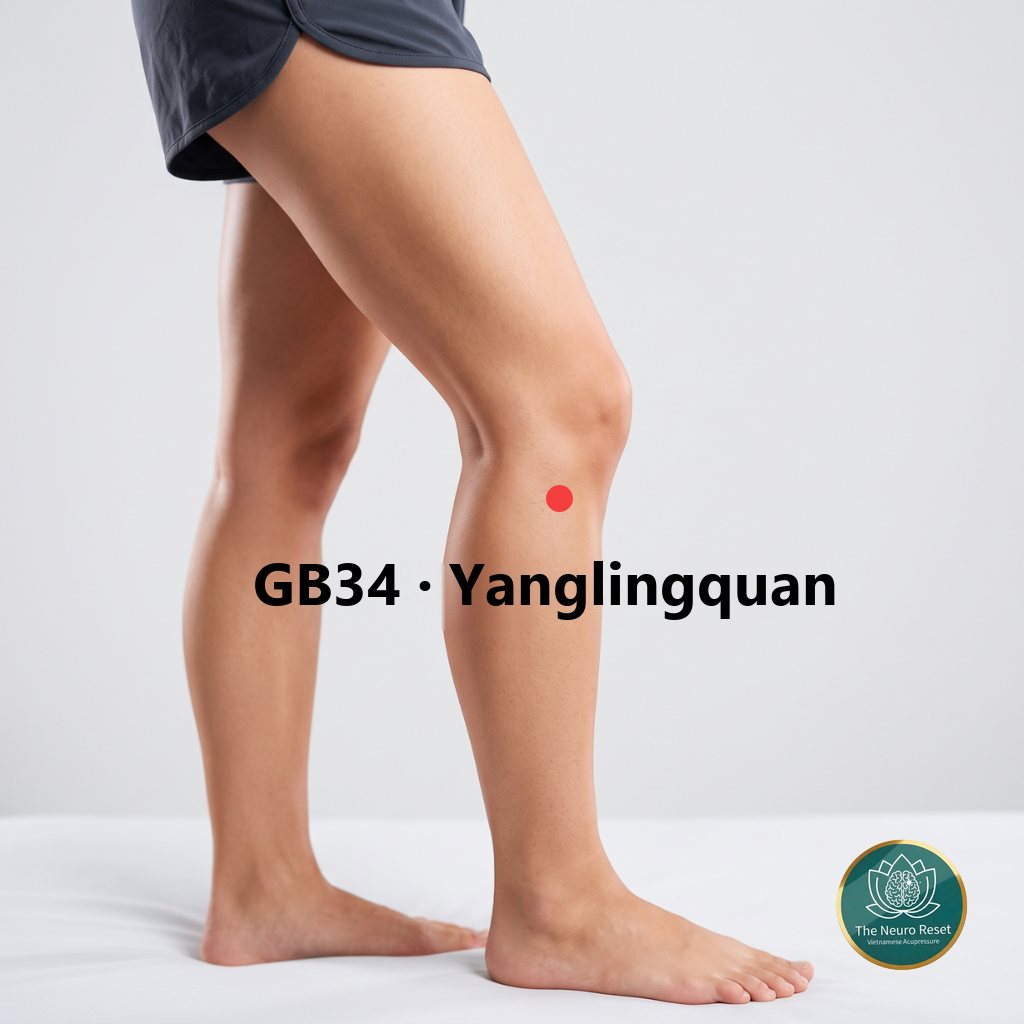
Still no bending. Stay seated, legs relaxed. Rest the palm of your hand over your kneecap, with your fingers curling around the outside of the knee (video 2:21).
Now feel below the knee, on the outside of your leg. There is a small, round knob of bone there. In front of that knob, and a little below it, there is a soft hollow. That is the spot.
Find the same hollow on the other leg, so both legs work at once. Fingertips or thumbs in the hollows. Search for the tender spot, then small, slow circles.
If you feel very little here, that's fine. Don't press harder to feel more. Let your shoulders drop.
For a lower leg that feels far away: outside of the shin — Waiqiu (GB36)
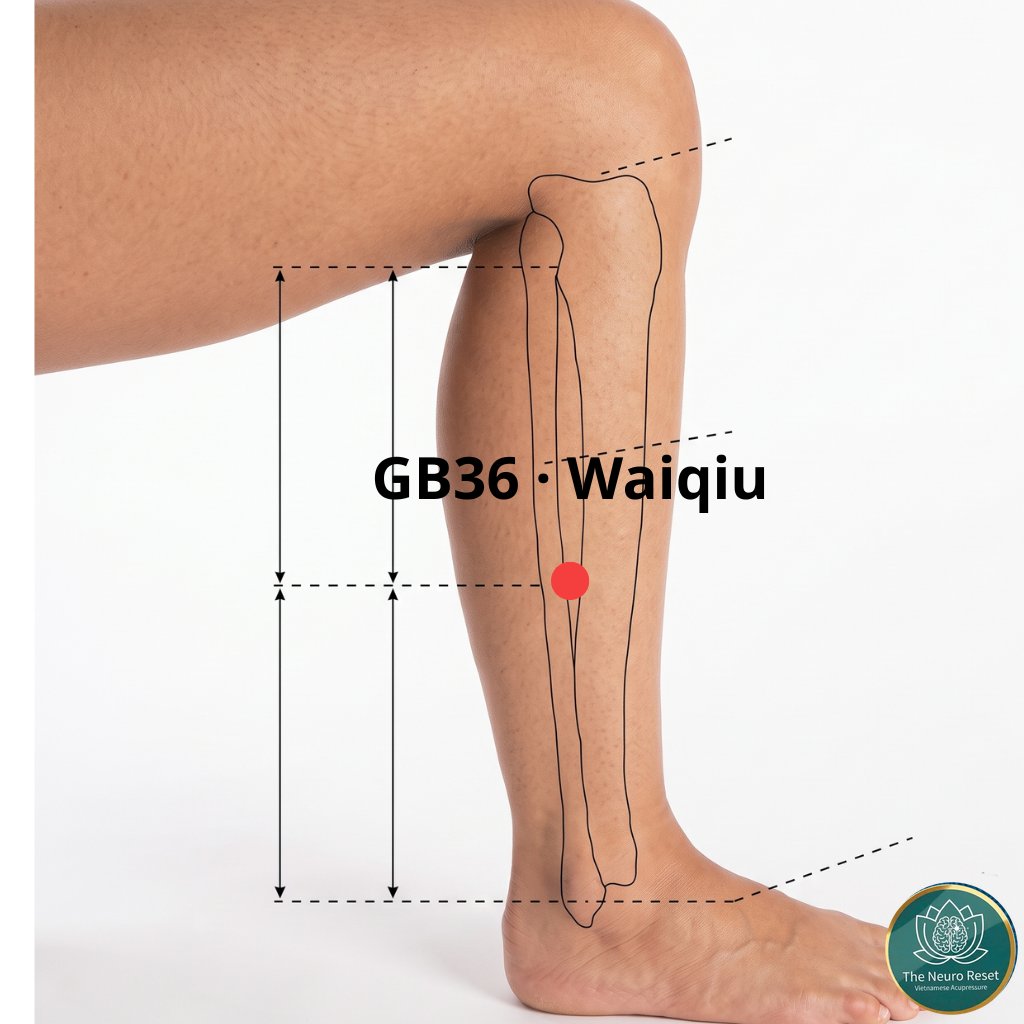
Start with one leg. In the video I begin with the left. Find the bone that sticks out on the outside of your ankle (video 3:45).
Lay four fingers flat across your leg, right above that bone. Lay four fingers again above them, then add one thumb width more. You are now about a third of the way up to your knee. A thin bone runs down the outside of your leg here. The spot is right in front of it.
From here on the spots sit lower, and bending down to them pulls on your back. So I use the small round tip of a wooden stick. If you don't have one, use your thumb tip, gently.
Hold the stick loosely, like a pen. Let the stick do the work, not your thumb. Move the spot, not the skin. After about a minute, lift off and move to the other leg. Measure up from the outer ankle bone the same way.
A slow stroke for the ankle: around the inner ankle — Vietnamese Dong Ung stroke
This one comes from the Vietnamese method I was taught. It is a stroke, not a press (video 6:34).
Put your feet close together in front of you. Find the round bone on the inside of each ankle. Use both hands, one on each ankle. Place the soft pad of your thumb in front of the ankle bone.
Now stroke slowly around and under the bone, following its curve, toward the back of the heel. Lift off, go back to the start, and stroke again. Always in the same direction.
Keep it light, like stroking a cat. Breathe out on each stroke and let your hand stay soft. Skip this one if your ankle is swollen.
For the heel and the outer foot: outside of the heel — Pucan (BL61)
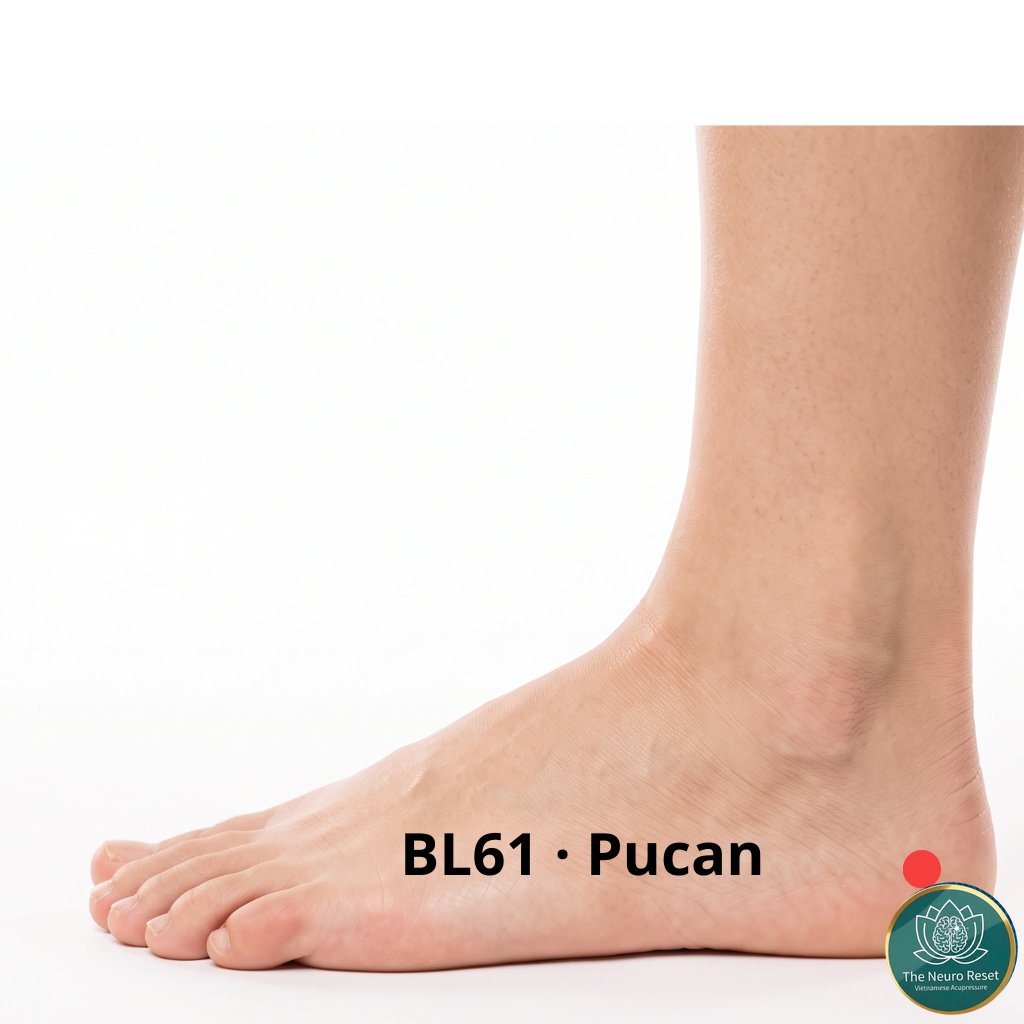
Same small tip of the stick, one foot at a time. In the video I start with the left (video 7:59).
Behind the outer ankle bone is a hollow, before the thick cord at the back of your heel. Go straight down from that hollow until you reach the top edge of the heel bone. There is a small dip there.
While you're here, look at the back of the heel. If there is a crack or a sore, skip that heel today.
Light pressure. Search for the tender spot, then small circles. Glance at your skin as you go. If it goes white or red, ease off a little. Then bring the other foot up and find the same dip.
For soles like cotton wool: the hollow on the sole — Yongquan (KI1)
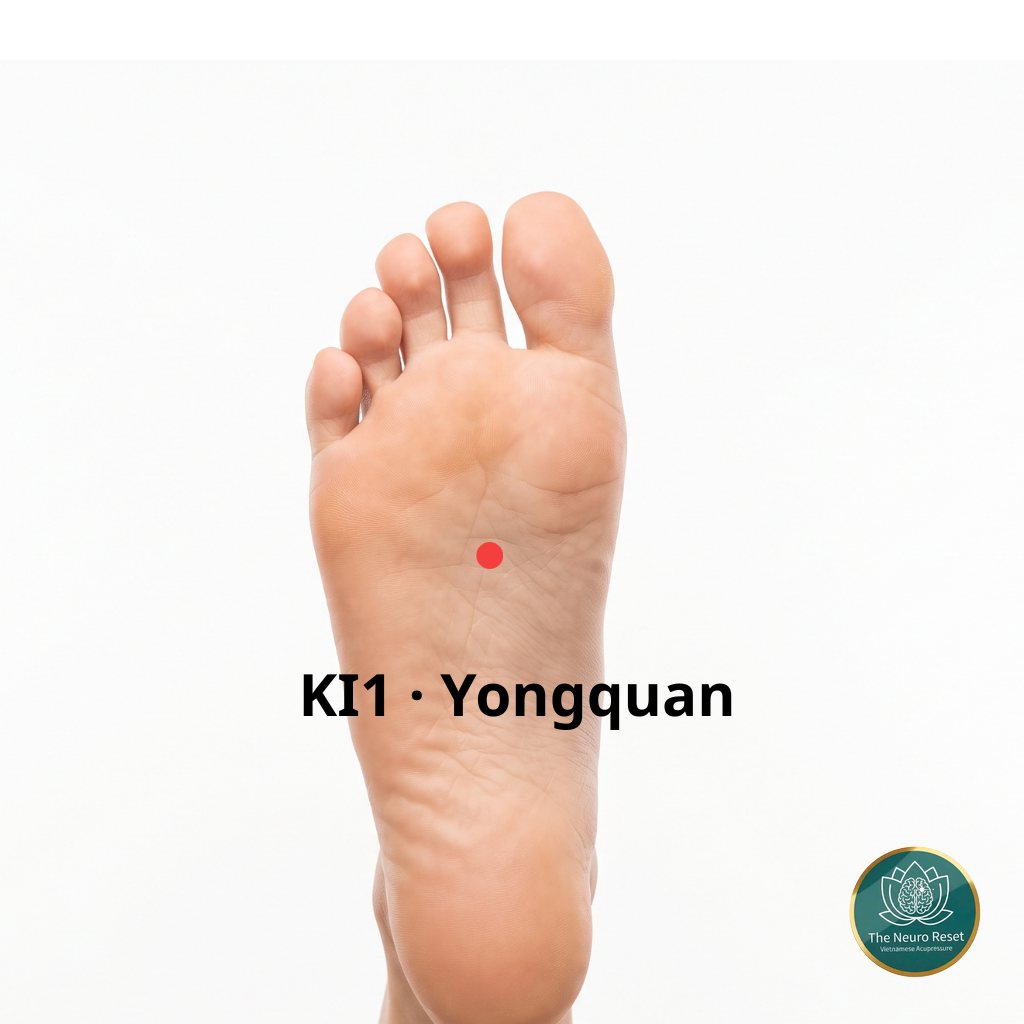
The last one. Stretch your legs out in front of you so you can see the soles of your feet (video 10:30).
Find the ball of the foot, the padded part below your toes. Right below it, in line with your second toe, there is a soft dip. That is the spot.
With a stiff hip, the stick makes this one much easier to reach. One foot at a time. Press gently, then small, slow circles.
Many people notice warmth spreading through the sole here. Others feel very little at first. Both are fine. After a minute, move to the other sole.
When you finish
Put both feet flat on the floor and press them down gently. Many people notice the floor feels a little clearer under the soles (video 13:00).
How I press the points for numb feet at night
- Find the area. You don't need a pinhead. Get into the right neighbourhood using the bony landmarks above.
- Search for the tender spot. Move slowly around the area. One spot will feel a little sharper than the rest. That's your spot.
- Make small, slow circles on that spot. Move the spot, not the skin. About one minute, then lift off.
It should feel tender while you press and ease once you lift off. Hunt for the spot that stings. That's the one. Stay on it. Leave a spot alone if it still hurts afterwards.
If you can't bend down to your feet. A stiff back or hip keeps the feet out of reach. Thumbs get tired and stiff after a minute. And the skin on the sole is thick, so a thumb barely gets through. That's why I use the Neuro Reset Wooden Stick in the video. The small round tip reaches your shin, heel and sole without bending as far. Your hand stays relaxed, and it spares your thumbs. If your thumbs are fine and you can reach, your thumb tip works too.
Three things to keep every day
- Check your feet every day. The tops, the soles, and between the toes. Numb feet don't always tell you about a cut or a blister.
- Wear warm socks and shoes that fit. Loose cuffs, no tight elastic. Shoes that don't rub.
- Talk to your doctor about any new or spreading numbness. Don't wait for it to settle on its own.
When to see a doctor about numb feet at night
Numb feet at night are common, but sometimes they're a message. Please see your doctor if:
- the numbness is new, or is spreading up your feet or legs
- only one foot or one leg is affected
- you have diabetes and notice any change in your feet
- you have a sore, blister or cut on your foot that is slow to close, or that you didn't feel happen
- your feet feel weak, you trip more, or your balance is worse
- the numbness comes with back pain that runs down the leg
Get help straight away if feeling goes suddenly. The same if the numbness comes with weakness in a leg, a drooping face, or trouble speaking. Or if it comes with new trouble controlling your bladder or bowels. Those are emergencies. Call 999 in the UK or 911 in the US.
If any of these fit, start there. The routine on this page can wait.
The honest timeline for numb feet at night
Some people notice something the first time: the floor feels a little clearer, or the soles feel warmer for a while. Steady change is slower. Think about fifteen minutes a day, for two to four weeks. Some notice very little, and I'd rather you heard that from me now.
A small plan helps. When you sit down with your evening cup of tea, then put the video on and press along once.
What This Won't Do
This won't repair damaged nerves. It won't replace your diabetes care, your blood tests, or your foot checks. It won't bring feeling back for everyone. If a doctor is looking after your nerves or your blood sugar, keep doing exactly what was prescribed. This is something you do in addition. A few gentle minutes with your own hands, so your feet feel a little more like yours again.
Questions people ask about numb feet at night
Why do my feet go numb at night? The nerves to your feet are the longest in the body, so pressure or irritation shows up there first. Lying still, crossed legs and tight bedding add to it. Diabetes, low B12 and a slow thyroid are common reasons your doctor will check.
What pressure points help numb feet? In my routine I use six spots: above the knee, Futu (ST32); below the outer knee, Yanglingquan (GB34); the outer shin, Waiqiu (GB36); a stroke around the inner ankle; the outer heel, Pucan (BL61); and the sole, Yongquan (KI1). About one minute each, pressed gently.
Can I do this if I have diabetes? Ask your doctor or foot specialist first. If they agree, press lightly, use the rounded tip of a stick rather than force, and watch the skin. Never press on a sore, a crack or swollen skin, and check your feet every day.
How long until I feel a difference? Some people notice the floor feels a little clearer right after. Steady change usually takes two to four weeks of short daily practice. Some people notice very little, and that's worth knowing too.
How hard should I press on numb feet? Gently. You may not feel how hard you're pressing, so let your skin tell you. If it turns white or red, ease off. Hunt for the spot that stings. That's the one. Stay on it.
What if I can't reach my feet? Start with the two knee spots. Both are done sitting up, with no bending. For the lower spots, a wooden stick with a small round tip reaches the shin, heel and sole without bending as far.
Is numbness in the feet at night a sign of something serious? Often not, especially if it fades when you move. New, spreading or one-sided numbness, sudden loss of feeling, or a foot sore you didn't feel need a doctor.
I have spent fifteen years studying traditional Vietnamese medicine, and I write about things you can do for yourself at home, sitting down.
This is general wellness education, not medical advice. It is not a substitute for care from your doctor. If you have a health condition, are pregnant, or take medication, check with your doctor first.
(Points shown: ST32 Futu, GB34 Yanglingquan, GB36 Waiqiu, inner-ankle stroke from the Vietnamese Dong Ung method (no code), BL61 Pucan, KI1 Yongquan.)