Pressure Points for Sleep: When Pain Wakes You at Night
It's 2:47 a.m. You fell asleep well enough. Now your hip is aching into the mattress, your shoulder is stiff, and a dull ache sits low in your back. You turn over. The ache follows you. The house is quiet, and you are wide awake again.
If that sounds like your nights, you are not doing anything wrong. This page is the written version of my 15-minute press-along video. It's the routine I do before bed, sitting on the edge of my bed: seven points from head to ankles. On the head: between the eyebrows (Yintang, GV29), behind the earlobe (Anmian) and the base of the skull (GB20). On the arms: the wrist crease (HT7) and the inner forearm (PC6). On the ankles: above the inner ankle (SP6) and behind it (KI3). Read it here, or press along with me in the video.
Pain at night: the short answer
| Question | Answer |
|---|---|
| Which pressure points help with sleep? | The seven I use: Yintang (GV29), Anmian, Fengchi (GB20), Shenmen (HT7), Neiguan (PC6), Sanyinjiao (SP6) and Taixi (KI3). |
| When do I press them? | In the evening, right before you lie down. About one minute per spot, roughly 15 minutes in all. |
| Should I press when pain wakes me at 3 a.m.? | No. At night the job is to stay calm and warm. Pressing is for bedtime. |
| Will it stop pain waking me? | I can't promise that. Many people find they settle more easily. Most notice it in the third week, not the third night. |
| Who should ask a doctor first? | Anyone who is pregnant, takes blood thinners or has a pacemaker. |
Press along with me: the video for pain at night
This page is the written version of the video below. Watch it and press along with me, or read the steps further down. Pause any time.
Woken by Pain at Night? 7 Pressure Points for Sleep (15 Min) · Watch on YouTube
Why does pain wake you at night?
During the day, you move. Movement keeps your joints warm and loose. A busy mind also ignores a lot of small aches.
At night, you lie still for hours. One hip or one shoulder takes your weight in the same position. Stiff joints get stiffer. And in the second half of the night, sleep grows lighter. An ache you would sleep through at midnight can be enough to wake you at three.
Then the waking feeds itself. You lie there tense, listening to the pain, and the tension makes it louder. That loop is what this routine works on. It doesn't remove the cause of the pain. It helps your body go quiet and heavy before you lie down, so the night starts from a calmer place.
If you wake without pain, or you're not sure what wakes you, I wrote a separate page on why you wake up in the middle of the night. This page is the routine itself.
How I press the points for pain at night
I have studied Vietnamese acupressure for fifteen years. This is the way I was taught, and the way I press in the video.
- Find the area. You don't need to land on a pinhead. Get into the right neighbourhood.
- Search for the tender spot. Move your fingertip around slowly. One spot will feel a little sharper than the rest. That's your spot.
- Make small circles on that spot. Use the tip of the thumb, not the soft pad. Move the spot, not the skin.
Start with about one minute per spot. In the video I keep the time for you. It should feel tender while you press and ease once you lift off. If a spot still hurts after you let go, leave it alone.
Before you start, a safety check. If you are pregnant, take blood thinners or have a pacemaker, ask your doctor first. Don't press on broken skin, a rash, a swollen joint, varicose veins, or anywhere you've had recent surgery.
The ankles are the hard part. Bending down to your foot pulls on a sore back. And by the last two points, stiff, tired thumbs can end up hurting more than the spot. So on the ankles I use the Neuro Reset Round-End Stick, the small round tip. The stick does the pressing, and your hand stays relaxed. You don't have to bend as far, either. I show it at the end of the video (video 14:09). No stick tonight is fine: your thumb tip works too, gently.
The routine, point by point
Sit on the edge of your bed, feet flat on the floor. Rub your palms together until they're warm. We go from the head down to the ankles, about one minute per spot.
To let the forehead go: between the eyebrows — Yintang (GV29)

Find the flat spot right between your eyebrows, at the top of the bridge of your nose. Use one fingertip and close your eyes. (video 0:41)
Search for the most tender spot, then make slow, small circles on it. If you feel very little at first, that's fine. Let your breath slow down. Breathe out a little longer than you breathe in.
Most of us carry the whole day in the forehead and the jaw. Let your jaw go loose. One minute, then lift off.
For a heavy, sleepy feeling: behind the earlobe — Anmian (extra point)
Put a fingertip on the back of your earlobe. Right behind it you'll feel a firm, bony bump. Slide your finger back off that bump, toward your hairline, into the soft dip behind it. (video 1:53)
Do both sides at the same time, with your thumbs or fingertips. Find the tender spot on each side and make small circles. Move the spot, not the skin.
Many people feel a heavy, sleepy feeling run down the side of the neck here. One minute.
For a tight neck and head: base of the skull — Fengchi (GB20)
Follow the back of your neck up to the bottom edge of your skull. On either side of the middle, a thumb's width out from the two thick neck muscles, there's a hollow. (video 3:08)
Lace your fingers loosely behind your head. Let your thumbs drop into the two hollows. Find the tender spot in each, and circle gently upward toward the skull. Let the weight of your head rest into your thumbs.
If your shoulders are sore, put a pillow on your knees and rest your elbows on it. Your arms shouldn't have to hold themselves up. A deep ache may spread up the back of your head. Let your shoulders drop. One minute.
For a busy mind: wrist crease, little-finger side — Shenmen (HT7)
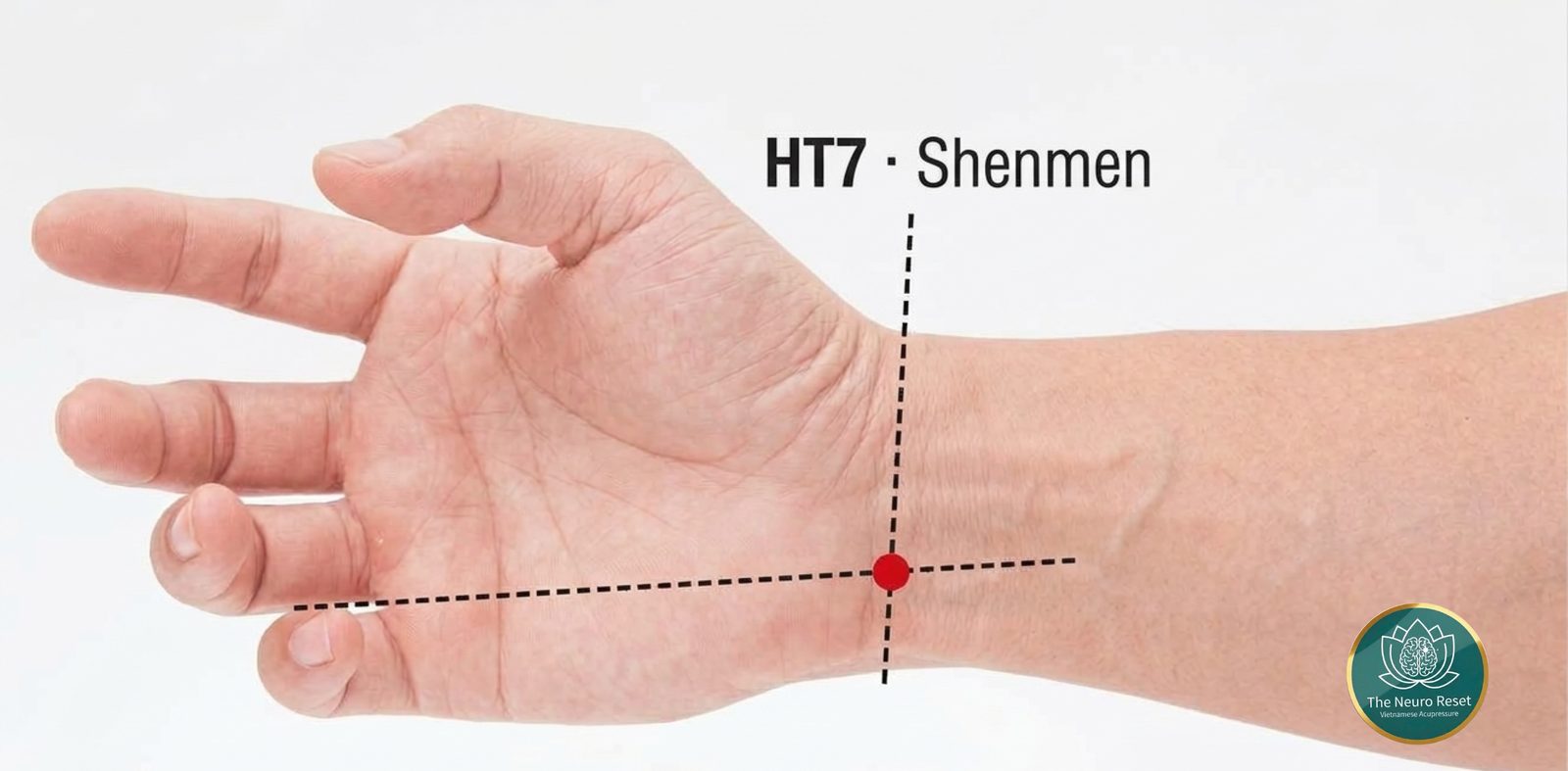
Turn your left palm up. Follow the wrist crease toward the little-finger side until you meet a small round bone. There's a hollow tucked right inside it. (video 4:26)
Use the thumb tip of your other hand. Search for the tender spot, then make small circles. A soft ache that spreads into the hand or the little finger is normal. Notice your breathing. It may already be slower than when you started.
One minute, then lift off and turn your right palm up. Same crease, same little bone, one more minute.
For a restless, unsettled feeling: inner forearm, three fingers up — Neiguan (PC6)
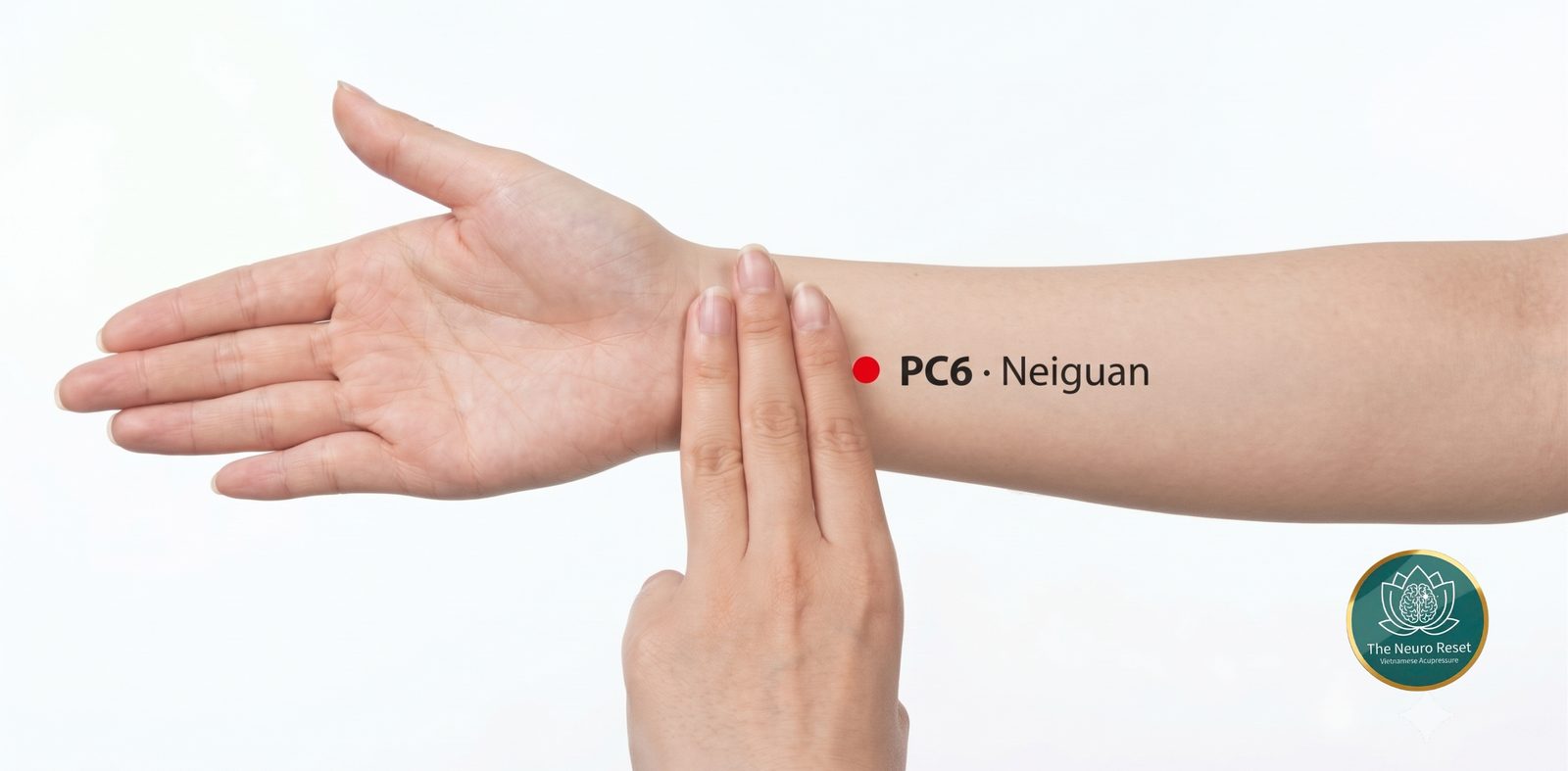
Palm up again. Lay three fingers of your other hand across your wrist, starting at the crease. Where your third finger sits, in the middle of the forearm, you'll feel two cords running up the arm. The spot is between them. (video 6:46)
Thumb tip between the two cords. Search for the tender spot, then small, slow circles. If it buzzes sharply into your fingers, move a little off the cord. A dull ache is what you want.
One minute on each arm.
For the lower legs: four fingers above the inner ankle — Sanyinjiao (SP6)
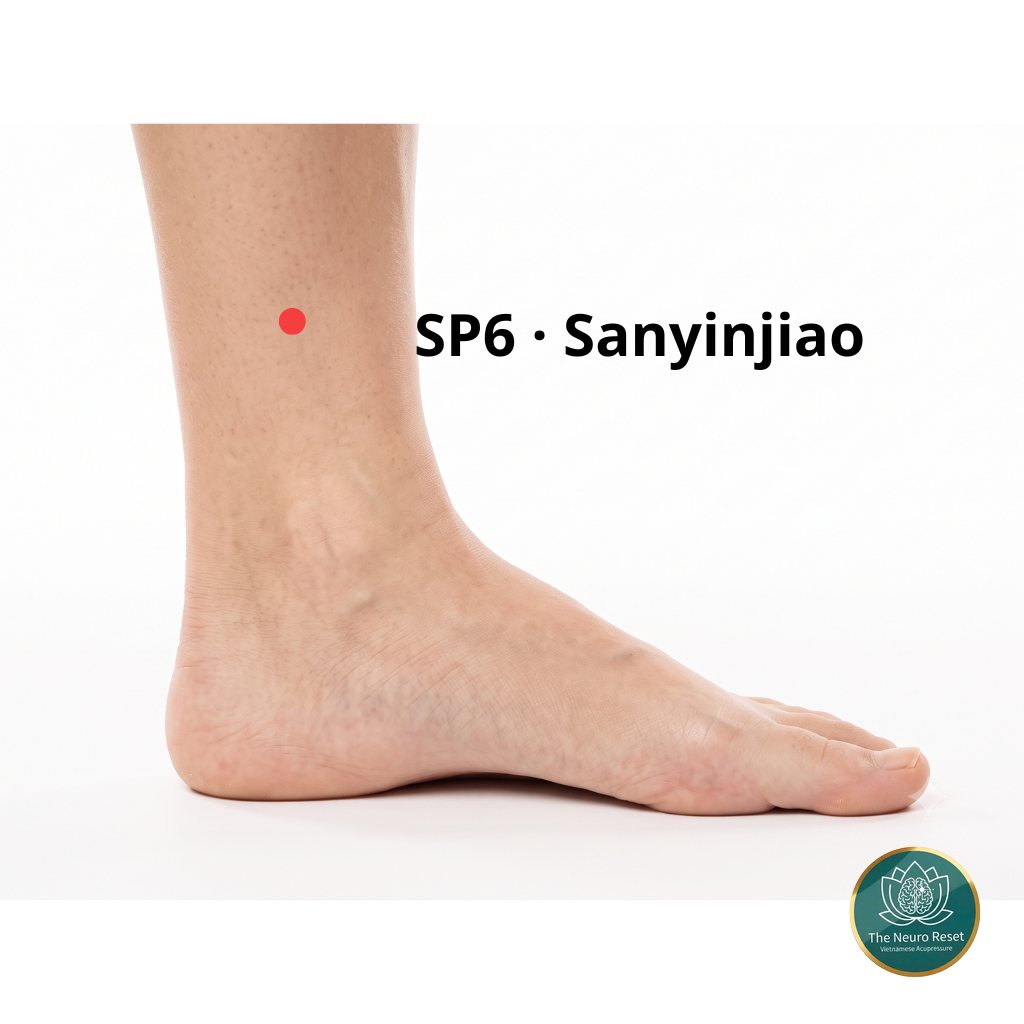
Bring your left foot up onto your right knee, or onto a low stool. Only go as far as is comfortable. Find the highest point of the bone on the inside of your ankle and lay four fingers above it. Above your top finger, behind the edge of the shinbone, there's a slight dip. (video 9:07)
Skip this point if you are pregnant, or if there are varicose veins or swelling there. Skip it too if you have ever had a blood clot in that leg.
Put the small tip of the stick in the dip, or use your thumb tip. This one is often tender, so go easy. Search for the tender spot, then small, slow circles. Hold the stick loosely, like a pen.
A dull ache running down toward the ankle is normal. Many people find this spot more tender than they expected. One minute, then do the other leg.
If you can't reach your feet tonight, stay with the first five points. That's a full routine on its own.
To finish at the ankle: hollow behind the inner ankle — Taixi (KI3)
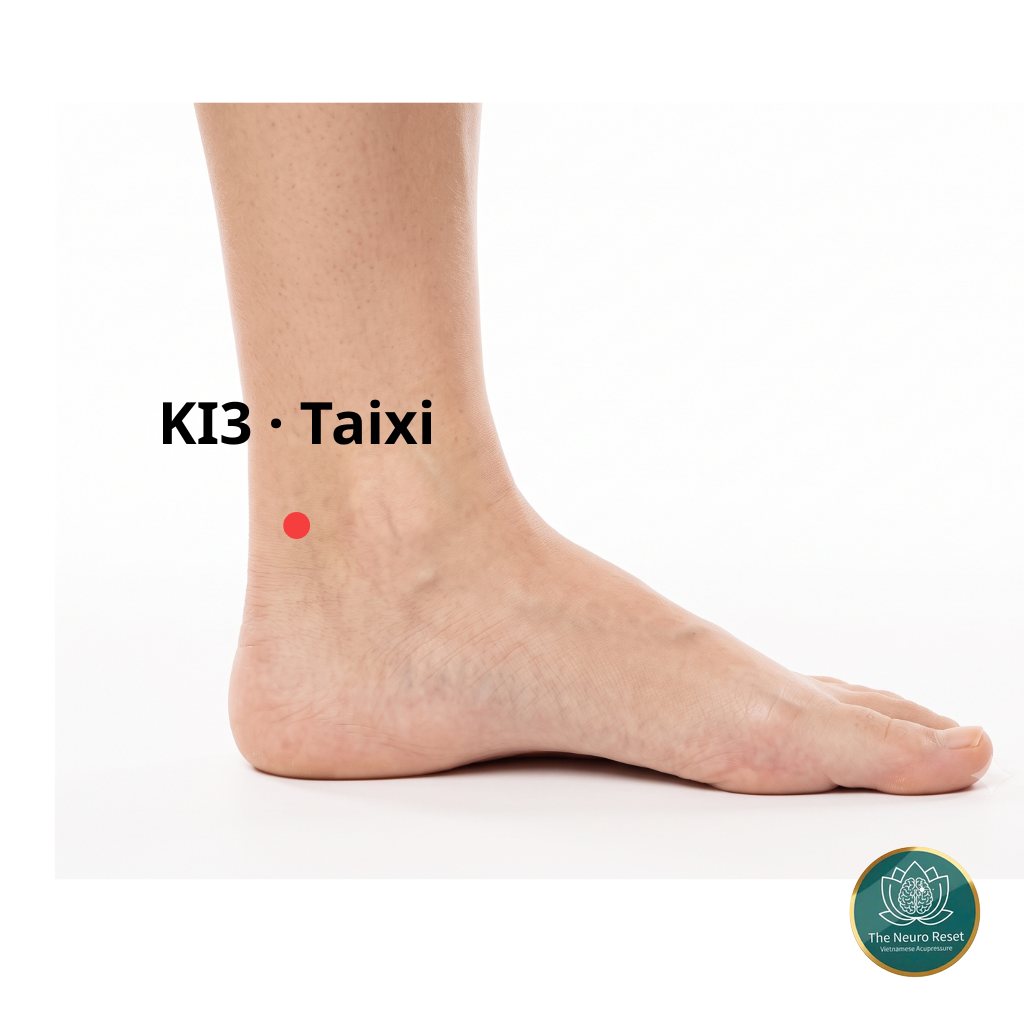
Stay on the same foot. Find the top of the inner ankle bone again. Now find the thick cord at the back of your heel. Halfway between the two, there's a soft hollow. (video 11:46)
This area can be sensitive, so start lightly. Put the small tip of the stick in the hollow, or use your thumb tip. Search for the tender spot, then small circles. You may feel a pulse here. That's normal.
Your hand should feel as easy as your foot. One minute, then swap feet.
When you finish all seven, put your socks on. Warm feet settle more easily. Then lie down, put your phone away, and let your eyes close on their own.
What to do when pain wakes you at 3 a.m.
One rule I keep: I press in the evening, never in the middle of the night. Hunting for a tender spot at 3 a.m. is wake-up work. At night, the job is to stay calm and warm.
- Don't look at the clock. Once you know the time, your mind starts doing sums.
- Breathe out longer than you breathe in. Slow and soft, with no counting.
- Change position gently. If your back is sore, lie on your side with a pillow between your knees.
- Keep your feet warm. Socks back on if they came off. Keep a spare pair by the pillow.
- Bathroom first, slowly. Sit on the edge of the bed for 30 seconds before you stand. Then stand up slowly, one hand on the bed.
Some nights you'll lie awake for a while anyway. That isn't a failure. It's a night.
When to see a doctor about pain at night
Night pain is common. But some patterns need a doctor, not a routine. Please see your doctor if:
- pain wakes you every night and is getting worse week by week
- you are losing weight without trying
- the pain comes with a fever, chills or night sweats
- numbness, tingling or weakness spreads down an arm or a leg
- a joint is red, hot or swollen
- poor sleep has lasted for months
Get help straight away if you wake with chest pain or you're short of breath. The same goes for back pain with sudden loss of bladder or bowel control. That is an emergency.
If any of these fit, start there. The routine on this page can wait.
The honest timeline for pain at night
Some people notice something on the first night: a heavier head, slower breathing, shoulders that drop. Not everyone does.
Steady change takes longer. Most people notice something in the third week, not the third night. So give it about three weeks of evenings, the same seven points in the same order. Some people notice very little, and I'd rather you heard that from me now.
Tonight, when you sit on the edge of your bed, try the routine once with the video. Which spot was the most tender for you? Tell me in the comments under the video. I read them.
What This Won't Do
This won't remove arthritis, a worn disc or an old injury. It won't promise you a full night's sleep, either. If a doctor is looking after your pain or your sleep, keep taking exactly what was prescribed. This is something you do in addition. A quiet routine with your own hands, so the night starts from a calmer place.
Questions people ask about pain at night
What pressure points help you sleep? The seven in this routine. Three on the head: between the eyebrows, behind the earlobe and the base of the skull. Two on the arms: the wrist crease and the inner forearm. Two on the ankles: above and behind the inner ankle bone. About one minute each, right before bed.
Why does pain wake me up at night? You lie still for hours, so stiff joints get stiffer and one hip or shoulder takes your weight. Sleep also grows lighter in the second half of the night. An ache you would sleep through at midnight can wake you at three.
Should I press points when I wake at 3 a.m.? I don't. Searching for a tender spot wakes you up more. At night, breathe out long, keep your feet warm and change position gently. Save the pressing for bedtime.
How long before bed should I do this? Right before you lie down. Sit on the edge of your bed, do the seven points, put your socks on, then lie down. The whole routine takes about 15 minutes.
Is it safe to use pressure points if I take blood thinners? Ask your doctor first. The same goes if you are pregnant or have a pacemaker. Never press on varicose veins, broken skin, a rash or a swollen joint.
What if I can't reach my ankles? Stay with the first five points. That's a full routine on its own. On the ankles I use a round-end stick so I don't have to bend as far, but your thumb tip works too.
How long does acupressure for sleep take to help? Some people feel calmer on the first night. Steady change, if it comes, usually shows in the third week rather than the third night. Some people notice very little.
I have spent fifteen years studying traditional Vietnamese medicine, and I write about things you can do for yourself at home, sitting down.
This is general wellness education, not medical advice. It is not a substitute for care from your doctor. If you have a health condition, are pregnant, or take medication, check with your doctor first.
(Points shown: GV29 Yintang, Anmian (extra point), GB20 Fengchi, HT7 Shenmen, PC6 Neiguan, SP6 Sanyinjiao, KI3 Taixi.)