Why Do I Wake Up in the Middle of the Night and Can't Go Back to Sleep?
It's 3:07 a.m. Your eyes open. The house is silent, the ceiling is dark, and your mind is already wide awake. You were fast asleep an hour ago. Now you'll be lucky to drift off again before the alarm.
If that's your night, you are in very good company. Waking in the middle of the night and not getting back to sleep has a name. It has causes. And there are things you can do about it, tonight and over the next few weeks. This page walks through all of it. At the end are the five pressure points I press on myself before bed: the back of the knee (BL40), the outer knee (GB34), the back of the forearm (TE5), the wrist crease (HT7) and the inner leg above the ankle (SP6).
Waking up in the middle of the night: the short answer
| Question | Answer |
|---|---|
| What is it called? | Sleep maintenance insomnia — or, when it happens toward morning, early morning waking. |
| Is it normal? | Brief wake-ups are normal for everyone. Lying awake for an hour, night after night, is common but worth working on. |
| Why does it happen? | Six usual suspects: age and hormones, habits your brain has learned, things you eat, drink or take, stress, your bedroom, and pain or the bathroom. |
| What to do at 3 a.m.? | Don't check the clock. Breathe out slowly. Stay warm. If you're still awake after about 20 minutes, get up to a dim room until you feel sleepy. |
| What to do before bed? | A calm routine, and about 15 minutes of pressing the points that match your night. |
Press along with me: a video for waking up in the middle of the night
If you would rather watch than read, here I press the points on myself, sitting down. Pause it any time.
Woken by Pain at Night? 7 Pressure Points for Sleep (15 Min) · Watch on YouTube
What is it called when you wake up in the middle of the night?
Doctors call it sleep maintenance insomnia. You fall asleep without much trouble. Staying asleep is the hard part.
When it happens in the last hours of the night, it is also called early morning waking. It has nothing frightening about it. The name only describes when it happens: at the far end of your night, not the beginning.
Is it normal to wake up at night?
Yes. Everyone wakes briefly many times a night. Most of those wake-ups last a few seconds, and you never remember them.
What matters is what happens next. If you roll over and drift off, that's an ordinary night. If you're still lying there an hour later, staring into the dark and counting the hours left, that's the pattern this page is about.
Why do I wake up at 2 a.m. or 4 a.m. every night?
Your sleep comes in waves. The deepest, heaviest sleep is packed into the first half of the night. After that, your sleep grows lighter and lighter, with more dreaming, until morning.
So by 2, 3 or 4 a.m., you're sleeping in the shallow end. A small noise, a full bladder, a stiff hip or a passing worry is enough to bring you to the surface. And once you're up, it's harder to sink back down, because the deep sleep is already behind you.
That's why the clock so often reads the same time. It isn't a curse, and it isn't a sign that something is wrong with you. It's the point in the night where your sleep is thinnest.
Six reasons you keep waking up
1. Age, hormones and your body clock
Sleep changes as we get older. In our sixties and seventies, we tend to get sleepy earlier in the evening, sleep more lightly and wake earlier. Our bodies also make less of melatonin, the hormone that tells the brain it's night.
For women, the years around menopause bring hot flushes and night sweats that can tip you awake. Some people are also built to wake early. It runs in families.
You can't change your genes. But knowing that your body is wired this way takes away some of the worry, and worry is half of what keeps you up.
What helps: staying active during the day, getting outdoors in the morning light, and not going to bed far earlier than you're sleepy. If hot flushes or a supplement such as melatonin are on your mind, talk them through with your doctor.
2. Your brain has learned to be awake at that hour
The brain loves a routine. If, night after night, 3 a.m. is when you lie there frustrated, scroll on your phone or replay tomorrow's worries, your brain quietly files 3 a.m. under "awake time".
It also learns that the bed is a place for tossing and turning, rather than sleeping.
What helps: keep the bed for sleep. Go to bed and get up at the same time each day, weekends included. And if you're up in the night, keep it dull and dim. Nothing exciting, nothing stressful, no screens. You're teaching your brain that the small hours are for sleeping too.
3. Things you eat, drink and take
Caffeine lingers for hours, so an afternoon cup can still be at work at midnight. Alcohol makes you drowsy, then wakes you a few hours later as it wears off. A heavy meal late in the evening can do the same.
Some medicines affect sleep too, including some antidepressants, beta blockers, steroids and decongestants.
What helps: keep caffeine to the morning, go easy on evening alcohol, and eat your last big meal a few hours before bed. If you suspect a medicine, don't stop it on your own. Ask your doctor or pharmacist whether the timing can change.
4. Stress and a racing mind
You wake, and before you know it your mind has picked up a worry and is running with it. Money, health, the children, a conversation from three days ago. In the dark, every problem looks twice its size.
What helps: give your worries somewhere to go before bed. Write them down on paper, along with one small next step for each, then close the notebook. Gentle exercise during the day helps too. So does a firm line between the day and the night: no email, no news and no difficult phone calls in the last hour.
5. Your bedroom
Your brain takes its cue to sleep from darkness and from a drop in body temperature. A bright, warm or noisy room works against both.
What helps: a dark, quiet room that feels cool, around 18 to 20 °C (65 to 68 °F). But keep your feet warm. Cold feet make it harder to settle, so keep a pair of socks by the pillow. A warm bath an hour or two before bed helps as well. Your body cools down afterwards, and that cooling is what makes you drowsy.
Dim the lights in the house during the last hour of the evening. In the morning, do the opposite: get outside and let the daylight reach your eyes.
6. Pain, and the bathroom
For many people over sixty, this is the real reason. You don't wake up for no reason. Something wakes you: a sore back, a stiff hip, an aching shoulder you rolled onto, or a full bladder.
During the day, you move, and movement keeps stiff joints from setting. At night you lie still for hours, and the sore places stiffen like glue. Then you turn over, the stiff joint takes your weight, and you're awake.
What helps: change the position that hurts (more on this below), and use the pressing routine before bed for the area that wakes you.
What to do when you wake up in the middle of the night and can't sleep
This is the moment that decides the rest of your night. Here's what I do.
- Don't look at the clock. Once you know the time, your mind starts counting the hours left. The counting keeps you up.
- Breathe out longer than you breathe in. No counting, no technique to get right. Out through the mouth, slow and unhurried, as if you were cooling a cup of tea.
- Change the position that hurts. Sore back or hip? Lie on your side with a pillow between your knees. Sore shoulder? Lie on the other side and rest the sore arm on a pillow you hug. Sore knees on your back? A pillow under them.
- Check your feet. If they're cold, put your socks on.
- Still awake after about 20 minutes? Get up and go to another room with a soft lamp. Sit and do something dull: a book you've read before, folding laundry. Go back to bed when your eyelids feel heavy. This stops your bed from becoming the place where you lie awake and get cross.
If you need the bathroom, sit on the edge of the bed for 30 seconds first. Feet flat, circle your ankles a few times, then stand up slowly with one hand on the bed. A small night light on the way helps you stay half-asleep.
One thing I don't do at 3 a.m.: press points. Searching for a tender spot and working it is wake-up work. At night, the job is the opposite. I keep all my pressing for the daytime and for bedtime.
How to break the cycle of waking up in the middle of the night
One good night won't break the pattern. A few small habits, kept for three or four weeks, usually can.
- The same wake-up time every day, even after a poor night. This anchors your body clock.
- Morning daylight, ideally outdoors, within an hour of getting up.
- Something active every day. A walk counts.
- A wind-down hour: lights low, screens off, worries on paper.
- A bedtime routine your body can recognise, done in the same order each night. Mine is about fifteen minutes of pressing, sitting on the edge of my bed. It's below.
Waking up during the night to pee
Getting up once a night is common, especially after sixty. Getting up again and again deserves a word with your doctor. There can be a cause worth finding, such as the prostate, blood sugar, the bladder or some medicines.
In the meantime, drink most of your fluids earlier in the day. Ease off in the two hours before bed, and visit the bathroom last thing. The harder part, for many people, isn't the trip itself. It's getting back to sleep afterwards, and the five steps above are written for exactly that moment.
Before bed: five points I press on myself
I have studied Vietnamese acupressure for fifteen years. This is the short routine I do myself, sitting on the edge of my bed, about ten to fifteen minutes. Start with the point that matches what wakes you, then finish with the two settling points.
If your lower back wakes you: the back of the knee — Weizhong (BL40)

Bend your knee to about a right angle. Wrap both hands around it so your fingertips meet in the hollow behind it. Feel the firm cord on each side. The area is on the skin crease, halfway between them.
Light pressure only here. If you feel a pulse under your finger, move off it. One to three minutes on each leg.
If your hip, side or knee wakes you: the outer knee — Yanglingquan (GB34)

Run your fingers down the outside of your knee until you meet a small, round knob of bone. Slide down and forward from it into the soft dip. Search that dip for the spot that stings. One to three minutes on each leg.
If your shoulder or neck wakes you: the back of the forearm — Waiguan (TE5)

Rest your forearm on your lap, palm down. Lay three fingers across the back of your wrist, starting at the crease. Right above them, between the two bones, is a soft valley. Search it for the tender spot. One to three minutes on each arm.
For everyone: the wrist crease — Shenmen (HT7)
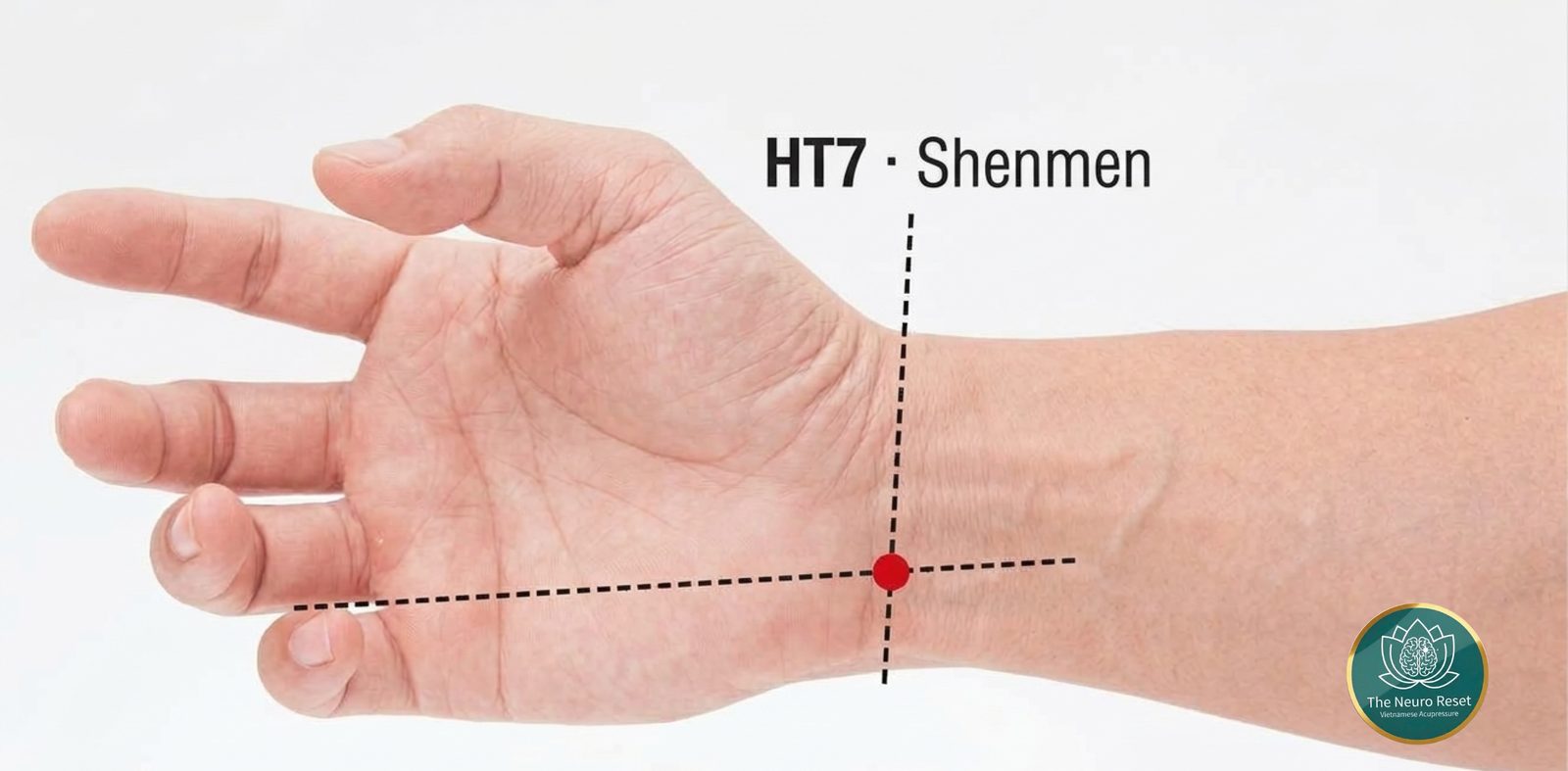
Turn your palm up. Follow the crease at your wrist toward the little-finger side, until your fingertip meets the edge of a small round bone. There's a hollow tucked right inside it. Press with the tip of your other thumb, then swap wrists.
For everyone: above the inner ankle — Sanyinjiao (SP6)

Bring one foot up across your other knee, or onto a low stool. Find the highest point of the bone on the inside of your ankle and lay four fingers above it. Right above your top finger, behind the edge of the shin bone, is a slight dip. It's often quite tender. Then the other leg.
Skip this point if you are pregnant, or if the skin there has varicose veins, swelling, a rash or a wound.
When you finish: socks on, lie down, phone face down and out of reach.
How I press the points for waking up in the middle of the night
- Find the area. You don't need to land on a pinhead. Get into the right neighbourhood.
- Search for the tender spot. Move your fingertip slowly around the area. One spot will feel sharper than the rest. That's your spot.
- Make small circles on that spot. Use the tip of your thumb, not the soft pad, with your nail short. Circle slowly without sliding away.
Start with about one minute per spot, and build up to two or three over the following nights. It should feel tender while you press and ease once you lift off.
Stop and leave a spot alone if it still hurts after you lift your finger off. The same goes if the pain spreads, or the skin looks swollen, hot or red.
Sore hands? A smooth, round-ended tool can do the pressing for you, and it finds the tender spot more easily than a tired thumb.
When to see a doctor about waking up in the middle of the night
Broken sleep is common, but sometimes it's a message worth listening to. Please see your doctor if:
- poor sleep has gone on for months, or is wearing down your days
- you snore loudly, gasp, or someone has seen you stop breathing in your sleep
- you wake with chest pain or short of breath
- you get up to pass water several times every night
- you feel low, flat or hopeless most days — early waking and low mood often travel together
- pain wakes you that is new, getting worse, or comes with fever, night sweats or weight loss
If any of these fit, start there. The routine on this page can wait.
For a medical view, read Johns Hopkins Medicine on waking up in the middle of the night and getting back to sleep.
The honest timeline for waking up in the middle of the night
Some things work on the first night: not checking the clock, warm feet, a pillow in the right place.
The rest is slower. Most people who keep a steady routine notice a change in the third week, not the third night. For the pressing, think about fifteen minutes each evening for two to four weeks. Some people notice very little, and I'd rather you heard that from me now.
What This Won't Do
This won't give you eight unbroken hours, and nobody honest can promise that. It won't replace anything your doctor has given you, either. Keep taking exactly what was prescribed. This is something you do in addition. A routine you can do with your own two hands, instead of lying in the dark waiting for the next 3 a.m.
Short videos on waking up in the middle of the night
Two short clips from my channel on the same subject. Each one is under a minute.
Questions people ask about waking up in the middle of the night
Why do I wake up in the middle of the night and can't go back to sleep? After the first few hours, your sleep becomes lighter. Small things such as pain, a full bladder, a noise or a worry then wake you more easily. Age, hormones, stress, caffeine, alcohol and a habit of lying awake at the same hour all make it harder to drift back off.
What does it mean if I wake up at the same time every night? Usually that you've reached the light part of your night, and your brain has learned the habit. It's common, and in most people it isn't a sign of anything serious. If it comes with low mood, loud snoring or pain, mention it to your doctor.
What is it called when you wake up in the middle of the night? Sleep maintenance insomnia. When it happens toward morning, it's also called early morning waking.
What should I do when I wake up in the middle of the night? Don't look at the clock, breathe out slowly, change the position that hurts and keep your feet warm. If you're still awake after about 20 minutes, get up to a dim room and do something dull until you feel sleepy.
Should I press acupressure points when I wake up at night? I don't. I press in the daytime and before bed. Pressing is wake-up work, and at night the job is to stay calm and warm.
Why do I keep waking up during the night to pee? Many things can play a part, including how much you drink in the evening, the prostate, the bladder, blood sugar and some medicines. If it's happening several times a night, ask your doctor to look into it.
Is waking up in the middle of the night a spiritual sign? Some traditions read meaning into it. Most of the time, though, the reasons are practical ones: lighter sleep toward morning, pain, the bathroom, stress or habit. Those are the ones you can do something about.
I have spent fifteen years studying traditional Vietnamese medicine, and I write about things you can do for yourself at home, sitting down.
This is general wellness education, not medical advice. It is not a substitute for care from your doctor. If you have a health condition, are pregnant, or take medication, check with your doctor first.
(Points shown: BL40 Weizhong, GB34 Yanglingquan, TE5 Waiguan, HT7 Shenmen, SP6 Sanyinjiao.)