Can't Bend Over to Put On Socks? Do It Sitting Down
If you can't bend over to put your socks on, the answer is usually not to bend further. It is to bring your foot up to your hands, sitting on the edge of your bed. Here is how I would set it up, what to stop for, and when to call your doctor.
Quick steps: socks on, sitting down
- Sit on the edge of a firm bed, both feet on the floor.
- Bunch the sock into a ring in your lap.
- Rest one foot on a low stool, so it comes up to your hands.
- Lean forward from your hips, with your back long.
- Ring over the toes, heel pocket down, then up and over the heel.
The Moment at the Dresser, Sock in Hand
You sit down with one sock. You lean forward. Somewhere around your knees, your back or your hip says no.
So you try the other foot, or a different angle. Or you hold your breath and go for it. Some mornings it works.
Some mornings you end up asking someone for help. That is the part that stings. If that is your morning, you are not lazy, and you are far from the only one.
Why Bending Is the Sticking Point
Putting on a sock asks three things at once. Your hips have to fold. Your back has to round, and your arms have to reach past your knees.
A stiff hip, a sore back, a knee that will not bend far, or a belly that gets in the way. Any one of these can take a few inches off your reach.
Those few inches are the whole gap between you and your toes. So the plan below does not ask you to bend more. It closes the gap from the other end.
When to Call Your Doctor First
Most stiffness that stops you reaching your feet builds slowly, over months or years. Call your doctor soon if yours is new, or came on fast. Also call if you notice:
- Sudden back or hip pain, especially after a fall.
- New weakness in a leg, or a foot that drags or catches.
- Numbness in the groin area, or changes in bladder or bowel control. Get medical help straight away for these.
- Pain that runs down a leg and is getting worse.
If you have had a hip replaced, ask your surgeon or physiotherapist which positions are allowed before you try anything below. Some people are asked not to cross their legs or bend deeply for a while.
Sit on the Bed Edge: A Reach That Does Not Need a Bend
This is the whole idea. Your hands stay near your lap, and your foot comes up to meet them.
- Sit somewhere firm. The edge of a firm bed, or a sturdy chair with arms. Both feet flat, bottom well back, so you feel steady.
- Bunch the sock first, in your lap. Gather it down until only the toe pocket is left, like a ring. Your fingers do the fiddly part at lap height, not at the floor.
- Bring the foot up. Rest it on a low stool, a step or a sturdy box. A higher stool means a shorter reach.
- Lean from your hips, not your back. Keep your chest long and tip forward from the crease of the hip, as if bowing a little. Stop where it is comfortable.
- Toes first, then the heel. Slip the ring over your toes, draw it up the foot, then ease it over the heel.
If your hip allows it, you can also rest the ankle on the opposite knee. Some people find that easiest. Others find it the hardest of all, so use the one your body agrees with.
Still out of reach? Occupational therapists often suggest a sock aid. It is a flexible sleeve on two long cords: you load the sock in your lap, lower it to the floor, slide your foot in and pull the cords.
A long-handled shoehorn does the same job for shoes. There is no prize for doing it the hard way.
Keep the Heel in View
The heel is where most socks get stuck. If you can see it, you can steer the sock round it.
Turn the sock so the heel pocket faces the floor before your toes go in. Sit in good light. With the foot on the stool, turn it slightly outward, so the inside of the heel faces you.
Socks with a softer, looser top give you more room at the heel. Tight socks fight back.
Stop If the Hip or Back Gives Way
A pull, a stretch, a mild ache that fades: those are fine. A sharp catch, a sudden give, or pain that shoots down a leg is not.
If that happens, stop. Sit up slowly, and try again another day with the foot higher.
If you feel dizzy as you lean forward, sit back and wait until it passes. Then stand up in stages, not in one go.
And never hold your breath to push through. If you have to hold your breath, the foot is still too far away.
While the Foot Is Up: One Spot Worth Knowing
Once your foot rests on the stool, its inside edge faces you. In this tradition, that edge is read as the line of your spine, from the big toe back to the heel.
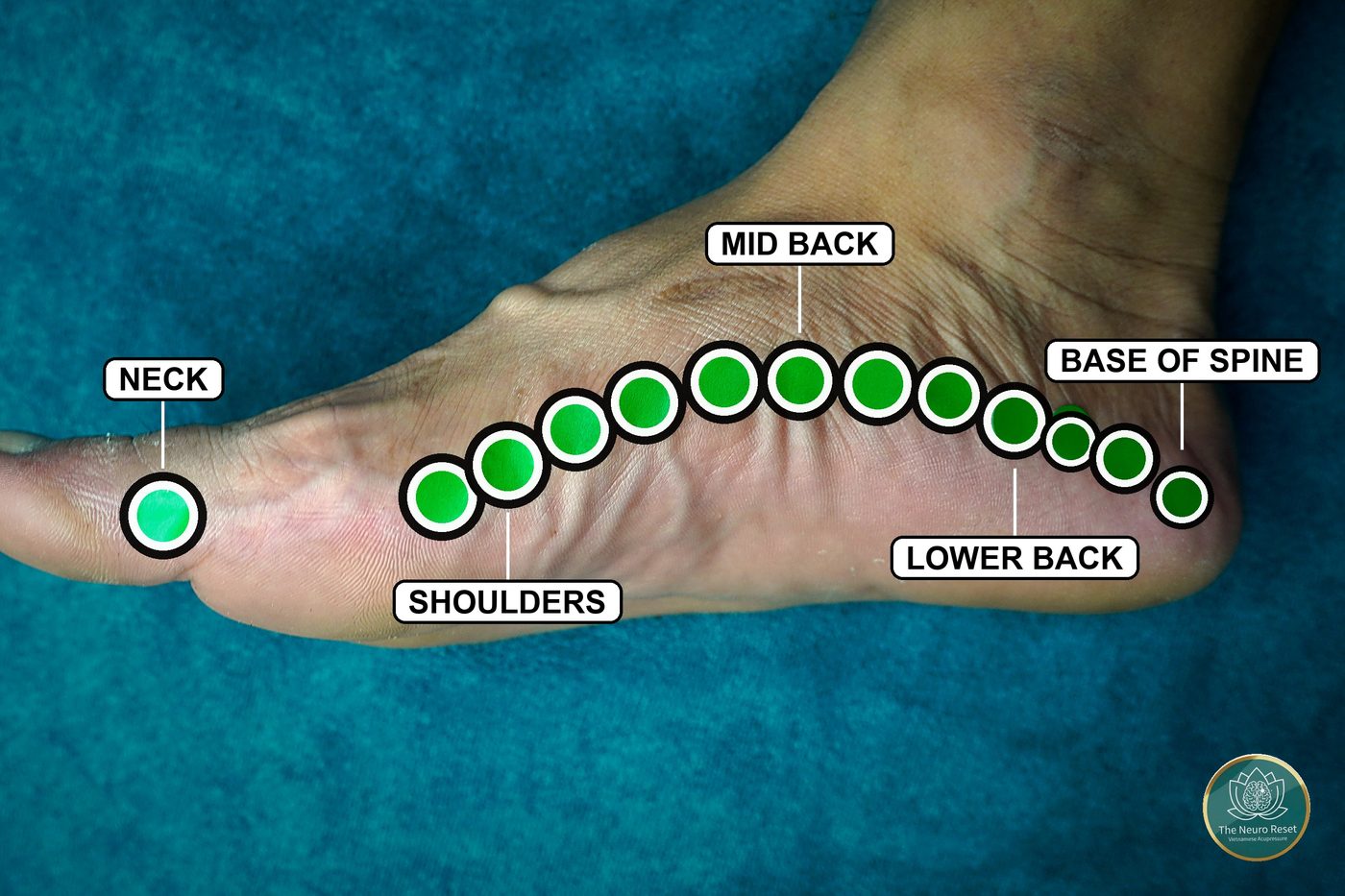
Your back may ache every time you reach. That is a separate job from getting the sock on. If the ache itself is the problem, start with the spot at the top of your arch.
All seven spots along that inside edge are in The Foot Map, with photographs, so you can find each one with your foot on a stool.
What This Won't Do
None of this will loosen a hip overnight. It changes the job, so your body has less to do on a stiff morning.
If reaching your feet keeps getting harder month by month, that is worth a conversation with your doctor or a physiotherapist. You deserve to know why, not only how to work around it.
Questions People Ask
What can I do if I can't bend over to put my socks on? Sit on the edge of a firm bed, bunch the sock into a ring in your lap, and raise your foot onto a low stool so it comes up to your hands. If that is still too far, a sock aid lets you put a sock on without reaching the floor.
Is it better to sit or stand to put socks on? Sit. Standing on one leg to pull on a sock is an easy way to lose your balance. Sit on a firm surface with both feet on the floor before you start.
Why can I reach one foot but not the other? Often one hip, one knee or one side of the back is stiffer than the other. Start with the easier foot, and give the harder one more height on the stool. If the difference is new, mention it to your doctor.
When should I see a doctor about not being able to bend over? If it came on suddenly, followed a fall, or comes with new leg weakness, numbness in the groin area, or changes in bladder or bowel control. Those need a doctor, not a better technique.
I am not a doctor. I have spent fifteen years studying traditional Vietnamese medicine, and I write about things you can do for yourself at home, sitting down.
This is general wellness education, not medical advice. It is not a substitute for care from your doctor. If you have a health condition, are pregnant, or take medication, check with your doctor first.