Lower Back Stiff in the Morning? Why It Happens, and What Helps You Stand Up Straight Sooner
Roll onto your side. Knees together. Push up on one elbow, then on your hand. Swing your feet over the edge. Sit there a moment.
Hand on the bedside table. Stand, but not straight, not yet. Walk to the bathroom bent like a question mark, and lean on the sink while you brush your teeth.
If you just read your own morning, keep reading.
One reader in a chronic pain group put it in a single line: they can "just about get up and get breakfast, washing my teeth holding onto the sink." In a thread where people with worn spinal discs compared where it hurts most, the lower back came up in 22 of the 39 replies I read. "Lower back, knife in the left side, always," one wrote.
You are far from alone. Low back pain affected about 619 million people worldwide in 2020, and the number is expected to keep rising.¹
I won't promise you'll spring out of bed. What most of you want is more modest: to stand up straight a little sooner, to get from the bed to the kettle without holding the furniture, and a first hour that "relaxes my muscles so I can start my day." Here's why the lower back is stiffest first thing, what you already do, and the three spots I press once I'm up.
Why is my lower back so stiff in the morning?
Usually a few things meet at the moment you sit up.
- Your discs fill up overnight. The discs between the bones of your spine lose fluid while you're upright during the day and soak it back up while you lie down. In one MRI study, the lower three discs of the back lost about 16% of their volume over a simulated day.² So in the morning they're at their fullest and tightest. Many people feel that as a back that doesn't want to bend first thing.
- Hours lying still. Muscles and joints that haven't moved for six or seven hours don't like being asked to bend all at once. As one reader put it: "I get stiff laying in one position, then when I move it hurts."
- The mattress. In one trial, the firmness of the mattress made a difference to back pain in bed (more on that below).⁴
- Getting up the hard way. Sitting straight up from flat, like a sit-up, strains the lower back when it's least ready.
- Sometimes it's inflammation. Back pain that came on gradually before 40, eases with movement but not with rest, and brings pain at night that eases once you get up is worth showing to a doctor. Specialists use these signs to spot inflammatory back pain, which is managed differently.⁵
None of this means you're lazy, or "just getting old." Your back is reacting to a night of stillness. The goal is to ease it into the day, not fight it.
What you're probably already doing (and how to make it work harder)
The same things kept coming up in the groups. Keep what works.
1. A hot shower or a heat pad first thing
One reader takes hot water in the morning because it "relaxes my muscles so I can start my day." The research agrees, with limits: a Cochrane review found moderate evidence that a heat wrap gives a small, short-term drop in pain and disability for back pain that has lasted under three months, and that adding gentle exercise brings extra benefit. For longer-lasting back pain, there wasn't enough evidence either way.⁶ Make it work harder: do your easy movements while you're still warm, not an hour later. Use a non-slip mat, and don't sleep on a heat pad.
2. Stretching in bed before you get up
Many people pull their knees to their chest the moment they wake. In a trial of 85 people with long-lasting low back pain, those who were taught simply to avoid bending forward in the first hours after getting up had about a third less pain, while a comparison group given a different set of exercises did not.³ Make it work harder: save the forward-bending stretches for later in the day. For the first hour or so, bend at the knees, not the waist. Put your socks on later, or sitting with your foot on a stool. Keep the kettle and cereal at waist height.
3. The roll-and-push way of getting out of bed
The right instinct. Make it work harder: breathe out as you push up, instead of holding your breath. Then sit on the edge of the bed for a full minute before you stand.
4. Pillows and the mattress
Pillows were a top tip in the groups: one between the knees on your side, one under the knees on your back. On mattresses, a trial of 313 adults with long-lasting low back pain found that those given a medium-firm mattress had less pain in bed and less disability after 90 days than those given a firm one.⁴ Make it work harder: if you're shopping for a mattress, don't assume harder is better.
5. Painkillers and gels
Keep what your doctor prescribed. Make it work harder: ask whether your dose can be timed so it's working when you get up, not after the worst hour.
6. Keeping moving through the day
The best advice in the groups came from people who'd lived with back pain for decades: "PACE yourself." Another reader does "stretches in my chair every hour." Make it work harder: set a gentle timer, so you move a little every hour.
Keep your hot shower. Keep your pillow between your knees. Add this.
What we do in Vietnam: three spots, once you're up
In Vietnam, when someone's back is stiff in the morning, we don't start with the back. We start with the edge of the hand, then the back of the knee, then the outer ankle. Traditional practice has used all three for an aching lower back for a very long time. I have taught this for 15 years, and more than 10,000 people in Vietnam have learned to do it themselves.
Why it may help
- In a trial of 129 people with long-lasting low back pain, one month of acupressure led to less disability than one month of physical therapy, and the difference was still there six months later.⁷
- In a smaller pilot trial, 67 adults with long-lasting low back pain pressed their own points daily for six weeks. Their pain fell by 35–36%, more than in a group carrying on with their usual care.⁸
The limits matter. In the first trial, people knew which treatment they were getting, which can tilt the results.⁷ The second was a pilot, too small to be sure, and it found no difference in disability or sleep.⁸ I won't promise your back will feel twenty again. What readers tell me is that they straighten up sooner, and the first hour is less of a battle.
There's also a plain reason. When you press a spot that stings, you breathe out, and muscles that have braced since you woke start to let go. Rocking gently while you press the hand lets the back move without being asked to bend.
My rule: don't press in bed. Get up, move, then sit and press
Most advice says do something before you get out of bed. I do the opposite. Get up the roll-and-push way, walk around for a few minutes, then sit on the edge of the bed or a firm chair and press. You've had a few minutes of moving, and you're not bending forward to reach your feet while the back is at its stiffest.³ Keep bending to a minimum for that first hour.
How to press, for every spot
Sit on the edge of the bed or a firm chair. Find the area, then hunt for the spot that stings — that's the one. Stay on it, small circles, 1–3 minutes. Use the tip of your thumb with the nail cut short, one slow circle a second. Do both sides. The whole routine takes 6 to 18 minutes.
The outer edge of the hand: Houxi (SI3)
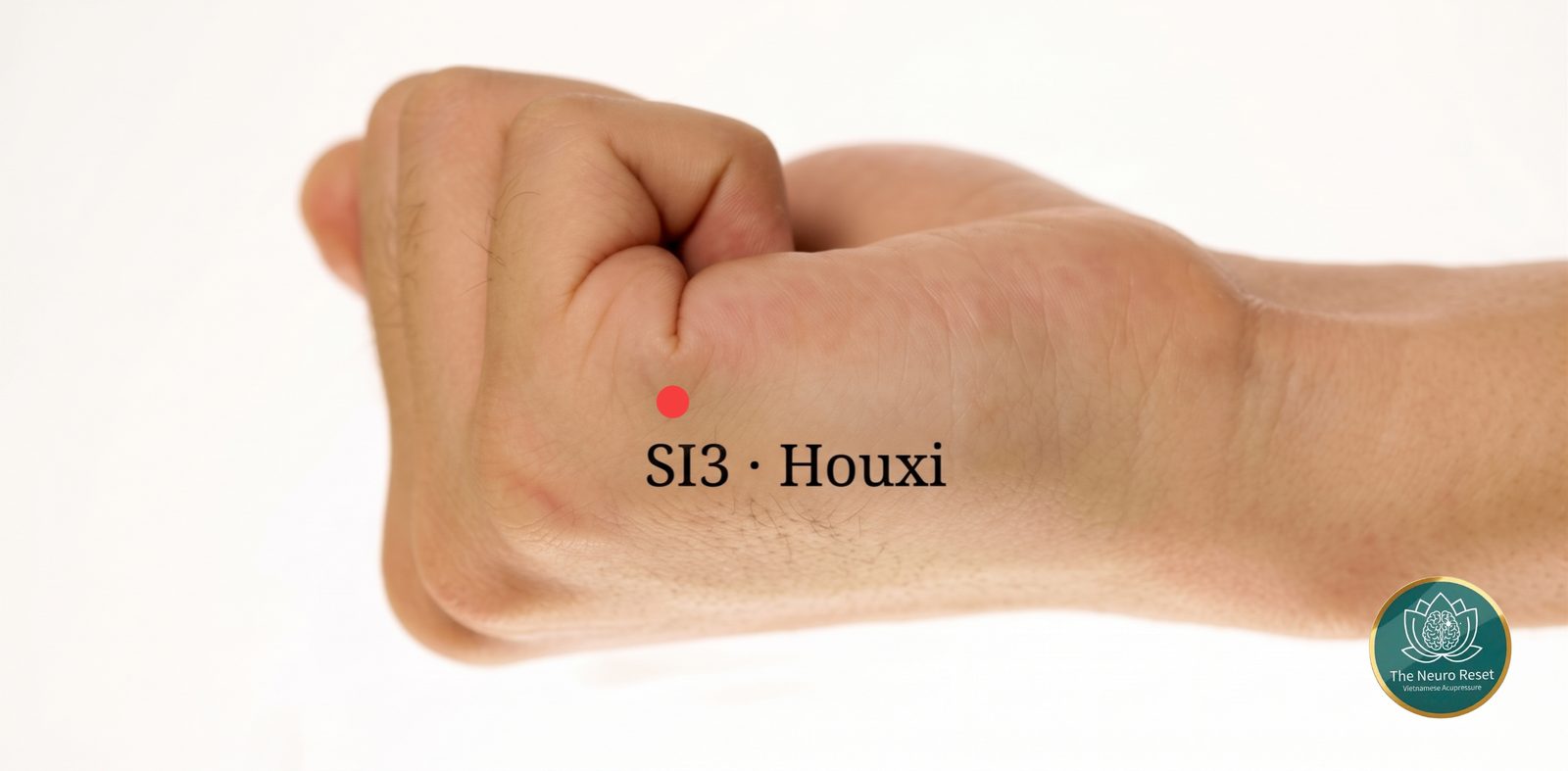
Close a loose fist. A crease forms across your palm, just below the fingers. Follow it outward with your other thumb until it stops at the edge of the hand, behind the knuckle of the little finger. Press there, and while you press, gently rock your lower back forward and back in the chair. Small movements. Each hand.
The back of the knee: Weizhong (BL40)
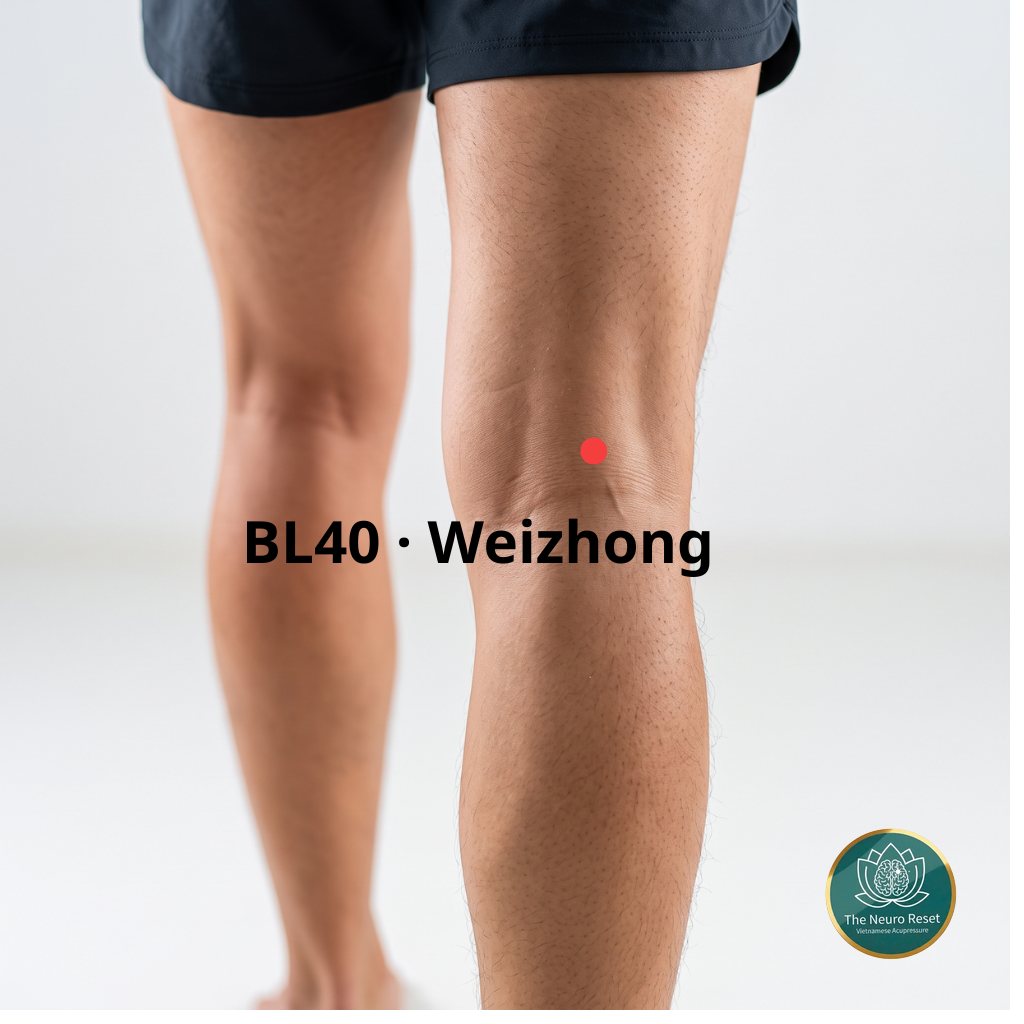
Sit and bend your knee. Feel the firm cord on each side of the hollow behind it. Go to the middle of the crease between them. Light pressure only: this is a soft place. A fingertip is enough. Each leg.
The outer ankle: Kunlun (BL60)
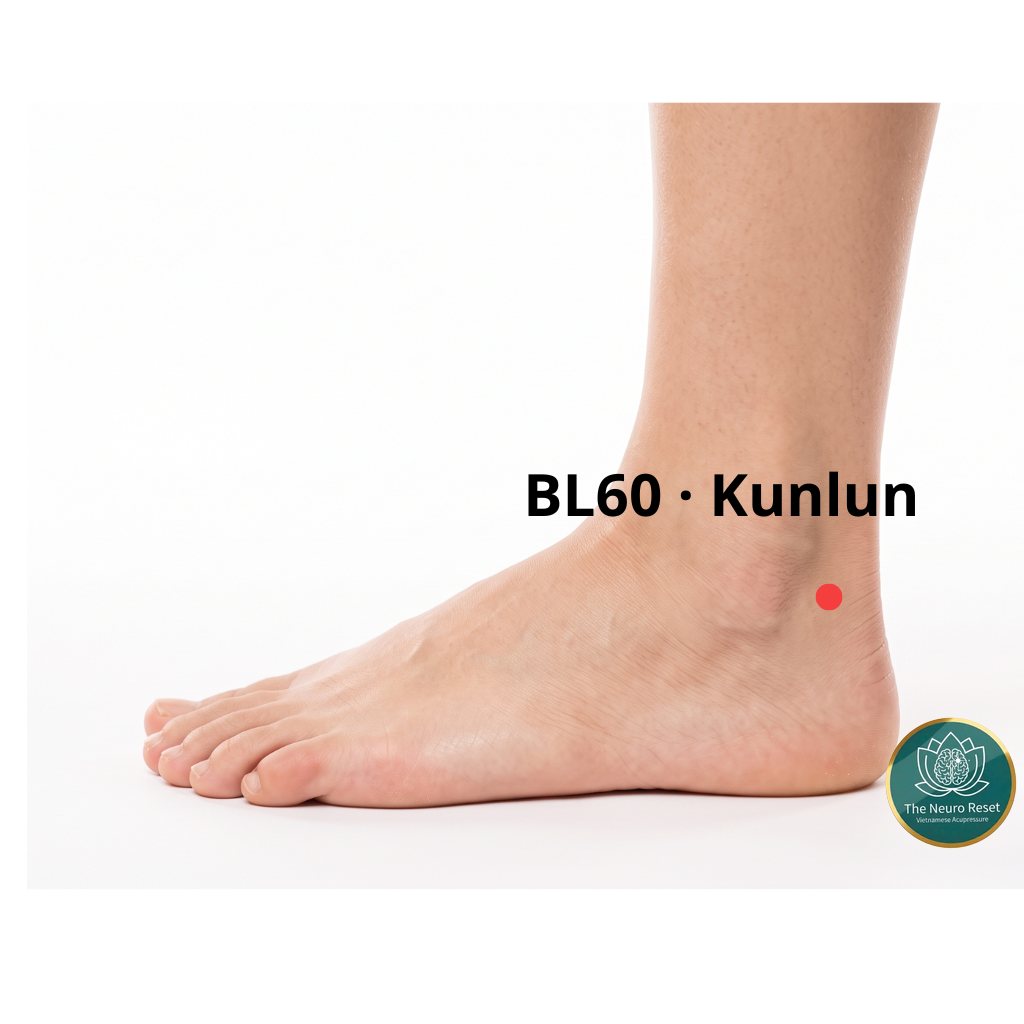
Rest one foot across the other knee if your back allows it, or raise it on a low stool so you don't have to bend down. Find the top of the outer ankle bone, then slide back toward the thick heel tendon and stop in the soft dip halfway between them. Each foot.
Then stand up slowly and walk around the room once. Score your stiffness 0 to 10 before and after, and give it two weeks before you judge it.
When to see your doctor instead
Please get checked, rather than just pressing, if:
- the back pain started after a fall or an accident,
- it comes with a fever, or weight loss you can't explain,
- the pain is worse at night and won't ease, whatever position you try,
- you have numbness, tingling or weakness down a leg,
- the stiffness is long-lasting every morning, eases with movement but not with rest, and started before you were 40.⁵
Get urgent help the same day if you have numbness around your bottom or between your legs, or new trouble controlling your bladder or bowels.
Safety for the spots above: skip Kunlun (BL60) on the outer ankle if you are pregnant, if the ankle is freshly sprained, or if your feet have lost feeling (for example with diabetes) unless your doctor says otherwise. At the back of the knee, Weizhong (BL40), use light pressure only, and leave it alone if you feel a pulse or a bulging vein, have varicose veins or have had a clot in that leg, or the knee is hot and swollen. Don't press over broken, bruised or inflamed skin or a swollen hand. With blood thinners or easy bruising, use the lightest pressure that still finds the sting. Stop if the pain stays after you lift off, spreads, or the area turns swollen, hot or red.
Keep seeing your doctor. This is something you can do between visits.
Frequently asked questions
Why is my lower back stiff in the morning but better once I move?
Your discs take up fluid overnight and are at their fullest when you wake,² and muscles stiffen after hours lying still. Ordinary stiffness eases once you've moved for a while. If it lasts a long time every morning, eases with movement but not rest, or started before 40, ask your doctor about inflammatory back pain.⁵
Should I stretch before getting out of bed?
Not forward-bending stretches. In a trial of 85 people with long-lasting back pain, avoiding bending forward in the first hours after rising reduced pain by about a third.³ Save toe-touches and knees-to-chest for later in the day.
Is a firm mattress better for a stiff lower back?
Not necessarily. In a trial of 313 adults, a medium-firm mattress led to less pain in bed and less disability than a firm one.⁴
What pressure points help a stiff lower back?
In Vietnamese practice: Houxi (SI3) on the edge of the hand while you rock the lower back, Weizhong (BL40) behind the knee, and Kunlun (BL60) at the outer ankle. Trials of acupressure for long-lasting low back pain have found less pain and disability, though they were small.⁷ ⁸
Does heat help morning back stiffness?
A heat wrap gave a small, short-term drop in pain for back pain lasting under three months, and moving afterwards added to it.⁶ Use the warmth, then move while you're warm.
Sources
- GBD 2021 Low Back Pain Collaborators. Global, regional, and national burden of low back pain, 1990–2020, its attributable risk factors, and projections to 2050: a systematic analysis of the Global Burden of Disease Study 2021. Lancet Rheumatology. 2023;5(6):e316–e329. https://pmc.ncbi.nlm.nih.gov/articles/PMC10234592/
- Botsford DJ, Esses SI, Ogilvie-Harris DJ. In vivo diurnal variation in intervertebral disc volume and morphology. Spine. 1994;19(8):935–940. https://pubmed.ncbi.nlm.nih.gov/8009352/
- Snook SH, Webster BS, McGorry RW, Fogleman MT, McCann KB. The reduction of chronic nonspecific low back pain through the control of early morning lumbar flexion: a randomized controlled trial. Spine. 1998;23(23):2601–2607. https://pubmed.ncbi.nlm.nih.gov/9854759/
- Kovacs FM, Abraira V, Peña A, et al. Effect of firmness of mattress on chronic non-specific low-back pain: randomised, double-blind, controlled, multicentre trial. Lancet. 2003;362(9396):1599–1604. https://pubmed.ncbi.nlm.nih.gov/14630439/
- Sieper J, van der Heijde D, Landewé R, et al. New criteria for inflammatory back pain in patients with chronic back pain: a real patient exercise by experts from the Assessment of SpondyloArthritis international Society (ASAS). Annals of the Rheumatic Diseases. 2009;68(6):784–788. https://pubmed.ncbi.nlm.nih.gov/19147614/
- French SD, Cameron M, Walker BF, et al. Superficial heat or cold for low back pain. Cochrane Database of Systematic Reviews. 2006;(1):CD004750. https://pmc.ncbi.nlm.nih.gov/articles/PMC8846312/
- Hsieh LL, Kuo CH, Lee LH, et al. Treatment of low back pain by acupressure and physical therapy: randomised controlled trial. BMJ. 2006;332(7543):696–700. https://pmc.ncbi.nlm.nih.gov/articles/PMC1410852/
- Murphy SL, Harris RE, Keshavarzi NR, Zick SM. Self-administered acupressure for chronic low back pain: a randomized controlled pilot trial. Pain Medicine. 2019;20(12):2588–2597. https://pubmed.ncbi.nlm.nih.gov/31237610/
Reader quotes come from public posts in chronic pain support groups (Nov 2026), shortened, names removed.
P.S. In the Vietnamese foot map, the arch of your foot follows the line of your lower back. My free Foot Map shows you where, with pictures: theneuroreset.com/map/