Why Do My Joints Hurt When It's Cold?
Many people find their joints ache more when the weather turns cold. Nobody has fully explained why, and the research is mixed. Here is what is known, a warm-up to do in bed before you stand, and one hand point, Hegu (LI4), that you can press sitting down.
Quick steps: a cold morning, before you stand
- Still under the covers, circle your ankles slowly, both ways.
- Slide one heel up toward you and back down, then the other.
- Open and close your hands slowly, as wide as is comfortable.
- Roll onto your side, push up with your arms, and sit on the bed edge.
- Press Hegu (LI4) on each hand: five slow breaths, rest one, three times.
The First Cold Morning
The heating has not come on yet. You wake, and your knees feel older than they did last week. Your fingers will not close around the mug.
Nothing has happened to them. No fall, no new strain. Only the first properly cold morning of the year.
Does that sound like your October? You are in good company. "I can feel the weather in my joints" is one of the oldest things people say.
What Is Known, and What Is Not
Here is the honest version. Research on weather and joint pain is mixed, and anyone who tells you it is settled is guessing.
A large UK study asked people with long-term pain to log it on a smartphone every day, matched to their local weather. It found a modest link: more pain on days that were humid and windy, with low air pressure.
A large US study took the opposite route. It looked at older adults' visits to the doctor and found no link between rainy days and visits for joint or back pain.
Both can be true. Weather may change how pain feels for some people, on some days, without sending more of them to the doctor.
As for why, there are ideas, not settled facts. Cold can make muscles and the tissue around a joint feel tighter. Most of us also move less when it is cold, and stillness on its own stiffens a joint. Changes in air pressure are another suggestion, still unproven.
What matters more is what you can do on the morning it happens. If you are reading this in Australia, your cold months are behind you for now. Save this one for May.
When to See a Doctor, Not Press a Point
Cold-weather aches come and go with the season. These do not belong in that group. Check with your doctor if you notice:
- A joint that is hot, red or swollen, especially if it is only one.
- A painful joint with a fever, or feeling generally unwell. Get seen the same day.
- You cannot put weight on a leg, or a joint gives way.
- Pain after a fall or a knock.
- Stiffness that is new, or getting worse week by week.
Warm Up in Bed Before You Stand
The hardest moment is often the first one: feet down, weight on, nothing warmed up. So start before that, still lying down, under the covers.
- Ankles. Draw slow circles with each foot, a few each way.
- Knees. Slide one heel up toward you and back down, slowly, a few times. Then the other.
- Hands. Open and close them slowly, as wide as is comfortable. Then rest them on your belly for a few breaths.
- Sit up in stages. Roll onto your side, push up with your arms, and sit on the edge of the bed for a moment.
- Warm feet first. Socks or slippers on before your feet touch a cold floor.
On cold nights, keep a warm layer within reach of the bed. Many people find warmth helps a stiff joint.
One caution. If any skin has less feeling than it used to, go carefully with hot-water bottles and heat pads. You may not notice when it is getting too hot.
Hegu (LI4): A Sitting-Down Point for Cold, Stiff Hands
Once you are sitting on the edge of the bed, your hands are the easiest place to start. You do not need to reach anything.
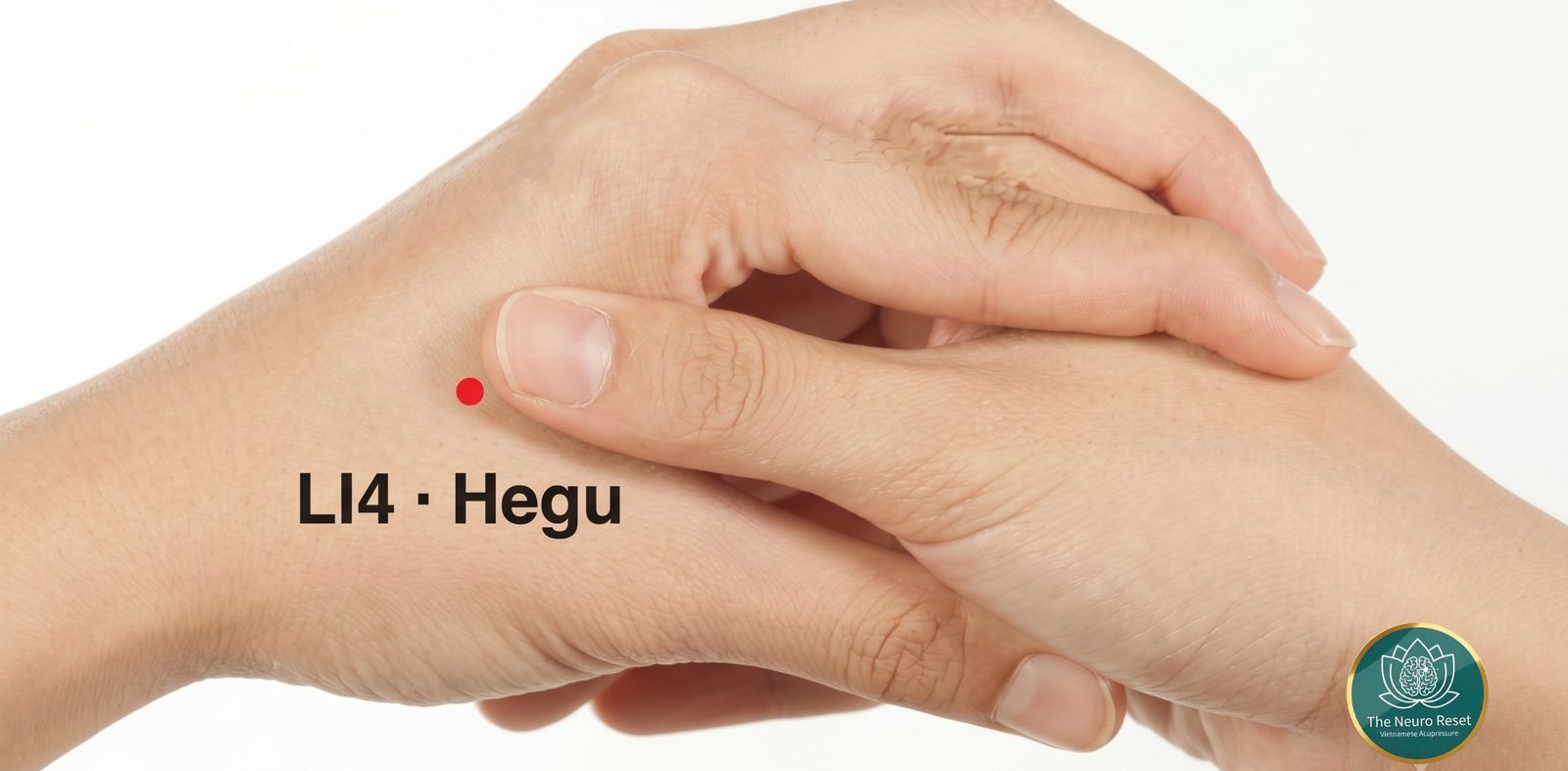
- Get settled. Turn one hand palm down and rest that forearm on your thigh, shoulder dropped.
- Find it. Start at the soft web between your thumb and first finger. Walk your other thumb back from the web, along the long bone of the first finger, to about halfway toward the wrist.
- Press. Roll onto the mound of muscle there and press in, angled toward the bone, until you feel a dull, heavy ache. Never sharp.
- Hold. Five slow breaths, rest for one, and repeat three times. Then switch hands.
In Vietnamese traditional medicine, this spot is commonly used to help ease everyday soreness. I am not going to tell you it changes anything inside the joint.
What it is, is something you can do, sitting down, on the morning your hands feel least like your own. Skip it if you are pregnant, or if the skin there is broken, bruised, hot or swollen.
The full guide, with more on where it sits and why, is on the page for this hand point. The general cautions are on the safety page.
Knees, Heels and the Back
If your knees complain first, there is a knee area on the outer edge of the foot, in the small hollow in front of the heel. Sitting down, hold steady pressure there for five slow breaths, rest for one, and repeat three times on each foot.
If the cold settles in your back, start with back pain relief.
Feet That Stay Cold Are a Separate Story
Feet that stay icy at night, even in socks, are a different question from aching joints. I will cover them in their own article later this season.
Do not wait for that post if one foot is colder or a different colour from the other, or if a sore will not close. See your doctor.
What This Won't Do
None of this changes the weather, and none of it changes what is happening inside a joint. It may take the edge off a cold morning, and it gives you something to do with your own two hands.
Keep taking exactly what your doctor has prescribed. This is something you do in addition.
Questions People Ask
Does cold weather make arthritis worse? Many people with arthritis say so, and some studies find a modest link between weather and pain. Others find none. If your joints ache more in winter, you are not imagining it, but the reason is not settled.
Why do my joints feel worst on cold mornings? Joints often feel stiffest after a night of lying still, and a cold room on waking can add to it. Many people find a slow warm-up in bed, before they stand, makes the first steps easier.
Is it safe to press Hegu (LI4) when my hands are cold and stiff? Generally yes, with a dull ache only, never sharp. Skip it if you are pregnant, or if the skin is broken, bruised, hot or swollen.
Should I use heat on a joint that hurts in the cold? Many people find warmth eases a stiff joint. Take care on skin with less feeling than it used to have. Do not put heat on a joint that is already hot, red and swollen; check with your doctor about that one.
Sources
- Dixon WG and others. How the weather affects the pain of citizen scientists using a smartphone app. npj Digital Medicine, 2019. doi.org/10.1038/s41746-019-0180-3
- Jena AB and others. Association between rainfall and diagnoses of joint or back pain: retrospective claims analysis. BMJ, 2017. doi.org/10.1136/bmj.j5326
- Healthline. Cold weather and joint pain. healthline.com/health/cold-weather-and-joint-pain
I am not a doctor. I have spent fifteen years studying traditional Vietnamese medicine, and I write about things you can do for yourself at home, sitting down.
This is general wellness education, not medical advice. It is not a substitute for care from your doctor. If you have a health condition, are pregnant, or take medication, check with your doctor first.
(Point shown: Hegu, LI4.)