Acupressure Points for Waking at 3 a.m. and Not Getting Back to Sleep
Waking at 3 a.m. and lying there is common, and it is not your fault. The points I use are pressed before bed, not at 3 a.m. They are the wrist crease (HT7), the inner forearm (PC6), between the eyebrows (GV29) and the sole (KI1). In the night, stay lying down, lamp off, and breathe out slowly.
Quick answer
| Question | Answer |
|---|---|
| Which points? | The wrist crease, little-finger end — Shenmen (HT7). Three fingers up the inner forearm — Neiguan (PC6). Between the eyebrows — Yintang (GV29). The hollow on the sole — Yongquan (KI1). |
| When? | In the last half hour before bed, sitting on the bed or lying down before lights out. Not at 3 a.m. |
| How long? | One to three minutes per point, both sides. About ten minutes in all. |
| How hard? | Firm enough to feel it. Hunt for the spot that stings. That's the one. Stay on it. |
| What if I wake at 3 a.m.? | Stay lying down. Eyes closed, lamp and phone left alone. Breathe out longer than you breathe in. |
| What can I expect? | Not an unbroken night. What can change, over two to four weeks, is how long you lie awake afterwards. |
Why I never press at 3 a.m.
This is where my advice differs from many sleep pages. Pressing means searching for a tender spot and working it. A strong sensation in the small hours keeps you on the surface, and tends to wake you further.
The same goes for sitting up, turning on a light, or walking to a cold kitchen. By the time you have done all that, you are properly awake.
So the work happens earlier. You press in the evening, so the body is calmer when it surfaces at three. When it does, you stay still.
At 3 a.m.: what to do instead
- Stay where you are. Don't sit up, and leave the lamp off.
- Leave the clock and the phone alone. Knowing the time starts the sums.
- Breathe out longer than you breathe in. In through the nose for four, out slowly for six or seven.
- Ease anything that aches. A pillow between the knees, or under them, often helps a sore back or hip.
Some nights you will be awake for a while anyway. That is not a failure. It is a night. If you want the reasons people wake, they are on my page about waking up in the middle of the night.
Before bed: four points, in this order
Sit on the edge of your bed with a cushion on your lap, or lie in bed with the lamp still on. Shoulders down, jaw loose.
The wrist crease — Shenmen (HT7)
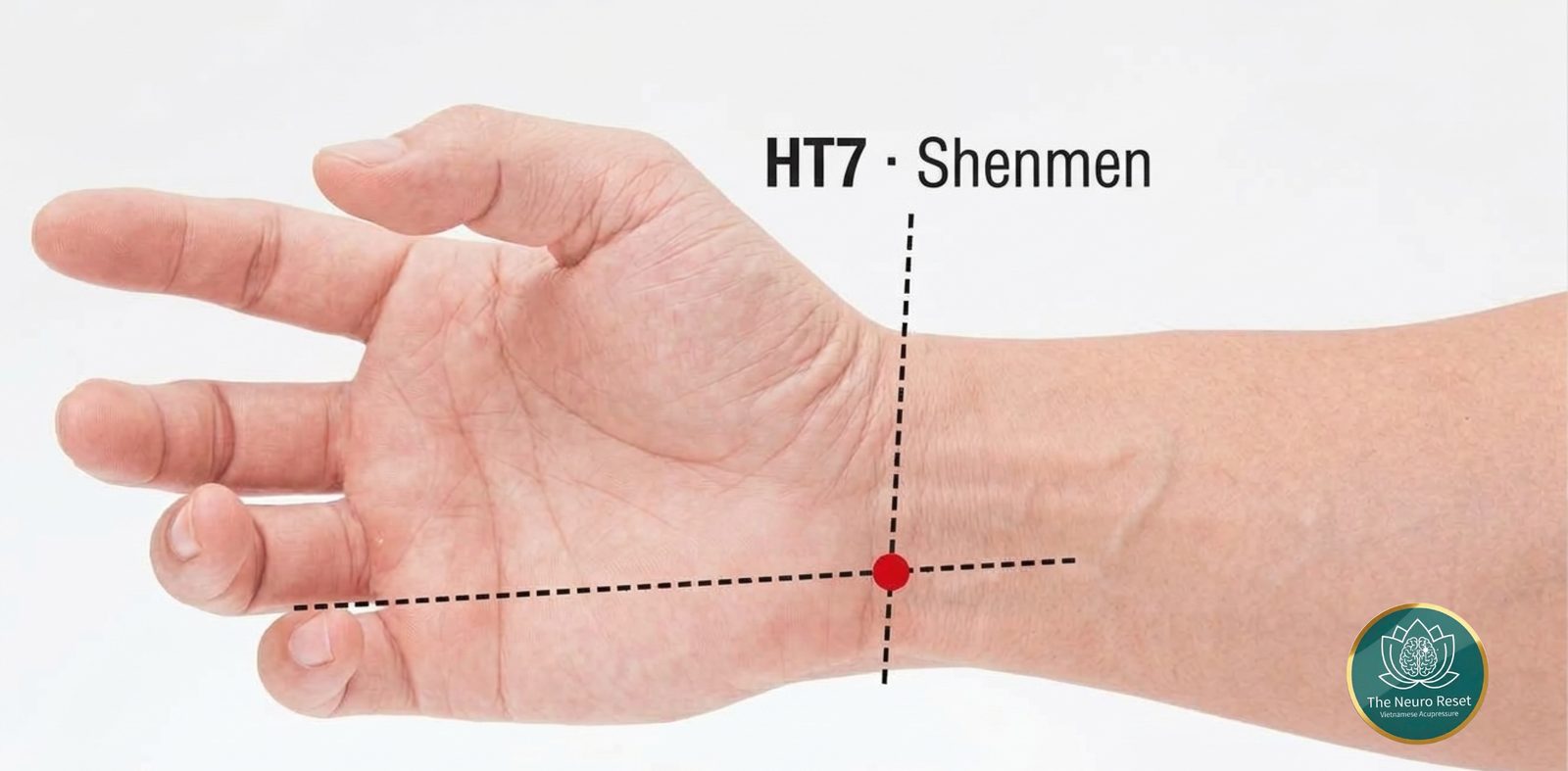
Turn your palm up. Walk your other thumb along the wrist crease toward the little-finger side, until it meets a small round bone. Step back off the bone into the hollow on its thumb side.
Search the hollow for the tender spot, then make small circles for one to three minutes. In this tradition it is the point most often reached for when someone wakes in the small hours. Then the other wrist.
The inner forearm — Neiguan (PC6)
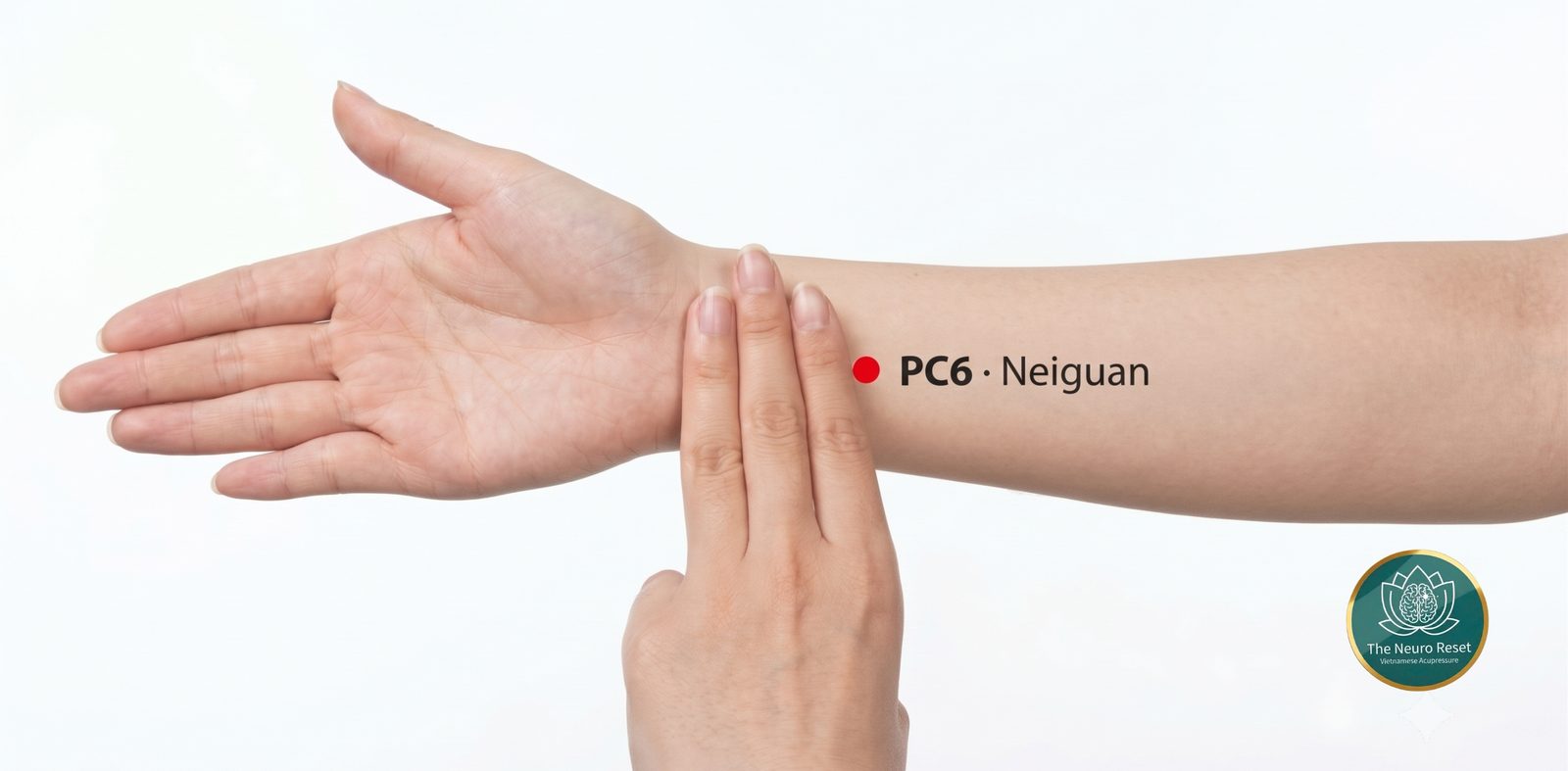
Keep the palm up. Lay three fingers across the wrist crease, pointing up your arm. Where the far edge of the third finger lands is your level.
Cup the hand a little so two cords rise. Search the gap between them for the tender spot. If a tingle runs into your fingers, move a little to the side. One to three minutes, then the other arm.
Between the eyebrows — Yintang (GV29)

Rest your elbows on a pillow or a table so your hand reaches your face without effort. Find the inner ends of your eyebrows and picture a line joining them. Where it crosses the line of the nose is the area.
Press gently into the bone and slightly upward, never sliding down toward the eyes. Small, slow circles, about a minute at first.
The sole of the foot — Yongquan (KI1)
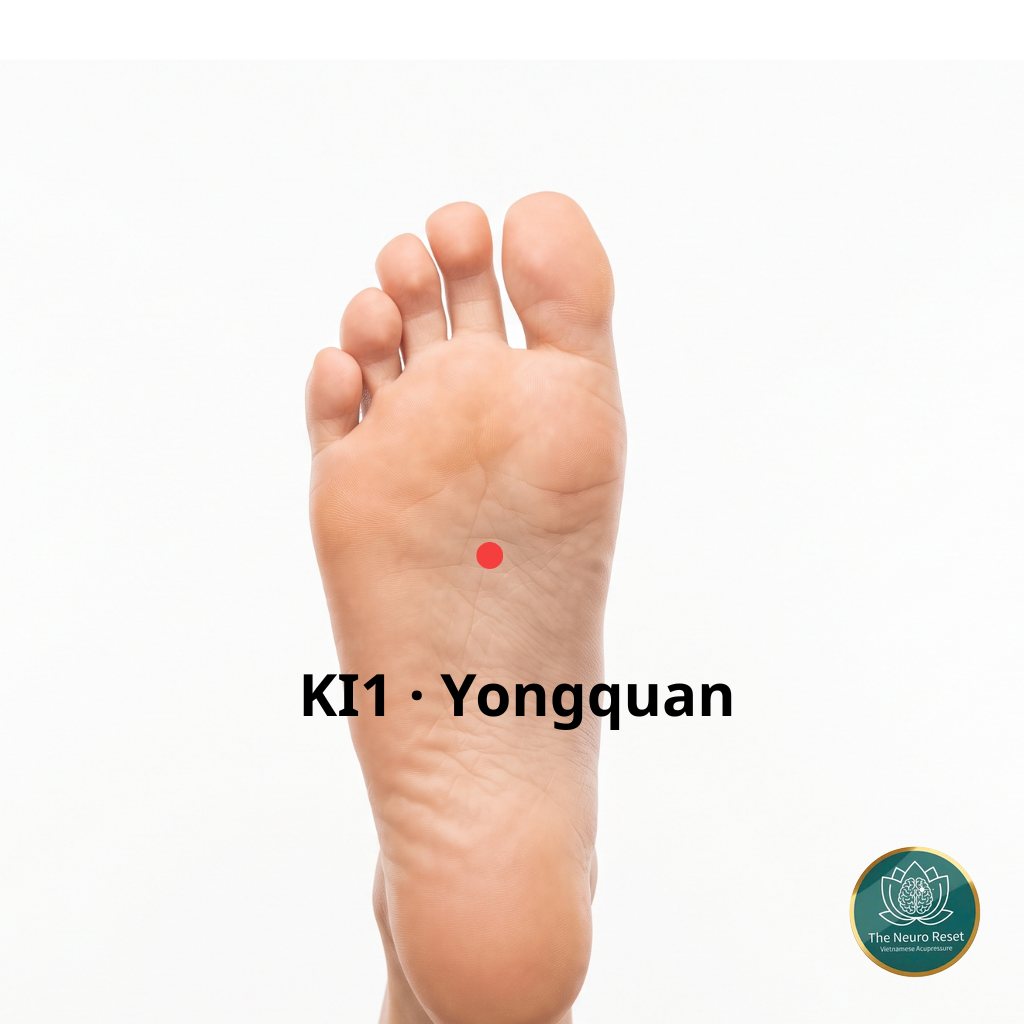
Bring one foot across the other knee so the sole faces you. Curl your toes. A hollow forms below the ball of the foot, in line with the second and third toes.
Relax the toes and search that hollow for the spot that stings. One to three minutes, then the other foot. Skip it if the sole has cracks or sores, or if your feet have lost feeling.
When you finish: socks on, lamp off, phone out of reach.
How I press the points for waking at 3 a.m.
I have studied Vietnamese acupressure for fifteen years. The way I was taught has three steps.
- Find the area, using the bones and creases above.
- Search for the tender spot. One spot will feel a little sharper than the rest.
- Make small, slow circles on it. One minute at first, up to three over the next nights.
Which of the four is hardest for your hands? For many people it is the small wrist hollow, because a tired thumb slips off it. If that is you, the Bedside & Chair Kit is the one that suits this routine. It is the only kit with the slim Acupressure Pen, which stays on your nightstand for the wrist and forearm before lights out. If your fingers are stiff, the wooden stick in the same kit sits in your palm instead.
It is $97.99 with free shipping. Your hands get tired. The tool doesn't. There is no hurry: your thumbs are enough to start tonight.
When to see a doctor about waking at 3 a.m.
Waking once or twice a night is ordinary from the fifties onward. Some patterns need your doctor rather than a routine:
- broken sleep nearly every night for months
- loud snoring with pauses in breathing that a partner has noticed
- sleepiness that catches you while driving
- low mood alongside the broken nights
- pain that wakes you and is new or getting worse, or comes with fever or weight loss you can't explain
If you take sleeping medication, keep taking exactly what was prescribed. Don't lower or stop it on your own. For a medical view, read the NHS guide to insomnia, which includes waking in the night.
The honest timeline for waking at 3 a.m.
You may feel calmer within a few minutes of pressing. That is the first layer.
The second layer is slower. Most people who press each evening notice a change in the second or third week: less time lying awake after they surface. About ten minutes a night, for two to four weeks. Some people notice little, and I would rather say so now.
What This Won't Do
It won't give you an unbroken night, and this site will not pretend otherwise. It does nothing about the reasons you wake: a full bladder, a sore hip, a warm room, a worry.
If pain is what wakes you, the pain is the problem. Start with the back pain relief pages, or the sleep relief collection.
Questions people ask about waking at 3 a.m.
Which acupressure points help when I wake at 3 a.m.? The wrist crease, Shenmen (HT7), is the one most often used. With it: the inner forearm, Neiguan (PC6), between the eyebrows, Yintang (GV29), and the sole, Yongquan (KI1). Press them before bed.
Should I press the points when I wake up in the night? No. Pressing in the middle of the night tends to wake you further. Stay lying down, lamp off, and breathe out slowly. Do the pressing before bed.
How long should I press each point? One to three minutes per point, on both sides. Start near one minute, and add a little as the nights go on.
Will acupressure help me sleep through the night? I can't promise that, and nobody honest can. What may change, over two to four weeks, is how quickly you settle again after waking.
Is it safe with sleeping pills or blood thinners? Keep taking what your doctor prescribed. If you take blood thinners, ask your doctor first and use light pressure only.
I have spent fifteen years studying traditional Vietnamese medicine, and I write about things you can do for yourself at home, sitting down.
This is general wellness education, not medical advice. It is not a substitute for care from your doctor. If you have a health condition, are pregnant, or take medication, check with your doctor first.
(Points shown: HT7 Shenmen, PC6 Neiguan, GV29 Yintang, KI1 Yongquan.)